
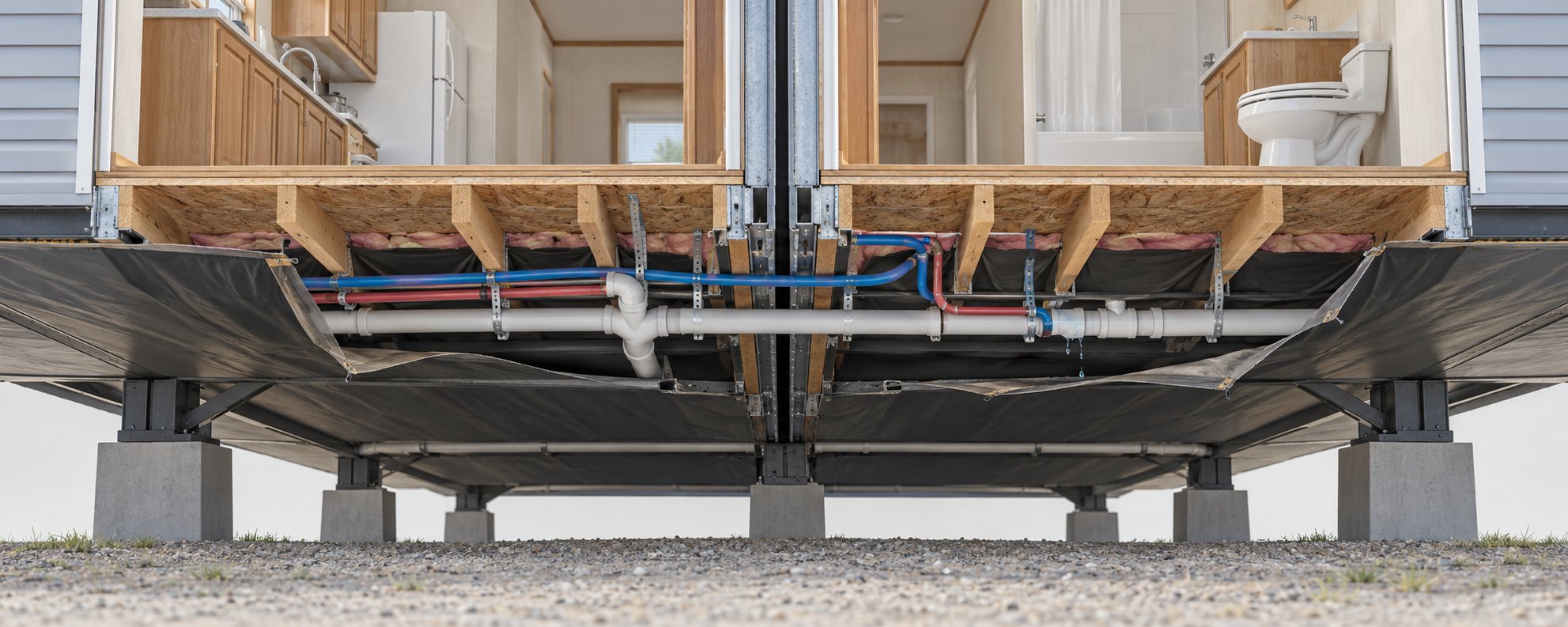
Plumbing repairs in a manufactured home can extend below the floor, through the belly, or across the connection between sections. A small leak may require access removal, drying, pipe repair, insulation or barrier restoration, and finish work after the plumbing is complete. A repipe quote should show those layers instead of treating the visible fixture as the whole job.
Locate the leak and the access path
Water can come from a fixture, supply line, drain, water heater, site connection, condensation, or a frozen pipe. Record when the leak appears, which fixtures are affected, whether the belly or floor is wet, and whether cold weather or movement preceded it. Underfloor access may be through a closet, floor opening, skirting, or the belly; each path has different restoration needs.
Do not assume the first wet area is the source. A leak can travel along a floor or barrier before it becomes visible. If water has reached electrical equipment, insulation, ducts, supports, or a soft floor, the plumber’s scope may need coordination with another qualified professional.
Local repair versus repipe
A localized repair may be appropriate when the damaged run is accessible and the surrounding system is sound. A partial or whole-home repipe becomes more plausible when leaks recur, access is broadly damaged, freezing has affected multiple runs, or the existing material and layout make isolated repairs unreliable. The material, age, manufacturer, section count, climate, and prior alterations must be verified rather than assumed.
U.S. installation standards organize water supply, drainage, field connections, and close-up as separate installation subjects. HUD’s installation FAQ also describes retesting water-supply and drainage systems after field piping is connected in its U.S. context. These sources support testing and careful close-up; they do not create a universal repair method or Canadian requirement.
Price the restoration, not only the pipe
Ask for separate lines for leak tracing, access, demolition, pipe and fittings, drain work, water-heater or site connections, freeze-damage repair, belly and insulation restoration, drying, disposal, testing, permits, and finish repair. Clarify whether the quote includes opening and closing the belly, replacing wet insulation, repairing a damaged floor, and checking for a second leak.
Keep U.S. and Canadian quotes separate and avoid age-based claims about what pipe material is in the home. A low pipe-replacement price may exclude access and restoration, while a high quote may include a broader system correction. Compare like-for-like scopes.
Model the pipe repair and restoration
For a U.S. planning scenario, a localized accessible repair might include $700 for diagnosis, $1,200 for access and pipe work, $1,000 for testing, and $1,500 for belly, insulation, or finish restoration: $4,400. A separate Canadian model could use CAD 900 + CAD 1,600 + CAD 1,300 + CAD 2,000 = CAD 5,800. These are illustrative allowances, not a national plumbing range. A repipe, frozen-line failure, sewage release, or difficult crawl path can make them inadequate.
Ask for separate lines for locating, isolation, demolition, pipe work, pressure or drainage testing, drying, contamination cleanup, and close-up. If the quote excludes the cause of freezing or the access needed to inspect the line, compare it as a temporary repair rather than a complete solution.
Treat freeze and contamination carefully
Freeze protection depends on pipe routing, insulation, belly condition, skirting, occupancy, climate, and the home’s design. Do not add generic heat cable or close up a wet cavity without product-specific and installation-specific guidance. Sewage contamination, mold concerns, damaged wiring, and confined-space conditions require the appropriate professional scope.
Choose the repair extent from the system condition
A single accessible leak may be repaired locally when adjacent pipe, fittings, supports, and connection points are sound. Repeated leaks, widespread corrosion or damage, multiple freeze failures, or difficult access along a long run can make a partial or whole-home repipe worth comparing. That decision depends on the material actually installed, its condition, availability of compatible fittings, and the ability to inspect the full system. Do not infer the pipe type from the home’s age or appearance.
Ask the plumber to map affected supply and drain lines, identify the section crossover and site connection, and state which areas could not be seen. A repair plan should identify isolation, material, connection method, pressure or drainage test, access, belly closure, insulation, and finish restoration. If damage is close to wiring or an electrical device, arrange the appropriate trade before reopening the system. If sewage or contaminated water is present, include a qualified remediation scope.
Compare the total cost of patching and repiping
A local patch often has less demolition and lower initial cost, but repeat visits may add access, drying, and restoration each time. A repipe can require broader access and new routing yet address a pattern of failures. Compare both over the expected time in the home: upfront work, likely repeat service, disruption, warranty, and damage risk. Avoid a universal age cutoff or “repair-versus-replace” rule; evidence for this category does not establish one.
Request separate prices for leak detection, access, pipe and fittings, drain work, site connection, water heater interfaces, pressure tests, drying, insulation, belly material, disposal, and finish work. Have the plumber state how much of the system was inspected and whether the estimate includes the exact source or assumes the leak location is known. For a possible repipe, ask where lines will run, how future access is maintained, what materials are proposed, and whether changes require a permit or inspection.
Consider freeze and water-damage consequences
If a line froze, ask why it was vulnerable: missing insulation, a damaged belly, air leakage, seasonal vacancy, water trapped in a low point, a failed heat source, or site plumbing exposure. Repairing the split without addressing the cause may leave the same risk. The correct prevention method depends on the home, pipe routing, product instructions, occupancy, and climate; do not add generic heat cable or insulation without qualified advice.
If the leak damaged flooring, support, ductwork, or electrical components, keep those repairs visible as separate scopes. The plumber should say what area was opened and what remains concealed. A dry floor surface does not prove the cavity is dry, and a new belly patch does not prove the pipe passed a test. Ask for the drying and test evidence that supports close-up.
Make the sequence and warranty explicit
Set the order: isolate and repair or replace the pipe; test; dry and inspect affected cavities; restore insulation and belly material; then replace skirting or finishes. Name who performs each step. Ask what protection is provided if the opening cannot be closed the same day and who bears the cost of a return visit. If plumbing and weatherization contractors overlap, agree who provides final testing and who pays if a later repair requires opening the same area again.
Keep the test record, material information, permits, photographs, warranty, and a sketch of the repaired route. This record can help a future plumber avoid unnecessary cutting and allows the owner to compare recurring symptoms. The useful project price includes a verified repair and the access restoration needed to leave the home serviceable, not just the pipe and fitting.
Decide who restores the cavity
The plumbing work can be complete while the access opening remains unfinished. Specify whether the plumber restores belly material, insulation, floor covering, cabinets, and skirting or hands the opening to another contractor. Ask for a schedule that allows testing and drying before closure, and identify the party who checks the completed work. If the plumber is responsible only for pipe, ask for a separate restoration quote before authorizing demolition.
Keep shutoff locations and the repaired route accessible for future service. A cleanout or valve hidden behind permanent work can increase the next repair cost. Include the final location in the closeout photographs and home record.
Separate emergency response from planned correction
An active leak may require immediate isolation and water removal before a full repair can be scoped. Ask the first contractor to document temporary work and preserve damaged components where an insurer or warranty administrator may need evidence. Then obtain a separate estimate for permanent pipe repair, drying, and restoration. Do not let an emergency invoice stand in for an agreed complete scope.
The owner should know which services remain off, what conditions make temporary protection unsafe, and when a qualified professional will return. Include emergency lodging, cleanup, or shutoff work in the total when the home cannot be occupied normally.
Include the effect of repeat leaks on finishes
If the same room has been repaired more than once, compare the cumulative finish removal, drying, and restoration cost with opening enough area to diagnose the line route. Replacing a larger section once can sometimes reduce repeated finish disruption, though the pipe condition and actual access determine whether that is justified. Ask the plumber to explain the limits of a localized repair and the evidence that would support expanding it.
Ask whether a shutoff is worth adding
If the repaired line lacks an accessible local shutoff, ask the plumber whether adding one is appropriate and what it costs. A reachable isolation point may reduce the time and water loss of a future leak, but it must be installed in an accessible, protected location. Include the added device and any permit or testing separately from the original pipe repair.