
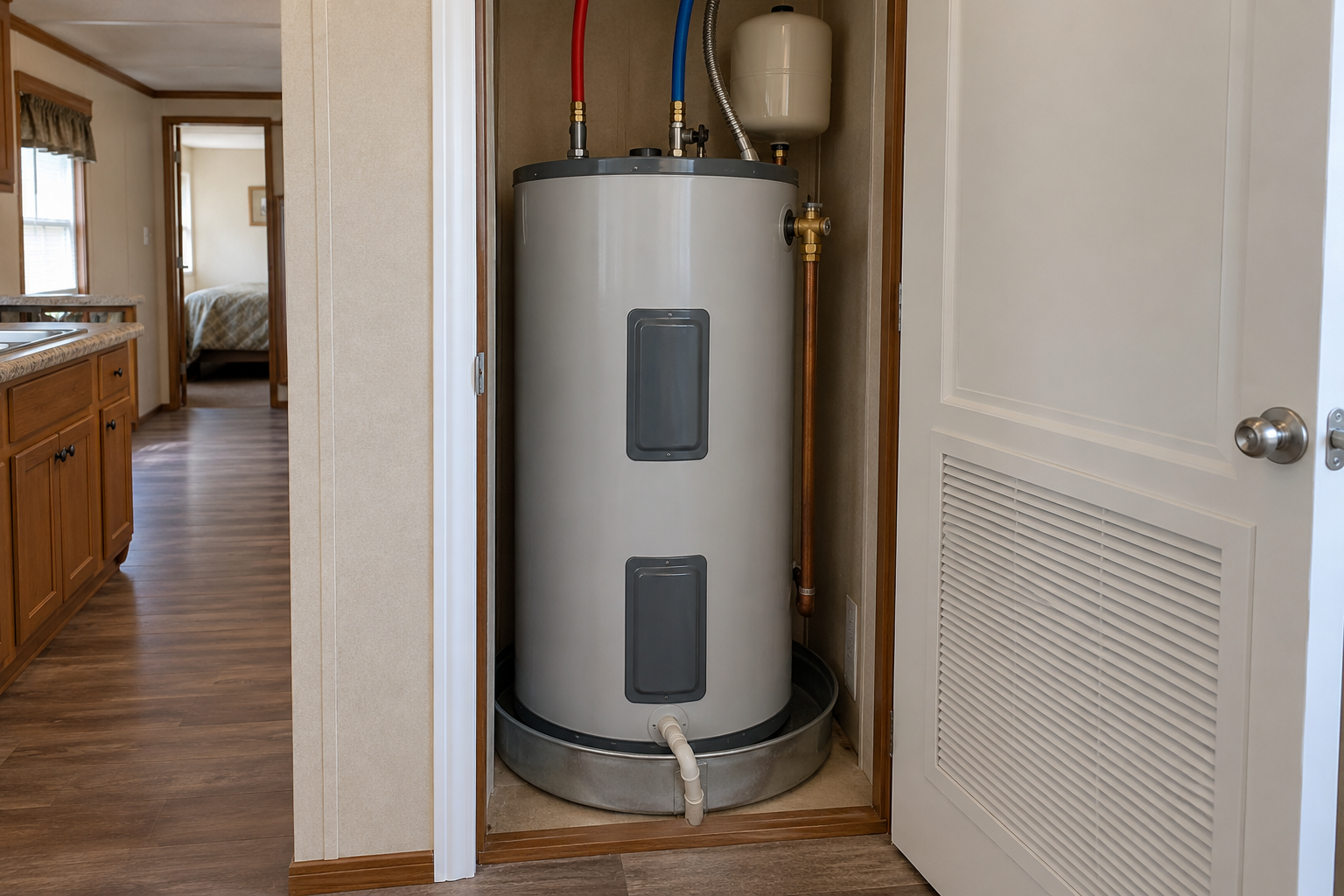
The water heater in a manufactured home may sit in a narrow closet with an exterior door, a special venting arrangement, limited service clearance, and plumbing or fuel connections that are difficult to alter. Replacement cost depends on the existing installation and the approved replacement—not simply on the tank or appliance price.
Identify the installation before choosing a unit
Record the existing heater’s fuel, model, capacity, dimensions, vent, access door, drain pan or discharge arrangement, shutoffs, electrical circuit, and water connections. Photograph the data plate and look for the home’s manuals and previous permits. Check for water damage, corroded connections, inadequate access, or a closet that has been modified around the equipment.
Do not assume that every manufactured home needs a uniquely branded “mobile-home” water heater, or that a conventional replacement can be installed without checking the home, equipment listing, venting, and local requirements. The correct choice can depend on the exact model, fuel, age, enclosure, climate, and jurisdiction.
Compare replacement paths
A like-for-like replacement may reduce changes when the existing installation is documented and the equipment remains appropriate. Switching from fuel-fired to electric or a heat-pump water heater can add electrical capacity, condensate, drain, clearance, recovery-time, and location questions. A larger tank may not fit, and a smaller or different technology may change household performance.
For fuel-fired equipment, a qualified professional must evaluate combustion air, venting, clearances, fuel connections, and carbon-monoxide risk. For electric equipment, verify the circuit, disconnect, grounding and bonding requirements, and available capacity. These are not safe decisions to make from a catalog dimension alone.
Ask for a complete installed quote
Separate diagnosis, removal, disposal, equipment, plumbing, pan and drain work, venting or combustion-air changes, fuel or electrical work, access modifications, permits, inspection, startup, and restoration. Clarify whether the quote includes a temporary water shutoff, leak protection, seismic or other hazard considerations where locally applicable, and disposal of the old unit.
If a closet must be enlarged or the belly or floor opened, price that work separately. The site and appliance boundaries can be jurisdiction-specific; B.C. guidance, for example, treats appliance installation as part of the site/code scope for the context it addresses. That is not a Canada-wide rule.
Cost the approved installation
For a U.S. planning example, assume $1,500 for an approved replacement unit, $1,000 for removal and delivery, $1,200 for plumbing or venting adaptation, and $800 for inspection and cleanup: $4,500. A separate Canadian model might use CAD 1,900 + CAD 1,300 + CAD 1,500 + CAD 1,000 = CAD 5,700. These are illustrative assumptions, not universal installed prices. Fuel type, closet dimensions, access, venting, electrical supply, and local approval can move the result.
Request the model or listing basis, connection scope, drain and relief provisions, venting, service clearance, disposal, and testing in writing. Do not select a unit because it fits the purchase budget if a qualified professional cannot confirm compatibility with the home and jurisdiction.
Keep the safety boundary visible
Use a qualified plumber, HVAC professional, or electrician as appropriate and verify the authority having jurisdiction before ordering equipment. Keep U.S. and Canadian quotes separate. The lowest appliance price is not the lowest project cost if it creates venting, electrical, access, or inspection problems that appear after delivery.
Compare replacement choices around the home’s constraints
Start with the actual closet, available service, fuel, household demand, and local code. A like-for-like unit may minimize changes if the existing installation is documented, compliant, and still suitable. A different tank size can affect recovery and fit. A heat-pump water heater needs space, air, condensate management, and a suitable electrical supply. A fuel change can require new service, venting, combustion-air, and utility work. None of these options can be selected responsibly from price and capacity alone.
Ask the plumber or HVAC professional to state the model and listing basis, dimensions, service clearances, venting, combustion air, relief and drain provisions, fuel or electrical connection, condensate route, and testing. If the home has a special exterior door or closet detail, include photographs and measurements. Ask whether the existing opening or enclosure was modified and what must be restored. A unit that physically fits is not necessarily compatible with the vent or access arrangement.
Separate the appliance from the enabling work
A complete estimate should separate diagnosis, equipment, removal and disposal, plumbing, pan or drain, venting or combustion-air changes, electrical circuit or service work, fuel connection, closet or floor repair, permit, inspection, startup, testing, and restoration. Clarify whether the contractor will shut down and restart utilities and what happens if corrosion, leakage, or rot is found behind the existing tank. If electrical capacity needs evaluation, ask whether that is a separate electrician visit.
A minimal replacement assumes an accessible, documented installation with the same suitable fuel and no damage. A moderate project may need a new pan, shutoffs, vent connector, or electrical work. A more involved conversion may require closet changes, service upgrade, condensate drainage, revised vent path, finish repair, and authority review. These are cost cases, not price ranges. Get current local bids for each viable path, and do not confuse the illustrative model already in the article with a market survey.
Choose on installed cost and household use
Compare each choice over the time the household expects to stay, including purchase and installation, energy, maintenance, expected service, warranty, and any needed electrical or fuel work. Use actual local utility rates and household water-use patterns. Ask the contractor to explain the efficiency estimate and note its assumptions. A more efficient appliance can have a higher first cost; the economics depend on the actual use, climate, energy price, and fit of the installation.
If a new unit is needed urgently, ask whether a safe temporary measure exists while evaluating the final replacement, but do not continue using a leaking, venting, or electrically unsafe appliance. Keep emergency stabilization distinct from the planned replacement so the owner can see the cost of each. Ask the contractor to state whether the installation can be completed before the home loses hot water and how parts or permit timing affect the schedule.
Check the water-heater rule without treating it as a retrofit approval
HUD’s 2024 manufactured-home rule revised appliance provisions, including a drain-pan requirement limited to storage tank-type water heaters or hot-water storage tanks. Its discussion of tankless options does not establish that a particular tankless unit fits, is listed for this home, or is approved for an existing-home replacement. Verify the current rule, the product listing and installation instructions, the home’s configuration, and local permit requirements with the responsible professional or authority before ordering equipment.
Verify the connection and closeout
The final scope should say how leaks, venting, combustion or electrical connections, temperature controls, drain and relief provisions, and startup are checked by the qualified installer. Obtain permit or inspection records where required, product documentation, warranty details, and photos of concealed or modified connections. Preserve the old model and serial information if it helps explain the home’s previous setup.
If the unit fails again or the closet shows water damage, the record can distinguish an appliance problem from an installation or enclosure issue. Ask who is responsible for follow-up if a test fails and whether the warranty covers labor, equipment, or both. For a future sale or insurance question, an invoice and permit may help document the work but should not be represented as universal code or lender approval.
Account for interruption and temporary arrangements
A water-heater failure can affect cooking, bathing, laundry, or occupancy. Ask the contractor how quickly diagnosis and replacement can occur, what parts must be ordered, and how long water or fuel will be shut off. If an interim unit or alternate bathing arrangement is considered, discuss it with the qualified professional and insurer where relevant; do not connect an improvised appliance to the home’s plumbing or electrical system.
Price any temporary equipment, return visit, disposal delay, or water-damage mitigation separately. If the tank has leaked, ask whether the floor or belly needs moisture assessment before a replacement is installed. This keeps urgency from disguising the lasting cost of correcting the source and restoring the affected assembly.
Ask about long-term serviceability
Check that the replacement leaves access for shutoff, inspection, drain, and future removal. A larger tank or new technology can fit but be difficult to service in a narrow closet. Ask where the professional will route condensate or relief discharge and how a future leak will be noticed. Keep the model and warranty information on the outside of the service record rather than relying on a label hidden behind the appliance.
If the homeowner plans to sell soon, confirm that the installed unit and required permits can be documented for the next owner. This does not guarantee transaction acceptance, but it avoids losing the information that explains the installation.
Compare the installation with the home’s resale record
A buyer may ask for appliance age, permits, and service records. Keep a readable photograph of the new unit’s data plate, model and serial number, installation invoice, and any inspection result. If a required label or manual is missing, request it while the installer or supplier still has the order details. This modest closeout task can prevent a future owner from repeating a compatibility search.
Include product disposal in the final amount
Ask whether the quote includes draining, removal, hauling, recycling, or disposal fees and whether a leaking tank requires special handling. Confirm whether delivery includes moving the new unit through a narrow doorway and removing a door or trim. These small logistics can change labor and restoration cost, especially in a constrained utility closet.