
Electrical work in a manufactured home can cross the boundary between factory-installed wiring and site-installed service equipment. The job may involve a feeder, disconnect, panel, grounding and bonding, a connection between sections, damaged site wiring, or added capacity for new equipment. Those scopes are not interchangeable with an ordinary branch-circuit or panel replacement.
Identify which part of the system is involved
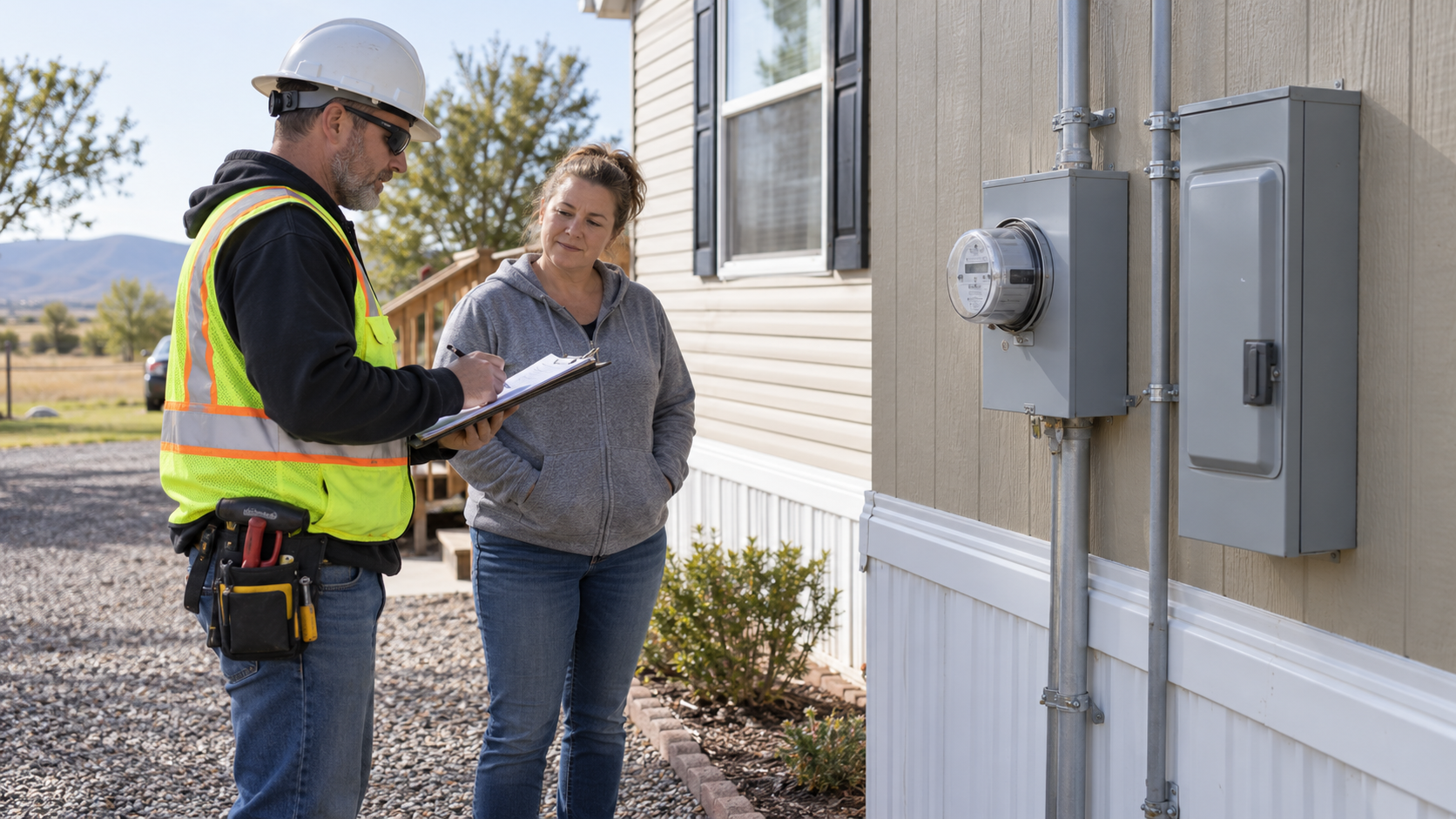
Ask the electrician to document the service equipment, feeder, panel, section arrangement, crossover, disconnects, visible damage, and utility interface. A tripped breaker, flickering circuit, warm connection, loss of power in one section, or failed appliance may originate in more than one location. If the home has been moved, altered, or exposed to water, the inspection should account for that history.
U.S. installation standards identify electrical systems and electrical crossovers as specific manufactured-home installation subjects. B.C. guidance is a reminder that site connections and appliance installation can remain part of a local site/code scope for its jurisdiction. Neither establishes a universal wiring method, service size, or Canadian rule.
Repair, replace, or increase capacity
A limited repair may address an identified damaged connection or enclosure. A panel replacement can expand when the feeder, service equipment, grounding and bonding, meter, or utility approval also needs work. Adding a heat pump, water heater, EV equipment, or other load may require a load assessment and coordination with the utility rather than a larger breaker.
Multi-section homes need particular care at the electrical crossover. A visible gap or lost connection can be an installation defect, damage, or a symptom of movement. Do not treat a jumper, panel, or strap as a universal replacement without the applicable code, manufacturer, utility, and authority requirements.
Make the quote explicit
Separate diagnosis, emergency stabilization, service equipment, feeder or crossover repair, panel, grounding and bonding, utility work, trenching, permits, inspection, access, belly or finish restoration, and commissioning. State whether the price assumes dry conditions, intact framing, accessible equipment, and no capacity upgrade. If a wall, floor, skirting, or belly must be opened, show restoration as a separate allowance.
Electrical market prices vary by service configuration, labor market, access, home age, and local requirements. Obtain a local quote in the United States or Canada under the rules for that property; do not use a converted number or a generic panel price as the project budget.
Model the service interface in layers
For a U.S. planning example, allow $900 for diagnosis, $2,500 for an accessible feeder or crossover repair, $3,500 for panel or service-interface work, and $1,000 for testing and inspection: $7,900. A separate Canadian model might use CAD 1,200 + CAD 3,200 + CAD 4,500 + CAD 1,300 = CAD 10,200. These are transparent planning allowances, not safe DIY instructions or universal electrical prices. Utility upgrades, trenching, grounding, and code corrections may be additional.
Require the quote to identify the utility-owned boundary, feeder, panel, grounding and bonding scope, crossover connection, service capacity, permit, and inspection. A price for replacing a device is not comparable with a price for correcting a service or capacity problem.
Do not make it a homeowner wiring project
Electrical service, feeders, grounding, bonding, and manufactured-home crossovers can create shock, fire, and equipment hazards. Do not open energized equipment, change breakers, tension connections, or copy an online wiring diagram. Use a qualified electrician and have the authority having jurisdiction and utility requirements confirmed before approving the work.
Identify the boundary of the electrical problem
A manufactured home can include factory-installed wiring, a site service, feeder or disconnect, meter, section crossover, and utility-owned equipment. Ask the electrician to identify which part has a defect and where ownership changes. A problem in one room may be a branch circuit; lost power in part of a multi-section home may involve the crossover; a new appliance may require a load assessment rather than a panel swap. The symptoms alone do not settle the scope.
Before the visit, record when the issue occurs, affected circuits or sections, recent water exposure, prior service work, new equipment, and any tripping or visible damage. Do not open an energized panel or test exposed conductors yourself. Provide equipment plans and the home’s documentation to the electrician and utility when relevant. Ask whether the quote includes diagnostics, safe isolation, utility coordination, permit, inspection, and final verification.
Compare the possible work paths
A local connection repair can be appropriate when the electrician confirms the service and equipment remain suitable. A panel replacement may expand if the feeder, disconnect, grounding and bonding, meter, or utility service also needs correction. Adding capacity for HVAC or other equipment can require a load calculation, new feeder, utility approval, or trenching. A multi-section crossover issue may also require the home installer or another specialist if movement or close-up damage contributed.
Ask the proposal to distinguish emergency stabilization from permanent correction. For each line, list diagnosis, device or component, feeder, crossover, panel, grounding and bonding, utility-owned work, trenching, belly or finish access, permit, test, and restoration. Ask whether the design uses the current authority requirements for this location and what evidence will demonstrate completion. Do not assume that an invoice for a panel proves the home has capacity for every planned appliance.
Keep capacity decisions tied to the planned loads
If the work supports a heat pump, electric water heater, range, or other major load, provide the electrician with the equipment models and expected simultaneous use. The professional should state what was included in the load assessment, what utility information was used, and what changes are outside the price. If the upgrade is part of a remodel, coordinate it before finishes or equipment are ordered. A replacement panel cannot by itself solve undersized utility service or wiring outside its rating.
A lower-cost repair may preserve the existing setup but leave an owner’s future equipment plans unresolved. A capacity project may cost more and require utility work, but could prevent repeat alterations. Compare the repair with the full intended scope and timeline, not with a theoretical future upgrade the owner has not decided to make. If the project is staged, label the first phase’s limitations in the quote.
Verify, document, and close
The bid should say which tests, permits, utility approvals, inspections, and labels are included and who obtains each. Ask the electrician to document any inaccessible or uninspected wiring and provide photos of concealed work before the belly, wall, or panel area is closed. Keep the one-line scope, load calculation when applicable, permit and inspection record, equipment manuals, and invoice together.
If a breaker trips again, power is lost in a section, or equipment fails after service work, use the documentation to contact the responsible professional. Do not repeatedly reset a tripping device or add a larger breaker. The follow-up should identify whether the cause lies in the repaired work, another circuit, the utility interface, or a newly added load. A complete price includes safe diagnosis and verified service, not only the visible box or cable.
Make safety part of the bid comparison
Electrical service, feeders, grounding, bonding, and manufactured-home crossovers can create shock and fire hazards. Use a qualified electrician and follow local permit and utility requirements. A quote that excludes safe isolation, inspection, or restoration may be less expensive because it transfers risk and unfinished work to the owner. Compare qualifications and completed scope alongside the amount, and do not use this guide as a wiring instruction.
Compare safe restoration and interruption costs
Service work can require a temporary outage, utility disconnect, refrigeration protection, or alternate heat and hot-water planning. Ask when power will be unavailable, what inspection must occur before reconnection, and who coordinates the utility. If the home is occupied, identify any essential equipment affected and arrange an appropriate qualified plan. Temporary generation or extension cords should not be improvised as a substitute for an approved service arrangement.
Include temporary protection, return visits, permits, reinspection, and repair of opened finishes in the estimate where they apply. These costs are distinct from electrical components but can determine the usable schedule and project total.
Confirm what insurance or transaction documents require
If the electrical work follows a loss or is needed for financing, ask the insurer or lender for the required report, permit, test, or completion record. A contractor invoice may not meet a program’s request. Get the requirements before work starts and give them to the electrician so the scope includes the correct evidence.
Keep repair documentation separate from a safety certification. If a report identifies additional deficiencies outside the bid, ask for a second scope and compare the cost and urgency before authorizing upgrades unrelated to the original failure.
Record equipment added during a service upgrade
Update the home file with new loads, circuits, capacity assumptions, and service documents after work. If an HVAC or water-heater replacement was part of the project, keep its model and startup papers together with the electrical record. A future contractor can then distinguish the original service from later changes and avoid repeating a load assessment without the prior information.