
The underbelly, belly board, or belly wrap is the underside barrier and insulation area below a manufactured home. Tears can be caused by plumbing or HVAC access, animals, water, age, or moving. The visible hole may be a small patch, or it may expose wet insulation, damaged ducts, leaking pipes, wiring, or a deteriorated floor.
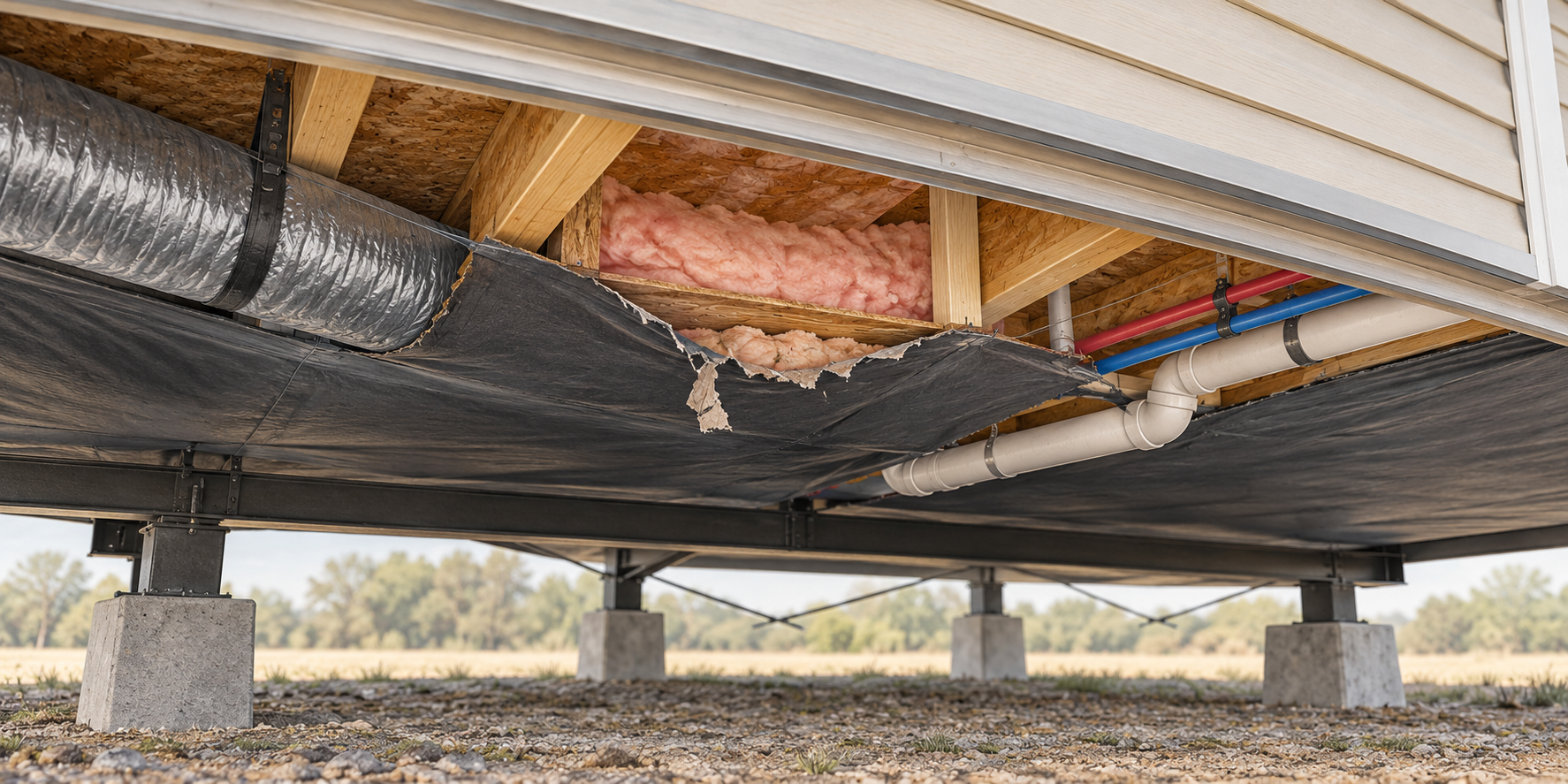
Find the source first
Before closing a tear, identify whether water comes from a pipe, site drainage, condensation, or an opening above. Check why insulation is sagging or missing and whether an animal can re-enter. A patch over wet insulation or an active leak traps the problem rather than restoring the assembly.
Part 3285 includes bottom-board repair within its U.S. installation and close-up subjects. DOE weatherization job aids treat belly insulation as specialized work with preparation and installation considerations. Neither source establishes one repair product or price for every home, and the U.S. material does not create Canadian requirements.
Patch, section repair, or rebuild
A limited repair may involve safe access, drying, compatible barrier material, insulation adjustment, and sealing around a former opening. A larger repair may require removing contaminated or wet insulation, repairing ducts or plumbing, replacing a section of barrier, correcting floor damage, treating animal access, and restoring skirting or finishes. Access, height, home age, material compatibility, and confined conditions change labor.
Ask the contractor to state what is being restored: air barrier, moisture control, insulation support, duct enclosure, plumbing access, or all of them. Confirm how the work will be coordinated with a plumber, HVAC technician, weatherization installer, or remediation contractor.
Safety and cost limits
Under-home work can involve electrical, combustion, biological, structural, sharp, and confined-space hazards. Do not enter or disturb a questionable area to save inspection cost. A professional may need to verify the source, isolate utilities, test moisture, or assess a floor or support condition.
There is no universal national belly-repair range. Keep U.S. and Canadian quotes separate and request allowances for access, source repair, drying, insulation, barrier, disposal, and restoration. If the quote only tapes the visible tear, ask how hidden damage and the cause were ruled out.
Build the repair from access and area
For a U.S. planning scenario, a small accessible opening might be modeled as $800 for inspection and access, $1,200 for source correction, $1,500 for belly-board and insulation repair, and $500 for cleanup: $4,000. A separate Canadian scenario could use CAD 1,000 + CAD 1,500 + CAD 2,000 + CAD 650 = CAD 5,150. These are illustrative allowances, not a national range. Larger areas, wet insulation, animal damage, confined access, floor damage, or utility isolation can make the scenario incomplete.
Require the quote to identify the affected area, moisture condition, insulation replacement, barrier material, support or plumbing exclusions, and how the repair will be inspected before close-up. If the source is unresolved, price investigation and temporary protection first. Avoid sealing a visible tear until the water, plumbing, animal, or access problem has been addressed.
Choose a repair level after opening the right amount
The affected area may be a small puncture, a seam, a section removed for plumbing, a long sagging area, or broad damage along the underside. Ask the professional to document its size and the condition of the material around it. A patch may be sufficient when the original barrier is dry, compatible, securely attached, and the cause is corrected. A larger section repair may be needed when the edges are weak or the opening crosses supports or utility routes. Broad wet or contaminated insulation can require removal and replacement before close-up.
Do not choose a repair product from a photo alone. The belly may have several layers or functions, including support for insulation, a protective barrier, and protection from air or animals. The existing material, framing, climate, moisture, access, and manufacturer details affect compatibility. Ask the contractor what assembly they are restoring, why the proposed material fits it, and whether another trade must complete work first.
When a plumber, HVAC contractor, electrician, pest professional, or remediation firm must enter the area, coordinate who removes and reinstalls the barrier. A sequence in writing can avoid paying twice for skirting, access openings, cleanup, or insulation. State who is responsible for verifying that wiring, ducts, pipes, and structural members are safe before a cavity is closed.
Compare the patch with a larger restoration
A small accessible repair may include inspection, local source correction, compatible barrier material, limited insulation work, and verification. A wider scope may involve skirting removal, safe access, wet insulation disposal, drying, plumbing or duct repair, replacement barrier, animal exclusion, floor or framing assessment, and finish restoration. A complete rebuild may be justified where damage is extensive or previous patches have failed, but it should be tied to observed condition rather than a general statement that the entire belly is old.
Ask for separate amounts for access, source correction, moisture or contamination work, insulation, barrier, support or service work, and restoration. Clarify whether the price covers material transitions, fastening, sealing, obstacle cutting, and inspection before close-up. Ask how concealed damage is priced and whether the crew will stop for approval when it finds a pipe, wire, or framing problem outside the bid. Compare bids by area and assembly rather than by one generic “belly repair” label.
Control moisture before insulation goes back
If insulation is wet, the proposal should describe the source and drying plan. Ask whether replacement material will match the existing cavity and climate, how it is supported, and what will prevent another leak or animal entry. If a plumbing leak caused the damage, require pressure or function testing before closure. If runoff or groundwater is involved, arrange drainage correction. If an animal entered, close the route using suitable materials and consider whether wiring or ducting was damaged.
A quote that replaces insulation and patches the membrane can be incomplete if the floor above is wet or the belly opening follows recurring service access. A limited patch can still be reasonable when the condition is truly local and the surrounding assembly is sound. The assessment should state which areas were examined and which remain concealed. Do not ask the installer to certify areas they could not see.
Plan around access and safety
Underfloor work can require removing skirting, landscaping, stairs, or a deck panel. The quote should identify the access route, work height, lighting, cleanup, and restoration. Confined, wet, contaminated, or electrically compromised spaces need an appropriate professional. Do not enter a questionable area or disturb material that may pose a health hazard to reduce an estimate.
Ask whether the contractor is responsible for temporary protection if weather interrupts the repair and whether the open area will be secure overnight. Clarify disposal of wet or contaminated insulation and how the crew handles utility isolation. If the work opens a cavity in an occupied home, make sure the household knows which rooms or services could be unavailable.
Verify the assembly before final payment
Before the belly closes, inspect the documented source repair, insulation placement, support, seams, penetrations, and any required tests with the qualified contractor. Save photographs of concealed work, product labels, invoices, and warranty. Note the repaired area on a simple plan so the next service visit can use it. If a replacement or broader project is proposed, compare it with a local quote that lists the same access and restoration assumptions.
The total cost comes from restoring a functioning assembly, not covering a tear. A transparent scope states what was wet, what was replaced, how the source was corrected, what could not be inspected, and what follow-up is included. That information is more useful than a single universal price for a barrier repair.
Decide who owns the repair after a trade visit
Many belly openings are created during plumbing, HVAC, or electrical work. Before that trade leaves, agree who will restore the barrier, insulation, and skirting and whether the price includes a return visit after testing. The service contractor may not have the materials or scope to rebuild the whole assembly. Get the handoff in writing, including who is liable if the repair is left open or damaged before close-up.
If the home is under warranty or an insurance claim is active, ask whether the repair needs prior notice or an approved contractor. A patch that solves the immediate problem but voids a warranty or complicates a claim may add avoidable cost.
Compare the repair with future access needs
If plumbing, ducts, or electrical systems are likely to need service, ask whether the restored belly can be opened locally and patched again without broad demolition. The installer may recommend a suitable access detail, but it must preserve the required barrier and assembly performance. Do not create an access panel that leaves a gap or substitutes for a designed close-up.
Record the location of shutoffs and service routes before closing. This small closeout step can lower the labor and damage risk of the next repair and makes a future quote more accurate.