
“Utilities included” does not always mean the home is connected, tested, approved, and ready for occupancy. The site may still need water, sewer or septic, electrical, gas or other fuel, meters, trenches, shutoffs, field connections, testing, permits, and restoration. Distance from the service point and difficult access can matter more than the connection hardware.
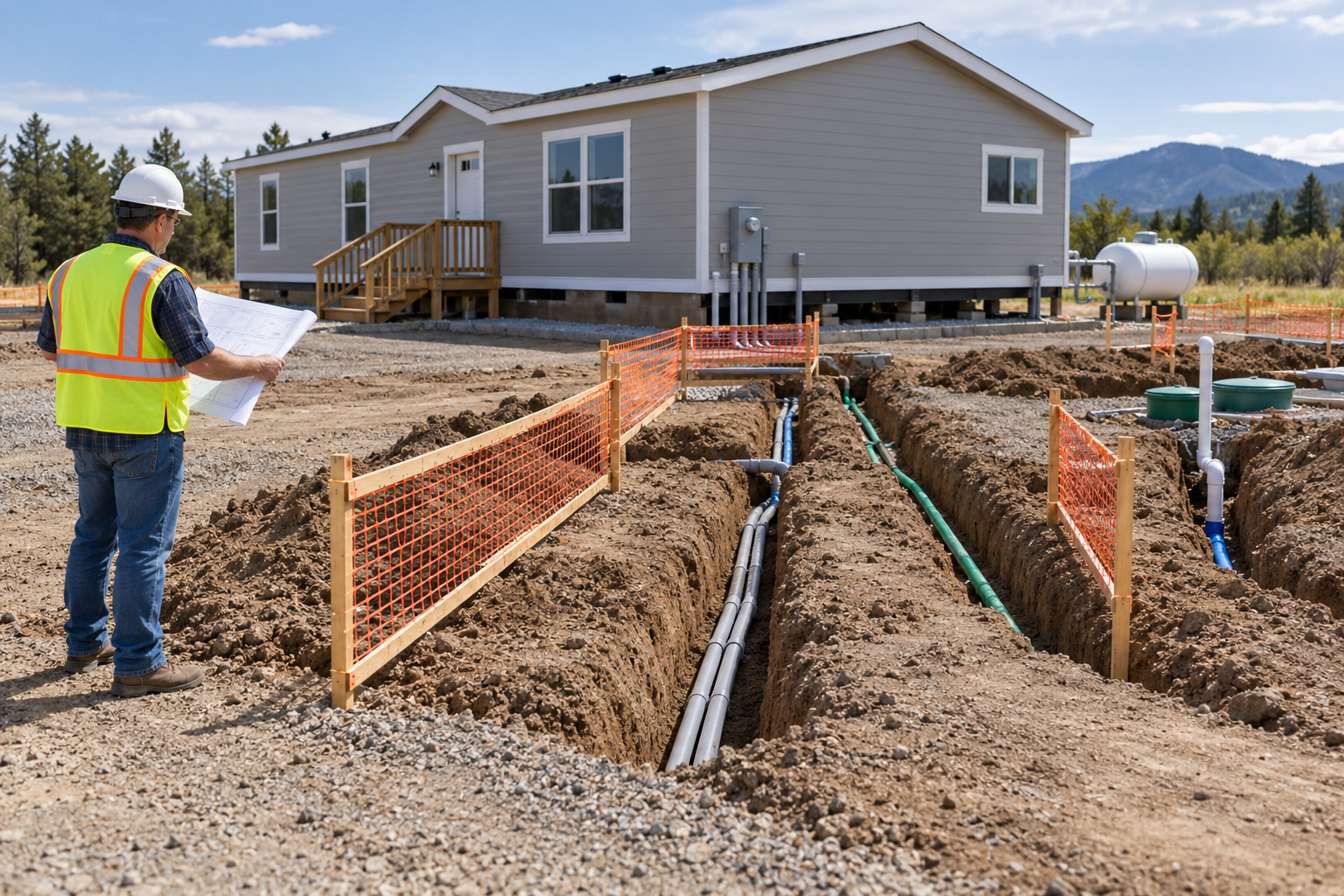
Separate the service scopes
Build the quote around the actual property:
- electrical service, feeder, meter, disconnect, and connection to the home;
- water service, pressure components, shutoffs, and freeze protection;
- sewer or septic connection, cleanouts, slope, and testing;
- gas, oil, or other fuel connection, storage, and safety review;
- trenches, boring, rock or groundwater work, traffic control, and restoration;
- permits, utility-owner fees, inspections, tests, and final commissioning.
The home’s internal systems and section crossovers may be part of a separate installer or trade scope. Ask who owns the connection from the property service point to the home and who restores the belly, skirting, floor, or finishes after the work.
Site conditions control the price
A short connection on an open, serviced lot is not comparable with a remote or wooded site. Cost can rise with long runs, elevation changes, rock, groundwater, frost, driveway or road crossings, utility conflicts, limited equipment access, a private well or septic system, or a need to upgrade existing service. Meters and utility extensions may be controlled by the utility rather than the installer.
HUD installation material treats utility hookups as part of installation planning and identifies field water and drainage testing in its U.S. program context. B.C. guidance places site preparation and service connections within the site/code boundary for its jurisdiction. These are scope boundaries, not national fee schedules or a universal Canadian checklist.
Ask for the tests and handoffs
An actionable quote identifies the utility owner, authority having jurisdiction, required permits, inspection sequence, pressure or leakage tests, meter responsibilities, and the documents supplied at completion. Make sure the plan says who corrects failed tests and whether temporary service, weather delays, trench backfill, landscaping, and final cleanup are included.
Do not publish or rely on a generic meter or permit fee as a national number. Obtain independent U.S. and Canadian quotes in the local currency and keep utility-owner charges separate from contractor work. No exchange-rate conversion captures local distance, soil, labor, or approval costs.
Build one scenario per utility
For a simple U.S. planning model, assume $6,000 for water and sewer connections, $5,000 for power, $3,000 for fuel or alternate service, and $4,000 for trenching, testing, permits, and restoration: $18,000. A separate Canadian model might use CAD 8,000 + CAD 6,500 + CAD 4,000 + CAD 5,000 = CAD 23,500. These are illustrative allowances, not utility tariffs or national hookup prices. Long runs, private wells or septic, rock, road crossings, meters, and service upgrades can dominate the total.
Ask for a site plan showing each connection point, route, capacity, owner of the meter or extension, testing, inspection, and restoration. Keep utility-owner charges and contractor work separate. The useful comparison is a tested, approved connection at the home—not a short pipe or cable line with the rest left outside the bid.
Compare the complete connection
Before accepting the lowest bid, compare route, capacity, connection point, testing, inspection, restoration, and exclusions. A quote that covers only a pipe or cable may leave the largest site costs outside the contract. If the home is being relocated, combine this review with the destination foundation, setup, section-close-up, and permit scopes.
Locate the service points before requesting prices
Prepare a site plan showing the home, property boundary, driveway or road, water source, sewer or septic, electrical service, fuel source, meter locations, and proposed connection points. Mark approximate distances and obstacles, then ask each utility or contractor to verify them. The route can affect trenching, boring, easements, restoration, capacity, and who owns a connection. If utility locations are unknown, price locating as a first step instead of assuming a straight, clear trench.
The utility owner may control a meter, service extension, transformer, connection inspection, or fee while a contractor performs work on private property. Ask where that boundary lies and who schedules each inspection. A “power included” or “water hookup” line should state whether it means a service is available at the property, extended to the home, connected, tested, and approved. These are different completion states.
Scope each service from source to home
For power, identify the utility point, service capacity, meter, feeder, disconnect, grounding and bonding, trench or overhead path, and home connection. For water, identify public or private source, pressure, shutoff, frost exposure, backflow or testing questions, and the point of connection. For sewer or septic, locate the tie-in, elevation and slope, cleanout, system capacity, and testing. Fuel work may involve storage, regulator, piping, clearance, ventilation, and inspection. Have the responsible licensed trade define the actual scope for each site.
Site conditions can change an apparently simple connection: long distances, road or driveway crossings, rock, groundwater, trees, limited access, utility conflicts, grade, freezing, or an undersized existing service. Ask which costs are quantities, which are allowances, and what finding triggers a change order. If the site needs a new well, septic system, transformer, or service extension, treat that as a separate design and approval project, not a small hookup charge.
Compare bids by the same endpoints
Give each bidder the same site plan, home details, utility responses, requested service capacities, and target completion date. Ask them to state source and destination points, route, length, trench method, backfill and restoration, permits, utility fees, tests, inspections, and responsibility for a failed test. A pipe or cable cost alone is not comparable with an approved operating connection.
Separate temporary service, permanent installation, utility-owned work, contractor work, meter charges, trenching, equipment, permits, testing, landscaping, and restoration. Include rework if the home is placed before a connection is ready. Ask who coordinates when one contractor’s work must be inspected before another can bury or close it. A schedule delay can create storage, equipment remobilization, or occupancy costs even when construction quantities remain the same.
Compare simple and difficult property scenarios
A serviced lot with nearby connection points and a prepared route may need limited extension and testing. A new site may require several trenches, permits, a service upgrade, or private systems. A remote parcel can add utility extension, easements, rock excavation, access road work, or water and wastewater systems. These cases describe cost structure rather than a price range. Replace the model allowances already in the article with local bids and utility-owner information.
Keep American and Canadian estimates in their own currencies and legal systems. A U.S. HUD installation reference or B.C. site-code bulletin helps identify topic boundaries; neither supplies a universal permit, utility fee, or testing schedule. Ask the local authority and utility directly. If a project is financed, give the lender the completion sequence and ask when it releases funds for site services.
Close out with test records
Before final payment, request the inspection or test results, utility authorization, meter information, as-built route, warranty, and restoration record. Record where shutoffs, cleanouts, disconnects, and access points are located. Ask who owns maintenance after handoff and how to reach the utility during a service failure. If a later addition or relocation changes load or demand, the current connection records help determine whether the service remains adequate.
The finished budget should show a complete usable service at the home, not just the portion a single contractor installed. Keeping endpoint, capacity, test, approval, and restoration lines visible makes it possible to compare the true setup cost and avoid paying twice for a trench or connection.
Check capacity for future use before burying the line
Tell the utility and installer about likely future loads or additions, such as a heat pump, workshop, accessory building, or second bathroom. It may be less costly to size a route or conduit for a known plan while the trench is open, but any oversizing must follow professional design and utility requirements. Do not pay for speculative capacity without understanding its present cost and approval implications.
Before backfill, photograph the route and note depth or marking information provided by the installer, shutoffs, cleanouts, disconnects, and meters. Keep the as-built plan with the property file. This reduces the risk of damaging the service during later landscaping or repair.
Account for deposits and ongoing charges
Utility extension deposits, meter fees, connection charges, and monthly service costs may come from different parties. Request current written amounts from the utility and ask whether a refundable deposit or capacity charge applies. Include these in the site budget separately from contractor installation. For private well, septic, or fuel storage, include ongoing testing, maintenance, or delivery obligations in the ownership comparison.
An inexpensive connection may still create a high annual service cost, while an up-front extension may reduce recurring expense. Compare only after confirming rates and ownership responsibilities with the provider; a contractor cannot quote the household’s future utility bill.