
The right cabinet intervention follows the problem you need to solve. Repair addresses a bounded failure. Refinishing changes or restores the surface. Refacing changes visible coverings and usually doors and fronts. Replacement changes the cabinet system. No universal percentage or age rule decides the break-even point.
Start with four tests
| Test | Favors preservation | Favors replacement |
|---|---|---|
| Box condition | Sound, square, dry, adequately mounted | Swollen, loose, delaminated, or repeatedly damaged |
| Layout | Current work zones and storage function | Circulation, storage, or appliance zones need redesign |
| Visible problem | Finish, hardware, door, or one localized defect | Broad mismatch, failed surfaces, or many components |
| Project horizon | A bounded improvement meets the near-term need | A short-lived fix would be removed in the next phase |
These tests structure the decision; they do not predict a cabinet’s remaining life without inspection.
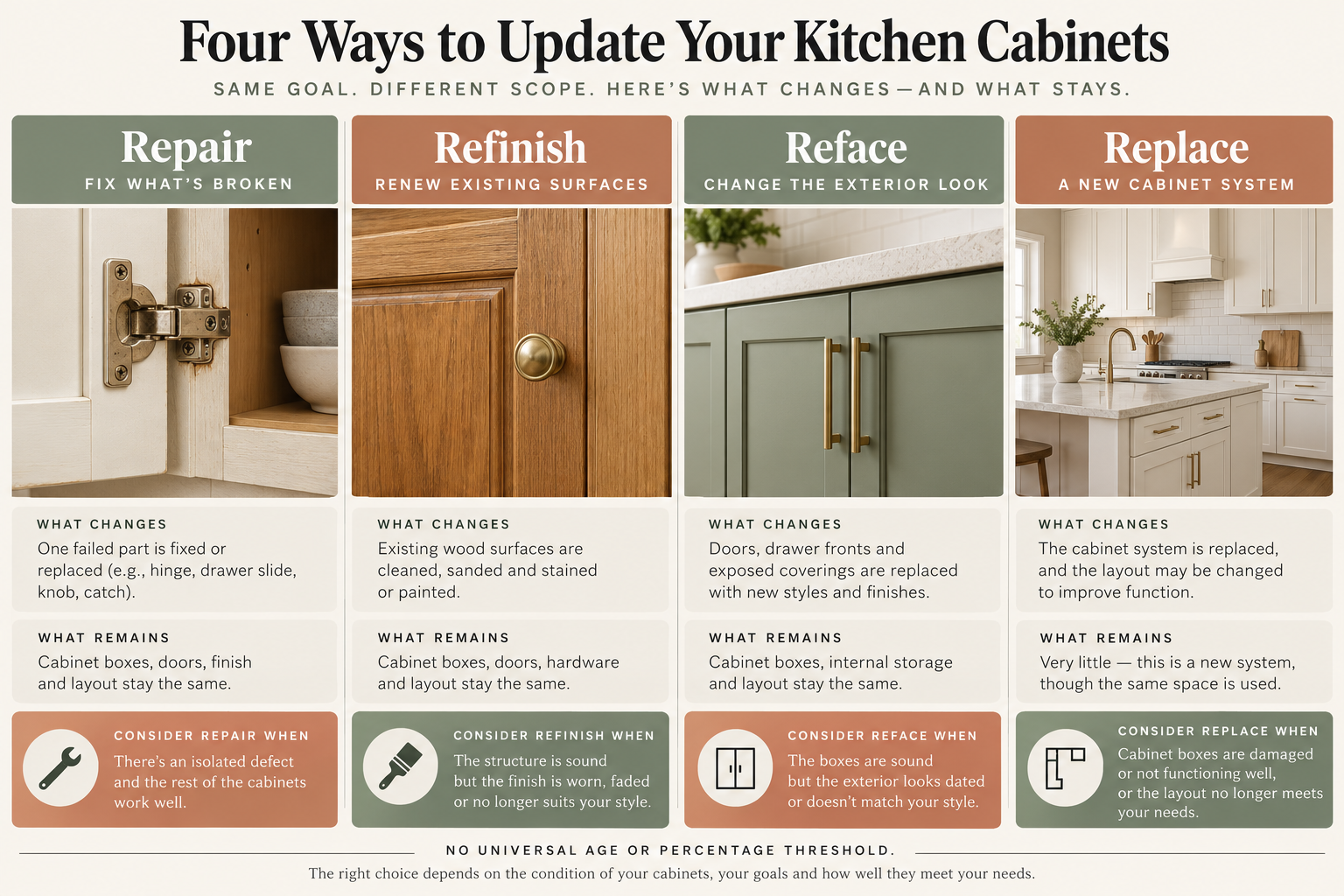
Match the intervention to the failure
- Repair: one hinge, drawer, shelf, door, trim piece, loose connection, or bounded damage.
- Refinish: the cabinet structure and parts work, but the surface is worn or the color needs to change.
- Reface: the boxes and layout work, but doors, drawer fronts, and exposed coverings should change together.
- Replace: the boxes, layout, function, or multiple components no longer justify retention.
Door-only replacement can fit between refinishing and refacing when exposed frames and sides already coordinate or an intentional contrast is acceptable.
Keep the U.S. cost signals in their own lanes
Two U.S. specialist guides provide context but not a shared break-even rule. Angi lists selected cabinet-repair examples, including $100–$500 for one cabinet and $1,200–$4,000 for a full kitchen of eight to twelve cabinets, while its overall average/typical project range is not reconciled to those larger projects. Fixr reports an $8,250 average and $3,000–$13,500 refacing range for its source-defined kitchen project. These figures cover different work and use different methods; they do not say when a specific cabinet should be repaired or refaced.
Use them only to understand that a localized repair, a group of cabinet repairs, and a refacing project are materially different quote scopes. Ask local providers to price the actual doors, boxes, finish, repairs, removal, and installation in your kitchen. No evidence here establishes a universal repair percentage, useful-life cutoff, or financial threshold for replacement.
Compare total scope, not the first price
Include measurement, removal, preparation, repairs, coverings, doors, fronts, hardware, installation, trim, protection, disposal, countertop impact, and future work. The Canadian HomeStars guide reports broad market signals for cabinet classes and installation, while Home Depot Canada describes refacing scope. Neither establishes a universal savings percentage or remaining-life threshold.
The KCMA A161.1-2022 standard is a voluntary performance and construction reference for factory-assembled cabinets. It does not promise a specific material, appearance, price, fit, or lifecycle outcome. Use actual condition and the product specification instead of retail tier alone.
Avoid paying twice
Do not refinish a cabinet that will be removed for a layout change. Do not install a countertop that will later be removed to replace failing boxes unless the temporary value and risk are understood. Correct an active leak before cosmetic work. If the proposed intervention cannot provide a durable interface with the next likely project, price both phases.
How the choice changes in common situations
Sound boxes, worn finish, useful layout. Compare professional refinishing with replacement fronts if the finish is the only visible problem. Include preparation and the treatment of fixed frames and ends; a new front can highlight a mismatched old frame.
Sound boxes, dated doors, poor storage access. Door replacement or refacing may improve the exterior, while a targeted organizer or pullout may address access. Price those as distinct goals. A full replacement is not automatically necessary unless the cabinet openings or arrangement prevent the required function.
Repeated water damage or loose mounting. Start by correcting the source and assessing the affected box, wall, and floor. Cosmetic work should wait. If several units have similar damage, ask whether individual repairs can produce a durable result or whether replacing the run is more coherent.
Layout no longer works. Compare replacement with a layout change only after identifying what would improve and what utilities, counters, flooring, or approvals move with it. A new door style cannot solve a blocked path or an appliance opening that is too small.
These examples help organize estimates, but they do not replace inspection. Ask bidders to state which conditions they saw, what is assumed, and what would change their recommendation.
Put the alternatives on one worksheet
For each viable option, record the same room result, retained boxes, affected doors and panels, repairs, removal, disposal, countertop impact, finish, installation, temporary conditions, warranty, and work that is likely in the next phase. Mark which assumptions have been inspected and which remain uncertain. This is especially useful when one contractor prices refinishing and another prices replacement: compare the resulting scope and any deferred work rather than choosing the smaller total in isolation.
Compare disruption and the next likely project
The lowest construction total may not be the least disruptive option. Repair can keep most of the kitchen available but may require repeat visits. Refinishing can leave the boxes in place while doors are handled elsewhere or the room is protected on site. Refacing changes more surfaces but still preserves the boxes and layout. Replacement generally adds removal, delivery, countertop coordination, and a longer period when the room is under construction.
Ask how long the kitchen will lose access to the sink, cooking area, or storage under each proposal. If a countertop, appliance, or layout change is likely soon, determine whether the preservation work would be removed or damaged by that later project. Include the likely next work in the comparison only when there is a real plan for it; do not invent a replacement date or assume the current cabinets have a known remaining life.
Safety boundary
Cabinet removal, sanding, or stripping may disturb painted surfaces. EPA guidance covers lead-safe renovation concerns in many pre-1978 U.S. homes. Health Canada provides separate guidance on lead paint and asbestos in older Canadian homes. Screen and use qualified professionals where appropriate; do not use this comparison as a DIY hazardous-material procedure.
A practical decision sequence
- Identify the failure and correct any active water source.
- Confirm whether the existing layout and storage solve the household’s problem.
- Inspect boxes, mounting, doors, fronts, hardware, and exposed surfaces.
- Price the smallest durable intervention and a replacement alternative.
- Compare disruption, future removal, finish matching, and uncertainty as well as totals.
Bottom line
Preserve cabinets when their structure and layout still create value and the chosen intervention solves the actual problem. Replace them when condition, function, or repeated scope expansion makes preservation a cosmetic detour.