
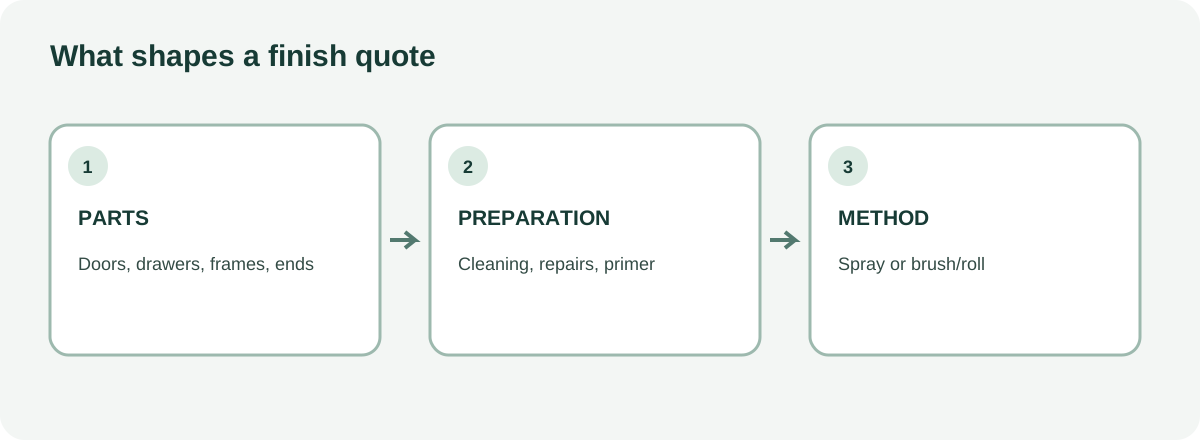
Cabinet painting changes the finish, while refinishing can mean restoring or recoating an existing wood or finished surface. Contractors use the terms differently. The quote should describe the preparation, coating system, location of the work, and which defects are being repaired before finish is applied.
Preparation is the labor
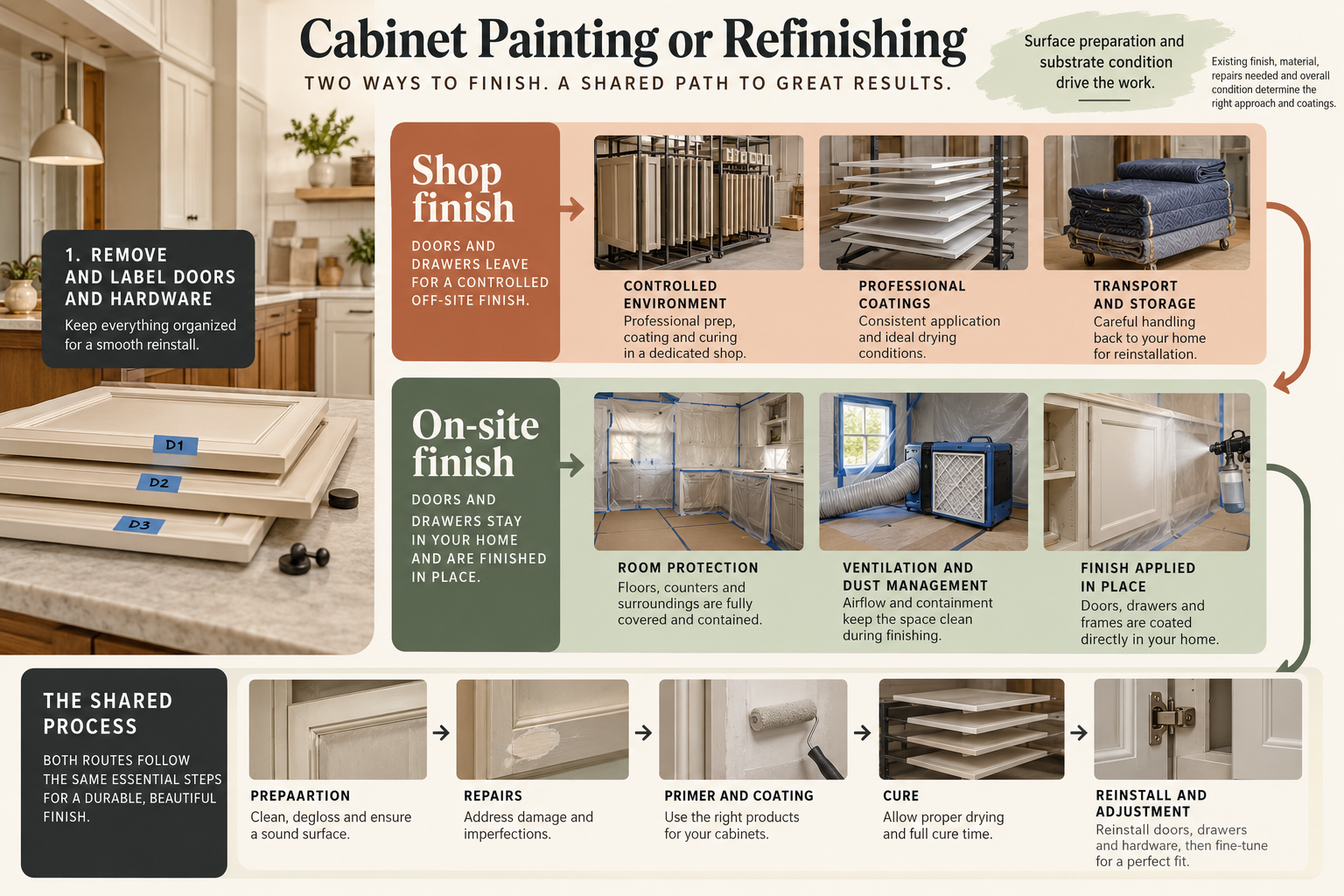
Professional work may involve removing doors and drawers, labeling hardware, cleaning grease, repairing dents or loose joints, sanding or otherwise preparing the surface, priming, applying finish coats, and reinstalling and adjusting components. Shop finishing can improve control but adds transport, handling, and scheduling. On-site work can reduce transport but requires protection, ventilation planning, and dust control.
The number of doors matters, but so do profiles, existing coatings, repairs, access, color changes, and the condition of exposed frames and ends. A product-only paint price is not a professional project budget.
One 2026 U.S.-oriented cost guide lists $2,500–$4,500 for professional painting in its 10-by-10-foot, 20–30-linear-foot kitchen example. It does not disclose a quote sample or calculation method, and the page does not explicitly code its dollar currency, so treat it as one guide’s planning signal rather than a verified U.S. range or a basis for comparison with Canadian prices. Door and drawer counts, preparation, repairs, and whether work is sprayed or applied on site can make another project substantially different.
Painting versus refinishing
| Question | Painting | Refinishing |
|---|---|---|
| Desired result | New color or finish system | Restoration, recoating, or renewing an existing finish |
| Main risk | Adhesion, preparation, and color coverage | Existing finish, substrate, and matching |
| Retained items | Usually boxes, doors, fronts, and layout | Usually the same, if suitable |
| Limitation | Does not correct structural failure | Does not correct structural failure |
Ask what happens to damaged veneer, swollen fiberboard, loose joints, stained interiors, and water-damaged sink-base areas. Finish work cannot make an unstable box sound.
Compare shop and on-site work by responsibility
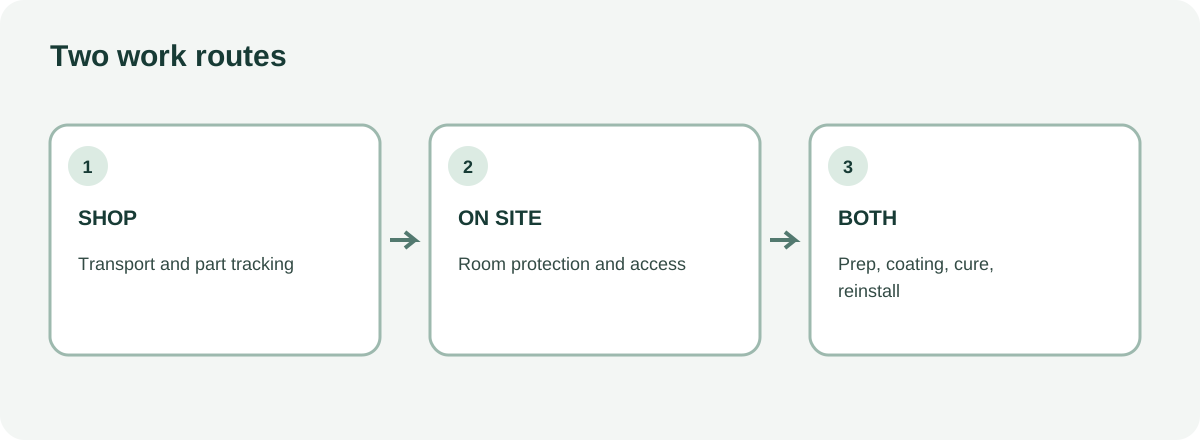
Shop finishing can provide a controlled place for doors and drawers to be prepared and coated, but it depends on labeling, safe transport, a place to store the parts, and a plan for protecting the kitchen while boxes are finished. On-site finishing avoids sending every part away but leaves the household with room protection, dust or odor management, access limits, and a longer period around active work. Ask each contractor where each step happens and how the parts are tracked, stored, and reinstalled.
The method alone does not predict quality. Ask for the actual preparation steps and coating system for the existing substrate, how damaged veneer or edges are treated, how the contractor handles adhesion uncertainty, and what care or cure-time restrictions apply. Confirm the expected appearance on a representative door before approving the full color and sheen. A sample panel makes differences in grain, texture, and older finish visible before they are repeated across the kitchen.
When preservation is not the right scope
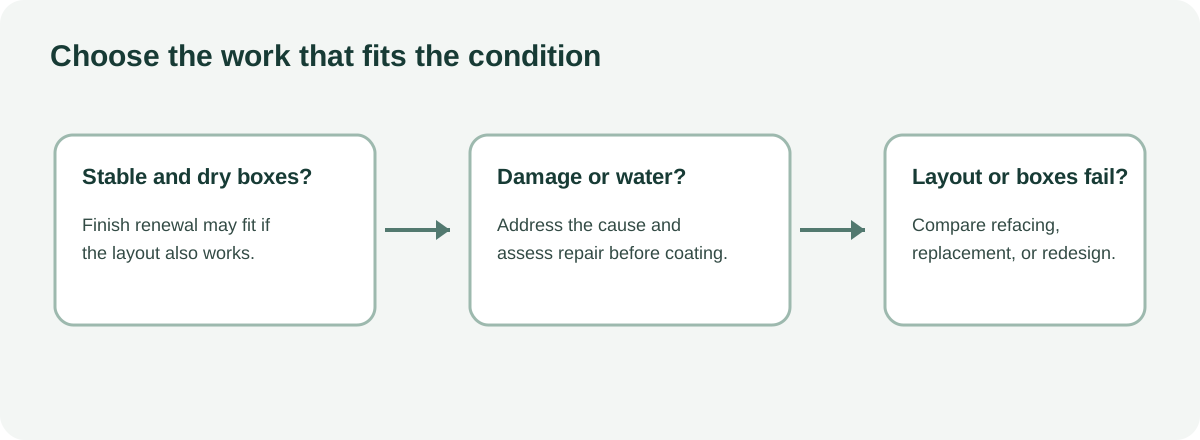
Consider repair, refacing, or replacement when cabinet boxes are swollen, delaminated, loose, poorly mounted, or repeatedly exposed to water. Correct active plumbing leaks before refinishing. If the layout or storage is the real problem, a new finish may spend money without solving the decision that prompted the project.
Older homes and lead paint
EPA guidance identifies pre-1978 U.S. homes as more likely to contain lead-based paint and recommends lead-safe certified contractors for paid work that disturbs painted surfaces. Health Canada says older Canadian homes may contain lead paint and recommends testing or qualified detection; it also says leaving intact paint undisturbed or covering it can be safer than removal. Confirm the rules and work practices that apply locally before sanding, stripping, or removing painted cabinet parts.
Compare a painting quote
Request the number of doors and drawers, removal and reinstall, preparation, repairs, primer and finish system, spray or brush/roll process, shop or site location, hardware handling, exposed ends, interior surfaces, protection, cleanup, warranty, and exclusions. Compare the result with refacing and door/front replacement rather than a paint-material allowance alone.
Compare the whole finish package
Normalize the proposals by counting doors, drawers, exposed frame area, ends, and interior surfaces. Identify removal/reinstall, hardware reuse or replacement, repairs, masking, ventilation and protection, cleanup, touch-up after reinstallation, and the treatment of damaged or delaminated surfaces. Ask whether the price covers one color throughout or different colors, whether a color change needs additional preparation, and how a return visit is priced if a finish issue appears after use.
Temporary use matters too. Confirm which cabinets stay accessible during the work, where doors and drawers will be stored, when the kitchen can be used, and what needs to be moved or protected. If the room is occupied, state who clears contents and protects counters, floors, and nearby rooms. Keep painting, refacing, new fronts, and replacement as separate options so a lower finish-only estimate is not compared with a more complete exterior scope.
Set expectations for the finished surface
Refinishing can change color and sheen, but it does not turn every old door into a factory-new component. Existing profiles, grain, dents, veneer seams, and prior repairs may still show through. Ask the contractor which defects will be repaired, which will remain visible, and whether the finish is intended to conceal or preserve the existing material. Agree on a representative sample and viewing conditions before the full set is coated.
Confirm the expected care and cure period from the coating manufacturer or contractor, including when doors can be handled, cleaned, or exposed to cooking moisture. Keep the product name, color code, sheen, preparation method, and touch-up process with the home records. This information matters if a door is later damaged or an adjacent cabinet is added.
Choose paint, refinish, or refacing by the retained parts
Painting or refinishing keeps more existing surfaces and depends heavily on preparation and adhesion. Refacing replaces more exterior material and can create a larger change in door style and finish, but it retains the cabinet boxes. New doors and drawer fronts can avoid refinishing old doors while leaving frames and sides to coordinate. Replacement changes the whole cabinet system. Compare which parts remain in view and which are being corrected; a low price for one option may simply retain more of the existing finish.
Bottom line
Professional cabinet painting or refinishing is mainly a preparation and handling project. It can be economical when the cabinet structure and layout deserve to remain, but the quote must make substrate condition and surface-disturbance precautions explicit.