
Cabinet repair is a condition-specific service, not a dependable national price category. A carpenter or cabinetmaker may repair a hinge, drawer, shelf, door, face frame, loose box, mounting point, or finish. The right budget starts with the failure and its cause.
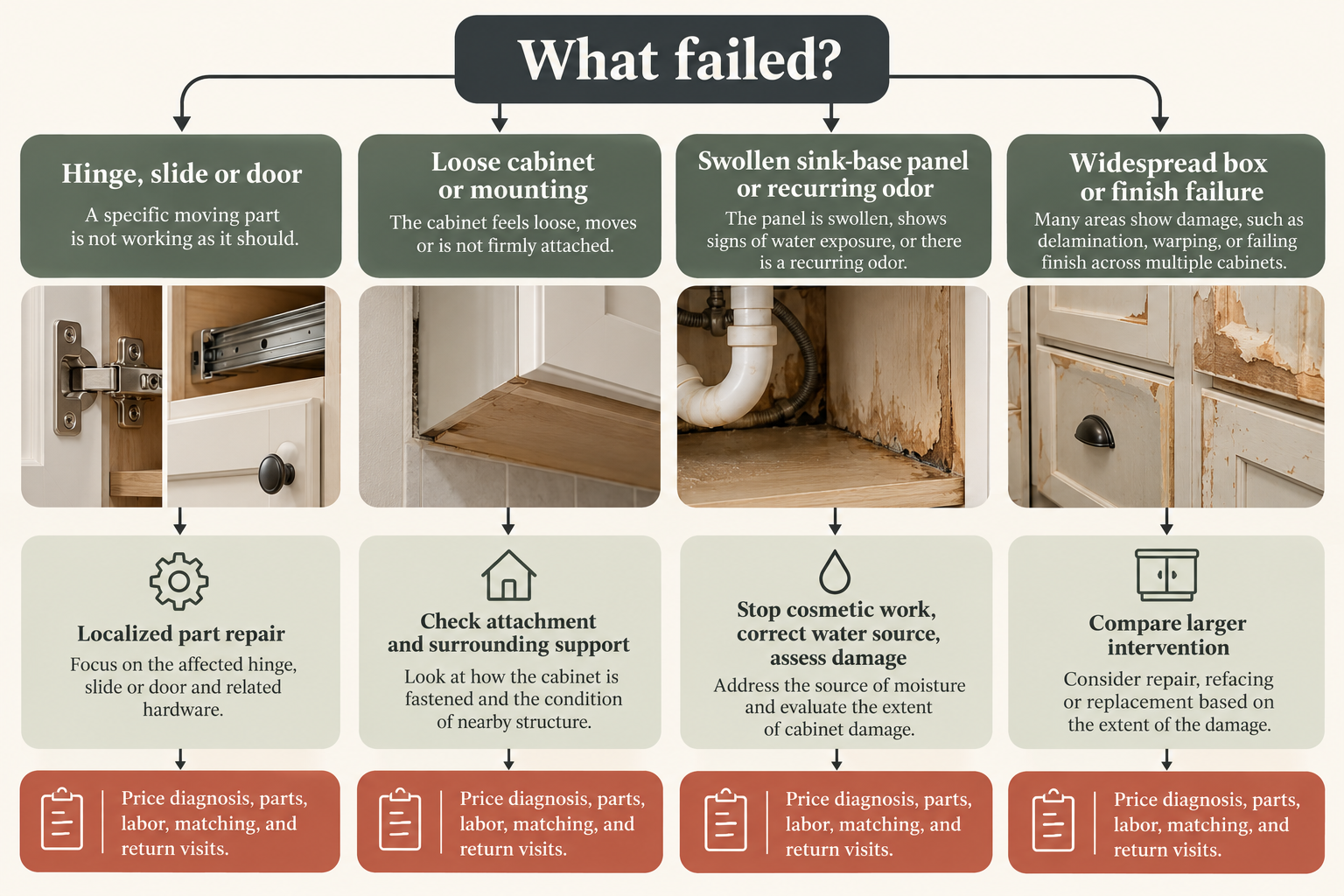
Repairs that may be localized
- hinge adjustment or replacement;
- drawer slide, drawer box, or drawer-front repair;
- loose door, shelf, or face-frame repair;
- damaged trim, filler, or panel replacement;
- limited veneer or finish repair;
- reinforcement or reattachment of a cabinet that has become loose;
- localized replacement of a sound cabinet component.
The cabinet’s construction, access, matching requirements, and availability of replacement parts affect feasibility. A standard replacement hinge may be simple; a discontinued door or an out-of-square box can make a small repair a custom job.
Water damage changes the question
Swelling, delamination, staining, soft panels, or recurring odor near a sink or dishwasher may indicate an active or previous leak. Correct the water source and determine the extent of damage before replacing a door or applying finish. If the wall, floor, or adjacent materials are affected, the work may become restoration or moisture remediation rather than cabinet repair.
One U.S. guide gives examples, not a dependable repair rate
Angi’s 2026 U.S.-oriented guide lists $100–$500 for one cabinet, $200–$1,200 for two to four cabinets, and $1,200–$4,000 for a full kitchen of eight to twelve cabinets. It also reports a $280 average and $200–$490 typical range for a cabinet-repair project, but does not reconcile those figures with its larger full-kitchen band. The examples show how strongly project size and damage scope matter; they do not create a national estimate or a repair-versus-replace threshold. Keep its different categories separate when asking for local bids.
How the service is priced
Expect a service call, diagnosis, travel, minimum labor, parts, fabrication, finish matching, and return visits to appear separately or inside a project price. Ask whether the quote includes measuring, ordering, disposal, adjustment, and cleanup. A repair that takes one visit can have different economics from a custom part that requires a site measure and later installation.
The available Canadian cabinet guide reports removal and installation signals, but the evidence does not establish a reliable national cabinet-repair range. Angi’s U.S. figures are source-defined and not reconciled, so they likewise do not establish a general rate. Do not turn adjacent removal or installation figures into a repair average. U.S. and Canadian homeowners should obtain local quotes.
From symptom to repair estimate
Describe the symptom and location before asking for a price: a door that will not stay aligned, a drawer that binds, a loose shelf, a soft sink-base panel, or a cabinet that has pulled away from its mounting. Photograph the area and note whether the issue recurs after adjustment, follows a leak, or affects several adjacent units. This information helps a repairer decide whether a site visit, matching part, moisture assessment, or wider inspection is needed.
Ask the quote to separate diagnosis, labor minimum, parts, custom fabrication, finish matching, return visit, and any adjacent wall or floor work. If the cause is not yet known, request a diagnostic fee and a written approval point before repair begins. A service call that fixes one hinge is a different scope from an investigation of recurring movement or water damage, even if both are described as “cabinet repair.”
Do not approve cosmetic cover-up before the source of water or movement is understood. A new front, veneer patch, or finish coat may not last if the panel remains wet, the cabinet is loose, or the supporting floor is damaged. Where the cause crosses into plumbing, leak response, or structural repair, ask the relevant qualified professional to evaluate that scope and keep its estimate separate.
Repair or larger intervention?
Repair is strongest when the failure is bounded, the cabinet system and layout still work, and the repaired part can provide a reasonable service period. Compare refacing or replacement when several boxes are failing, the finish is broadly damaged, storage needs have changed, or repair visits would repeat.
The KCMA A161.1-2022 standard describes performance under proper installation, normal use, and maintenance; it does not provide a repair threshold or guarantee a particular cabinet’s remaining life.
Older painted surfaces
Removal or sanding can disturb lead paint. EPA guidance applies to many paid renovation activities in pre-1978 U.S. housing, and Health Canada warns about lead paint in older Canadian homes. Use appropriate qualified professionals and local requirements when surface disturbance is possible.
Compare repair with a durable alternative
For a bounded defect, compare a repair estimate with the price of the affected part and a compatible replacement. For several failed boxes, compare the total of all proposed repairs, matching work, and repeat service visits with refacing or replacement. These are not automatic break-even formulas; they identify when a series of small invoices may be approaching a broader project without solving layout or storage needs.
Ask the repairer what visible result is expected, what cannot be restored, whether the repair carries a workmanship warranty, and what conditions would invalidate it. If the replacement part is discontinued, ask whether a close match is acceptable or whether an intentional contrast is more realistic. The decision should account for repairability and future service, not only the first call-out charge.
When a small repair changes category
A hinge or slide adjustment may stay within cabinet service work if the box and mounting are sound. A swollen sink-base panel may require correction of a leak and assessment of nearby flooring before the cabinet work can be priced. A loose wall cabinet may require a qualified review of its attachment and surrounding structure rather than simply tightening visible hardware. A failed finish across many doors may fit refinishing better than repeated spot touch-ups.
These distinctions help route the estimate to the right professional. They are not diagnostic conclusions based on a photograph or symptom alone. If the repairer sees damaged wiring, plumbing, a persistent leak, or movement outside the cabinet, ask them to stop at that boundary and identify the appropriate specialist instead of including undocumented work in a cabinet repair line.
Bottom line
Price cabinet repair after identifying the failure, water source, matching requirement, access, and likely return visits. Repair a bounded problem; investigate a pattern of swelling, looseness, or repeated failure before spending on cosmetic work.