
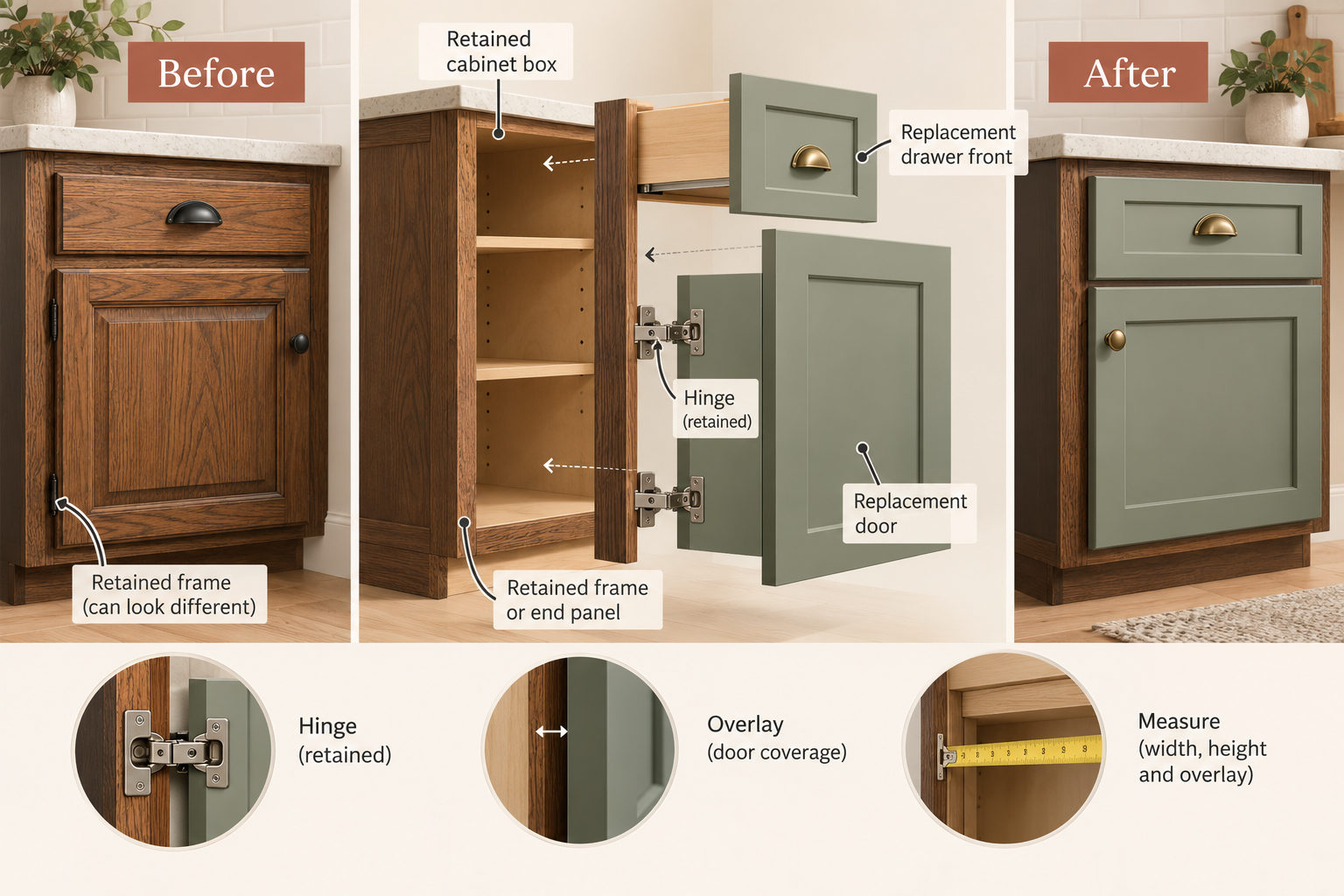
Door-and-drawer-front replacement changes the most visible cabinet parts while leaving the boxes in place. It is narrower than full refacing because exposed frames, end panels, veneers, and some hardware may remain. The result depends on compatibility and visual continuity as much as product price.
What the project includes
- measuring each door and drawer front;
- selecting overlay, inset, profile, material, color, and finish;
- deciding whether drawer boxes and slides remain;
- choosing new hinges, pulls, or knobs;
- fitting and adjusting the new parts;
- treating exposed frames, ends, fillers, and toe kicks so they do not visibly conflict.
A door-only project can look incomplete if the old frame finish, end panels, or cabinet sides remain visible next to new parts. Ask for a sample or finished mock-up before ordering a full set.
Compatibility controls cost
The opening dimensions, overlay, hinge location, mounting pattern, drawer-front attachment, and cabinet construction determine whether a replacement part fits. A nominal door size is not enough. Have the supplier or installer confirm measurements and identify what is being reused.
If the drawer box is damaged, replacing only its front will not solve the problem. If the box is sound but the slide is worn, price that hardware separately. If a cabinet is out of square or the frame is loose, installation adjustment may become repair work.
Approve the sample and measurement schedule first
Have the supplier or installer record each opening and replacement part rather than ordering from a general cabinet count. The schedule can note location, width and height, overlay or inset, hinge bore and position, drawer-front attachment, edge profile, material, finish, and whether old hardware is reused. Confirm who is responsible if a measurement is wrong and whether the seller will remake a part that does not fit the specified opening.
Review one door and one drawer front in the kitchen before releasing the order. Check the finish beside the existing frame, end panel, toe kick, countertop, and natural and artificial light. A sample helps distinguish an intentional contrast from a mismatch. If the old frames or sides will remain, include them in the decision; a visually coordinated front can still leave an obvious difference on the fixed cabinet surfaces.
Door replacement versus refacing
Door/front replacement may be suitable when the boxes, frames, and visible coverings already coordinate or when an intentional contrast is acceptable. Refacing usually adds new coverings to exposed cabinet surfaces and can produce a more complete exterior change. Painting changes the existing parts rather than replacing them.
Home Depot Canada describes refacing as a broader sequence that includes new doors, fronts, hinges, handles, and exterior coverings. That distinction is why a door-only quote should list exposed surfaces and retained hardware explicitly.
Price the installed result
Separate doors and fronts, finish, hinges, pulls, drawer boxes or slides, measurement, delivery, installation, drilling, adjustments, repairs, exposed ends, frames, fillers, and disposal. Small orders can carry design, measurement, shipping, and minimum labor charges that make a per-door price misleading.
Safety and older finishes
Replacing parts can disturb painted surfaces, especially during removal, sanding, or frame preparation. In older U.S. homes, EPA lead-safe renovation guidance may apply to paid work that disturbs lead paint. Health Canada recommends testing or qualified detection when older Canadian paint may contain lead. Confirm local requirements before surface preparation.
Price three levels of work separately
A narrow front-only proposal might replace doors and drawer faces while reusing hinges, slides, frames, and exposed box coverings. A compatibility repair may add new hinges, drilling, drawer-box work, alignment, or finish touch-up. A broader refacing package may replace the fronts and cover exposed box surfaces so the exterior reads as one system. Ask for the price and scope of each only if all are viable for the cabinet condition; this makes the cost of visual completeness visible.
List minimum order charges, measurement, shipping, damage replacement, drilling, adjustments, pulls, disposal, and taxes. Confirm whether specialty sizes or a single replacement part carry a longer lead time. If a cabinet is out of square, have the installer price correction before the new front is fitted. This avoids treating repeated adjustment as a product defect or ordering more parts before the opening is ready.
Plan for the fixed parts that will remain
Before placing an order, examine door and drawer fronts in context with the fixed face frames, exposed ends, toe kicks, fillers, and appliance panels. If a new door finish cannot match old frames, decide whether the frames will be painted, covered, replaced, or intentionally contrasted. Include those fixed surfaces in the sample review rather than approving a door color alone.
Decide whether existing hinges and pulls will be reused. New doors may require different drilling, overlay, hinge plates, or mounting patterns. If changing from a visible frame style to an inset or full overlay look, verify the cabinet opening and reveal on every affected unit; a style name does not guarantee compatibility. The supplier should state the opening and hardware assumptions before production.
Compare the installation route
An owner-measured order can reduce a service visit but increases the risk of incorrect sizes or bore locations. A professional measure adds a fee or lead time but can establish who is accountable for fit. Ask whether the installer has reviewed the actual boxes and whether the seller or installer will handle an error, a concealed condition, or a replacement part. Confirm that replacement doors arrive together and can be stored without damage before removal begins.
If the kitchen must remain usable, sequence the work by cabinet or run and confirm how long openings will be unavailable. Protect the room from dust and finish handling, and make sure old doors are not discarded until the new pieces have been checked. This can prevent a measurement or shipping issue from leaving the room without a usable cabinet door.
Bottom line
Door-and-front replacement is economical only when the retained cabinet system is suitable and the visible result is coherent. Confirm measurements, overlays, frames, ends, drawer boxes, hardware, installation, and finish matching before comparing it with refacing or replacement.