
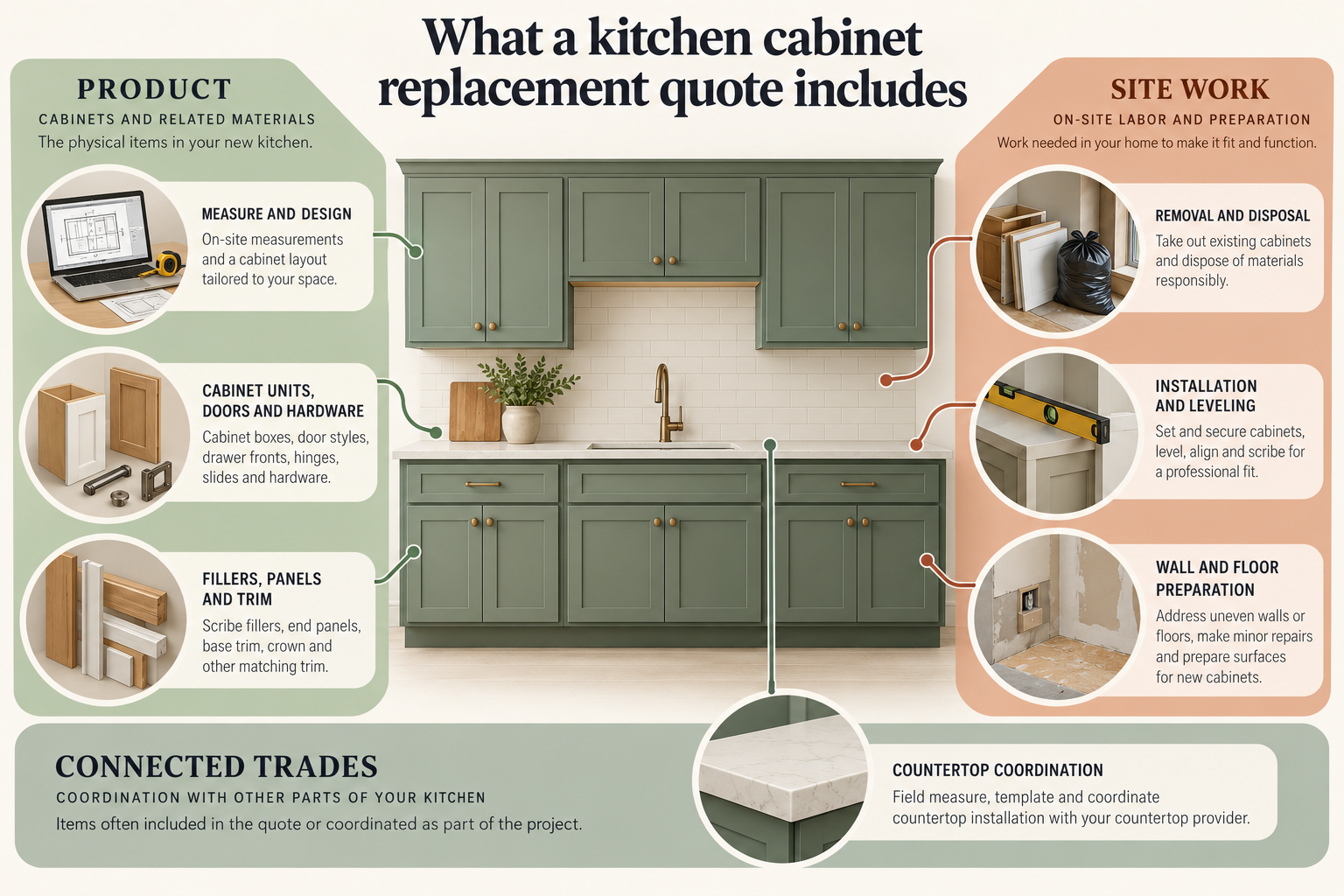
Cabinet replacement cost includes more than the cabinet boxes. Product class, measurements, fillers, panels, trim, hardware, delivery, assembly, removal, installation, wall and floor preparation, and countertop coordination can all change the quote.
Canadian market signals
The 2026 HomeStars Canadian cabinet guide reports source-defined signals of $100–$300 per linear foot for stock/RTA, $150–$650 for semi-custom, and $400–$1,500 or more for custom cabinets. It also reports $1,000–$6,000 for professional installation and $200–$1,000 for cabinet removal.
These are specialist marketplace estimates, not a universal Canadian price schedule. Confirm whether a quote includes installation, taxes, delivery, assembly, hardware, panels, fillers, modifications, disposal, and countertop work. U.S. homeowners need direct local U.S. pricing; the Canadian figures are not exchange-rate conversions.
As a distinct U.S. contractor example, Kolmo Construction estimates installed cabinetry for one 150-square-foot Seattle/King County kitchen at $7,500 for prefabricated/stock, $19,900 for semi-custom, and $34,500 for custom cabinets. The provider says the estimate includes 15% overhead/profit and claims a ±15% range, but it is a modeled single-kitchen estimate rather than a representative local quote sample; the page shows $ without an ISO currency code. It is useful for seeing how one provider prices different cabinet grades on the same kitchen basis, not as a national schedule or a direct comparison with HomeStars’ Canadian per-linear-foot signals.
What a complete quote should show
- measured cabinet list and layout drawings;
- base, wall, tall, pantry, specialty, and appliance units;
- doors, drawer fronts, boxes, shelves, hinges, and slides;
- fillers, toe kicks, end panels, finished backs, trim, and crown or valance;
- modifications for walls, floors, pipes, vents, outlets, and appliances;
- delivery, assembly, installation, leveling, shimming, fastening, and cleanup;
- removal, disposal, temporary protection, and countertop responsibility;
- allowances for concealed wall or floor repairs.
Cabinet counts and linear-foot totals are not comparable if the included components differ. A quote with fewer linear feet may still cost more if it includes tall units, finished panels, custom fillers, or difficult modifications.
Product class is only one choice
Stock, semi-custom, custom, RTA, and preassembled describe different dimensions of the purchasing decision. Read stock versus semi-custom versus custom and RTA versus preassembled before comparing labels.
The KCMA A161.1-2022 document is a voluntary performance and construction standard for factory-assembled kitchen and vanity cabinets. It evaluates expected performance under stated installation, use, and maintenance assumptions; it does not prescribe appearance, materials, design, legal compliance, price, or guaranteed service life. A certification or construction label is one question in a quote review, not a complete value judgment.
Replacement versus retaining boxes
Full replacement is more coherent when cabinet boxes are damaged, the layout no longer works, storage needs change substantially, or several components will otherwise be removed later. Refacing, refinishing, door replacement, or repair may be economically stronger when the boxes and layout are sound. Use the cabinet intervention comparison to make that decision.
Coordination risks
Countertops usually require final cabinet dimensions and levelness. Appliances need correct openings, clearances, utilities, and delivery paths. Plumbing, electrical, gas, ventilation, flooring, and structural work should be visible when they are independent scopes rather than hidden inside one cabinet allowance.
A used or showroom set needs its own complete budget
Secondhand, salvaged, or display cabinets can be worth investigating when a compatible set is available, but a low purchase price does not establish a lower installed cost. Before comparing it with a new order, obtain a cabinet-by-cabinet list, dimensions, finish and condition notes, photos of damage, and a statement of what is included: doors, drawer fronts, shelves, hinges, fillers, trim, panels, and hardware. Confirm whether there are enough matching units for the intended layout and whether replacements can be sourced if a part is damaged.
Ask the installer to review the actual set and layout before you commit. Include pickup or freight, loading, storage, missing pieces, cleaning, modification, new fillers, finish repair, assembly, installation, removal of the old kitchen, and countertop changes. A display set can be complete for its original showroom but still lack the fillers, appliance panels, finished ends, or sizes needed at another home. Used goods may have limited or no seller warranty; get the terms in writing and do not assume a future match is available.
Compare the reused option against a measured new-cabinet estimate with the same room result. If the used set requires extensive modification, cannot be accepted by the installer, or must be supplemented with custom pieces, price those tasks before treating the acquisition price as a saving. Local inventory and removal or donation terms must be confirmed directly; the available evidence does not support a general reuse discount.
Retailer examples are quote starting points, not market averages
IKEA U.S. describes a service that includes cabinet assembly, positioning and hanging, prefabricated countertop installation, integrated lighting, and handles/interior components. It reports an average IKEA kitchen product cost of about $5,500 excluding appliances and a typical installation amount of about $2,500 for that example. The figures are tied to the retailer’s own product and service, are not an independent U.S. market benchmark, and do not establish a cabinet-only labor rate. IKEA also says delivery is typically separate and it does not provide de-installation or demolition; verify local availability and written inclusions before using the example.
IKEA Canada instead publishes a kitchen-installation starting amount of $699 and a required $199 pre-install visit, credited to the final installation amount if the homeowner proceeds and non-refundable otherwise. The Canadian page shows $ without an ISO currency code, so the source notation is retained. The exact price depends on the plan and scope, and supplementary work may be separately quoted. These two retailer examples illustrate why an average package and a starting fee are different bases; they should not be compared as if they were competing national rates.
A cabinet quote comparison that holds together
Use one measured cabinet schedule as the basis for every provider. It should show each unit’s location, width, height, depth, type, door/drawer configuration, finished side, and any appliance or utility opening. Mark which existing cabinets remain and which are removed. Ask each seller to identify how its total handles design, delivery, assembly, install, removal, disposal, trim, fillers, modification, tax, and countertop work.
Then separate product choice from site correction. An uneven wall, floor, or corner may call for fitting or scribing, but a seller’s product quote might exclude that work. A plumbing or electrical conflict can require another trade and schedule. Compare the written exclusions, allowances, and change-order prices, and check whether the countertop fabricator can use the final unit dimensions. If the price basis is a per-foot number, require the actual unit schedule beside it so it is clear what the unit measures.
Bottom line
Compare cabinet quotes by the complete installed result. A low product price can move cost into assembly, delivery, removal, fillers, modification, installation, or countertop coordination. Require the same measured scope and a written list of retained and excluded work before choosing a bid.