
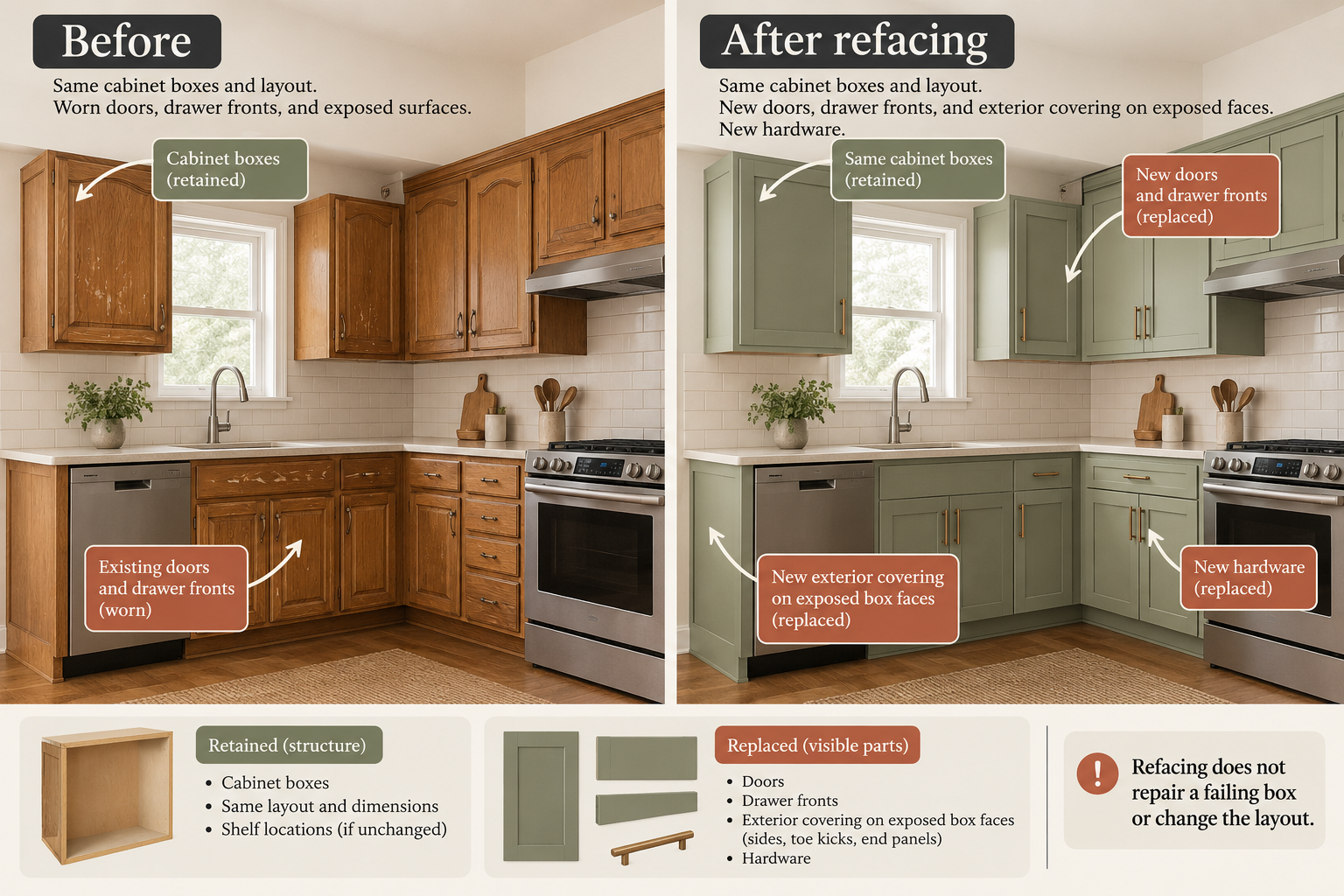
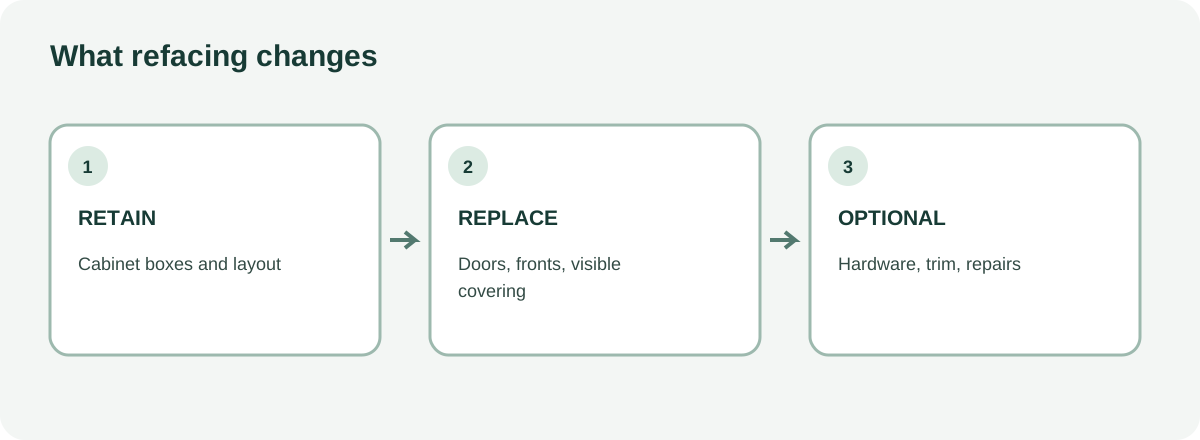
Refacing changes the visible cabinet system while retaining the existing cabinet boxes and usually the layout. It is more substantial than painting but less disruptive than full replacement. It only works when the retained boxes, mounting, and configuration are worth building around.
What refacing changes and retains
A refacing scope may include removing doors, drawer fronts, and hinges; preparing exposed surfaces; applying new exterior coverings; trimming them to fit; installing new doors, fronts, hinges, and handles; and adding optional crown, valances, or storage accessories. Sellers use “refacing” and “resurfacing” differently, so ask for the exact process and materials.
The cabinet boxes and interior layout usually remain, along with the wall and floor relationships, much of the storage geometry, and plumbing, electrical, appliance, and ventilation locations. Retained does not mean inspected. Swollen, loose, delaminated, poorly mounted, or repeatedly wet boxes can make refacing a poor fit. Ask the installer to identify what was inspected and what happens if a hidden problem is found after the surface work begins.
One Canadian provider’s price reference
Home Depot Canada currently reports an average refacing cost of CAD $6,500, with CAD $5,000–$12,000 for larger projects. Its stated scope includes new doors, updating the exposed cabinet boxes with engineered materials to match, new hinges and hardware, and labour; tax is excluded. This is the provider’s own service estimate, checked on September 27, 2026. It is not a national average or a comparable range for every refacing contractor, and the page does not define “larger” by a standard cabinet count or kitchen size.
Use it as a bounded reference when discussing a Canadian quote, then confirm the measured door and drawer count, box treatment, hardware, trim, repairs, taxes, delivery, and installation. U.S. pricing needs U.S.-specific sources; do not convert this Canadian service estimate into a U.S. range.
Home Depot’s U.S. service page gives a separate estimate of about $15,000 for a 27-linear-foot cabinet project in a 200-square-foot kitchen. It says the example includes materials, certified and insured installers, and project management. This is one retailer service estimate, not a national average or guaranteed quote; local availability, cabinet condition, and final measurements matter. Keep it separate from the Canadian Home Depot figure because the markets and service bases differ.
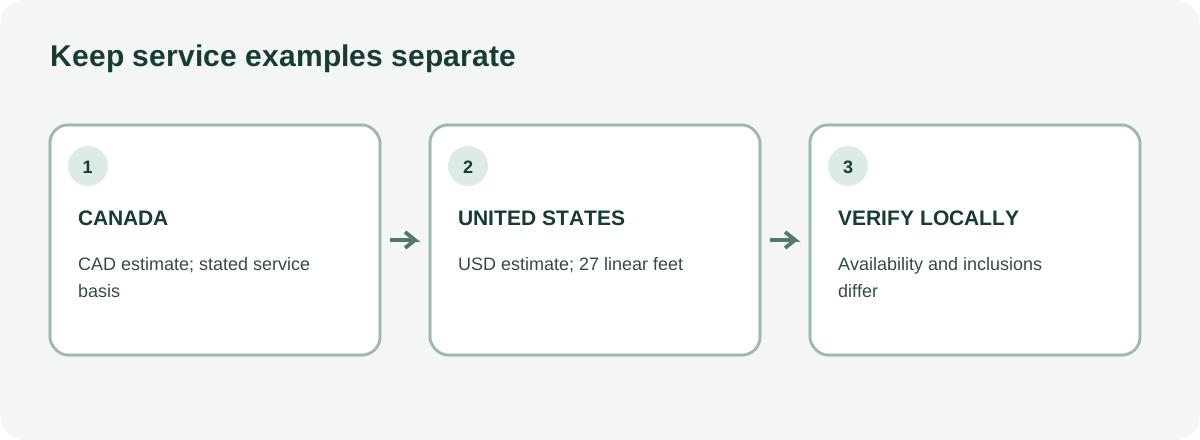
A separate U.S. estimate
Fixr’s 2026 U.S. refacing guide reports an $8,250 average and $3,000–$13,500 range for its source-defined kitchen project. It also lists separate linear-foot, per-door, size-band, material, and labor figures; those use different bases and should not be added together. The guide’s very small and high-end examples extend beyond the headline range without a common scope that reconciles them. Use the overall figures as one specialist-market signal, not a quote promise or a direct comparison with Home Depot Canada’s commercial service estimate.
What moves the quote
The number and size of doors and drawer fronts, covering or finish system, hardware, exposed ends, fillers, toe kicks, trim, and crown all affect the work. Repairs, access, room protection, removal, delivery, and installation may also matter. Organizers or layout changes should be priced separately from the base refacing scope so it is clear which parts are optional.
Ask whether the quote includes surface preparation, the material applied to each visible box, side panels, toe kicks, fillers, hinges, pulls, trim, disposal, and repairs. Request a measured schedule rather than relying on an approximate cabinet count. Make sure a comparison quote covers the same doors, exposed surfaces, finish, and accessories.
Check whether the retained boxes make refacing viable
Before requesting a final price, ask the installer to inspect and document the items that will remain: box sides and bottoms, backs, mounting points, face frames, interior shelves, and sink- or dishwasher-adjacent panels. Ask whether the inspection is visual only, whether any repairs are included, and how newly discovered damage will be priced. A surface treatment can hide an old defect without correcting it, so the estimate should identify the condition assumed for the retained cabinet system.
A useful fit test is to answer three separate questions: Are the boxes stable and dry? Does the current layout still work? Can the new doors and exterior covering be installed without making incompatible openings or exposed areas? A “yes” on appearance alone does not resolve the other two. If the room needs different storage or the boxes need substantial repair, compare that added work with replacement instead of treating refacing as a fixed-price shortcut.
Turn the provider example into a quote checklist
Home Depot Canada’s published reference is helpful only when the quote has a comparable scope. Count doors and drawer fronts, identify which exposed box surfaces receive the new engineered covering, and list hinges, handles, trim, toe kicks, fillers, and repairs separately. Ask whether the stated total assumes a particular kitchen size or cabinet count; the provider’s page does not define its “larger project” threshold. Keep tax, delivery, unusual repairs, and optional organizers visible.
For another contractor, compare the same measured work and ask how the finish will meet the wall, countertop, and appliance panels. Take a sample through the room lighting and review the color next to retained floors, counters, and trim. If perfect matching is unlikely, decide whether a deliberate contrast is acceptable before ordering. A signed sample and written list of retained surfaces reduce the chance that two bidders price different visual outcomes.
Refacing versus painting or replacement
Painting or refinishing may preserve the existing doors; preparation can be lighter or more involved depending on their material and condition. Refacing replaces more visible components and can change the door style, which adds materials and fitting work. Neither choice fixes a failing cabinet box or a layout that no longer works.
If the boxes are sound and the arrangement works, retaining them can avoid removing and replacing the full cabinet system. If box condition is uncertain, compare the cost and result with repair or replacement before committing. A lower initial quote is not a saving if it leaves damaged boxes or a poor layout in place.
Older painted cabinets
EPA guidance says paid renovation, repair, or painting that disturbs painted surfaces in many pre-1978 U.S. homes may require lead-safe practices and certified contractors. Health Canada also warns about lead paint in older Canadian homes. Treat this as a screening and professional-referral issue, not as something a standard refacing quote assesses. Local requirements and the correct handling of suspect materials need qualified, jurisdiction-specific advice.
Compare the quote
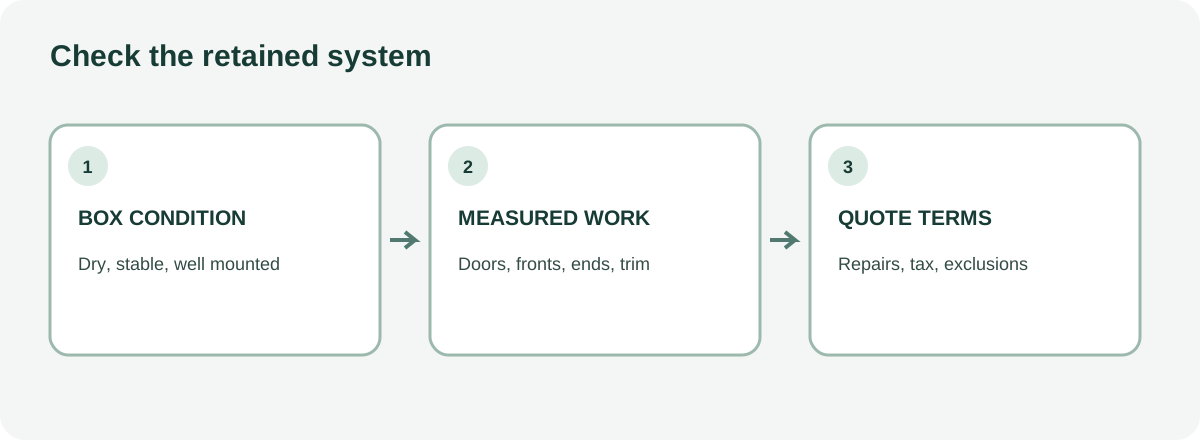
Ask for a measured door and drawer schedule, retained-box assumptions, covering and finish description, hardware list, end-panel and trim treatment, repairs, protection, disposal, warranty, exclusions, and change-order terms. A strong quote says why the existing boxes are suitable and what happens if concealed damage is found. Compare that complete scope with painting, door-only replacement, repair, and full cabinet replacement.
Plan the work around the retained interior
Refacing primarily changes the cabinet exterior. Before the job starts, decide whether shelves, organizers, drawer boxes, hinges, and interior finish will remain or be upgraded as separate work. If the kitchen has a storage problem, list it before the estimator prices the exterior so an optional pullout or drawer conversion is not quietly treated as part of the base package.
Ask how doors and fronts are labeled for removal and return, where they will be finished, how exposed box faces are protected, and what access the crew needs. Confirm whether counters, appliances, or plumbing fixtures must be removed or protected. If a countertop will be replaced later, ask whether that work would damage the new covering at the top edge and whether the refacing contractor can provide a durable stopping detail.
Bottom line
Refacing can be a sensible middle path when the layout works and the boxes are sound. Home Depot Canada’s published figure is one commercial Canadian service reference with stated exclusions, not a price promise. Compare complete, measured local proposals and verify the retained cabinet structure before choosing.