
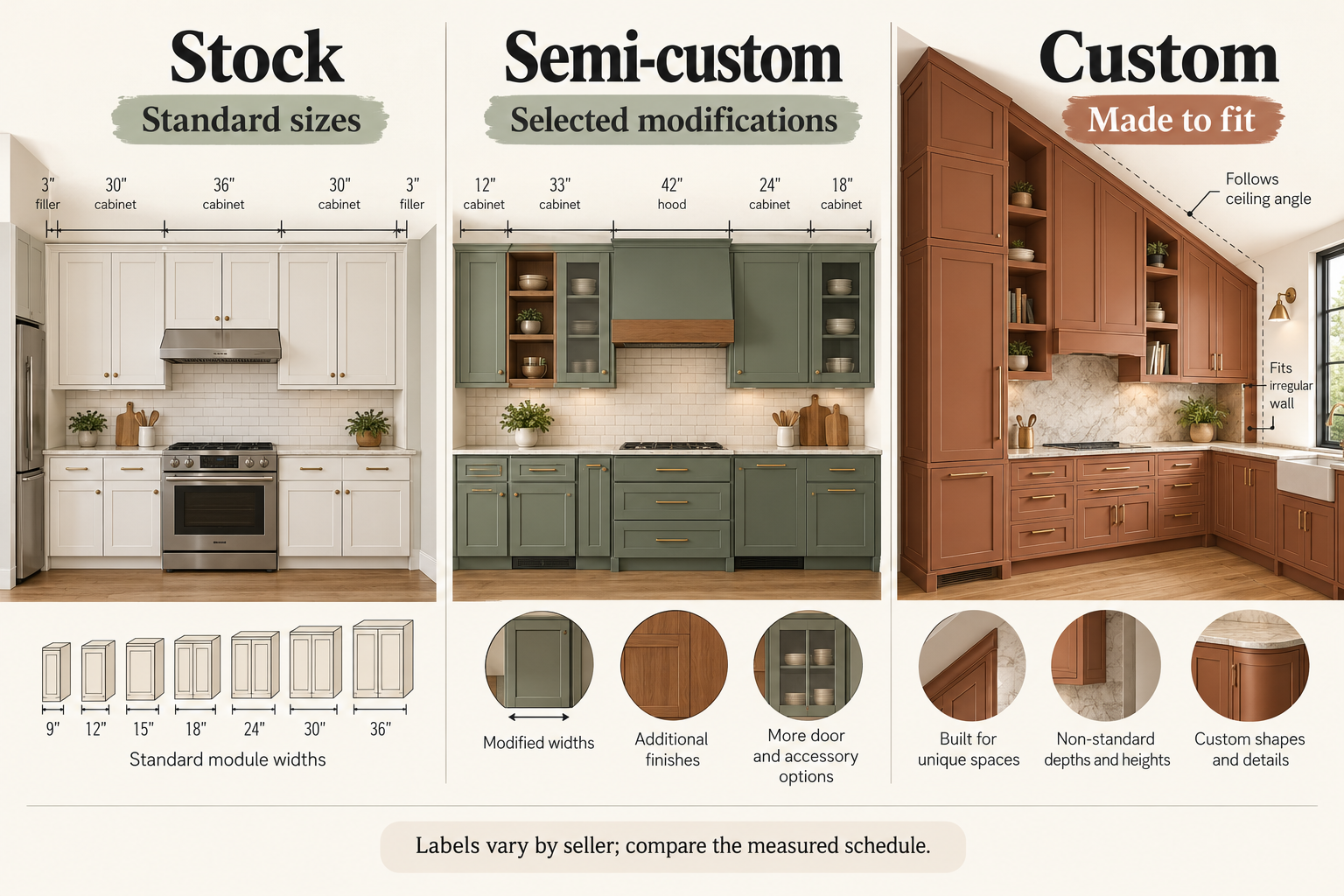
Stock, semi-custom, and custom are useful buying categories, but they are not universal technical standards. Sellers may use the labels differently, and price depends on finish, hardware, dimensions, panels, modifications, delivery, and installation as well as the category name.
The practical difference
| Class | Typical strength | Typical tradeoff |
|---|---|---|
| Stock | Predictable sizes and quicker selection | More fillers, fewer dimensions, and less modification flexibility |
| Semi-custom | More sizes, finishes, accessories, or modifications | Higher product cost and potentially longer ordering or replacement time |
| Custom | Designed around unusual dimensions, details, and preferences | Highest design, product, coordination, and replacement-part exposure |
These are tendencies, not guarantees. A well-specified stock cabinet can be a better fit for a simple room than a poorly documented custom cabinet.
Canadian price context
The 2026 HomeStars Canadian guide reports source-defined signals of $100–$300 per linear foot for stock/RTA, $150–$650 for semi-custom, and $400–$1,500 or more for custom. Linear-foot figures are not comparable when one quote includes finished ends, fillers, hardware, installation, or tall units and another does not. Use them as market context, then compare a measured cabinet schedule in local CAD.
A separate U.S. specialist signal
Fixr’s 2026 U.S.-oriented estimate lists stock cabinets at $100–$300 per linear foot, semi-custom at $150–$650, and custom at $500–$1,200. These are source-defined estimates, not a census or a quote sample. The article also gives a separate installation-labor statement, but the relationship between those amounts and the class figures is not sufficiently clear to add them together. Confirm whether any quote includes product, labor, or both, and do not infer an installed price from the class table alone.
The U.S. and Canadian examples overlap in some classes and differ in others. That does not show that one cabinet class costs a particular amount more in one country: the publishers’ methods, market coverage, and inclusions differ. Keep each example in its source market and currency, then build a local comparison from the same measured cabinet schedule. A price per linear foot is especially weak when one bid includes tall or finished units and another counts only a simplified run.
Pay for fit when fit is the problem
Customization can have economic value in an unusually narrow wall, sloped ceiling, deep corner, irregular opening, or room where fillers would consume useful storage. It can also coordinate appliance panels, full-height storage, trim continuity, and accessibility requirements.
Do not pay for customization merely because it sounds premium. First identify the problem the custom dimension or detail solves and price the alternative: fillers, standard units, a different layout, or an intentional contrast.
Quality is a separate question
“Custom” does not itself guarantee better durability. Ask about box, door, drawer, hinge, slide, shelf, finish, mounting, moisture exposure, warranty, and replacement-part specifications. The KCMA A161.1-2022 standard is a voluntary performance and construction reference for factory-assembled kitchen and vanity cabinets. It does not prescribe materials, appearance, design, price, legal compliance, or lifecycle economics.
Choose a class from the room’s constraint
Regular walls and standard appliance openings. Stock units may fit with limited fillers and predictable delivery. Ask for the finished cabinet schedule and check that fillers, end panels, and trim do not reduce the opening or storage more than expected.
One or two nonstandard dimensions. Semi-custom modifications may solve a narrow gap, unusual width, or height change without making every unit custom. Compare the modification charge and lead time with a standard cabinet plus field-fit trim or filler.
Unusual architecture or integrated appearance. Custom units may be warranted for a sloped ceiling, unusual depth, continuous paneling, or a specific accessibility need. Ask for a drawing and sign-off showing the dimensions and finished surfaces before production; design changes after approval can affect both schedule and price.
These examples do not predict which tier is best. They show why the same room can have more than one workable specification. Price two feasible approaches using the same appliance, trim, delivery, and installation assumptions rather than comparing a basic stock product with a full custom package.
Lead time and replacement risk
Lead times, finish availability, and replacement parts change by seller and product line. A custom finish may be difficult to match later. A stock system may be easier to replace but less adaptable to a future layout. Include delivery protection, damaged-unit replacement, storage, and schedule consequences in the comparison.
Decide where flexibility changes the result
Before requesting a premium tier, identify the dimension, finish, or feature that is not working in a standard system. A narrow opening may be handled by a filler; a ceiling-height gap may call for a trim detail; a wall that is out of square may need site correction rather than a custom box. Ask for the standard-unit solution and the modified or custom solution as separate alternatives, with the usable width, storage, finish continuity, and installation work stated.
This comparison often reveals that the choice is not simply “more custom equals more expensive.” A custom unit may reduce awkward fillers or solve a nonstandard appliance condition, while a standard layout may avoid lead-time and replacement-part risk. Have the seller state what is factory-built, what is modified on site, and what happens if the delivered dimensions or finish differ from the approved schedule.
Decision rule
Choose stock when the room accepts standard dimensions and the installation result is clear. Choose semi-custom when a limited set of sizing, finish, or storage changes materially improves fit. Choose custom when the room or use requires details the other systems cannot supply at an acceptable total cost.
Compare complete installed scopes, not the catalog label. Include fillers, panels, trim, hardware, assembly, delivery, installation, countertop impact, and any modifications before deciding whether flexibility is worth its price.