
Cabinet quality is a system of construction and performance choices, not a single material label. Compare the parts that affect fit, use, repair, moisture exposure, and documented performance rather than assuming plywood, MDF, framed, frameless, or “custom” always wins.
Ask about the cabinet system
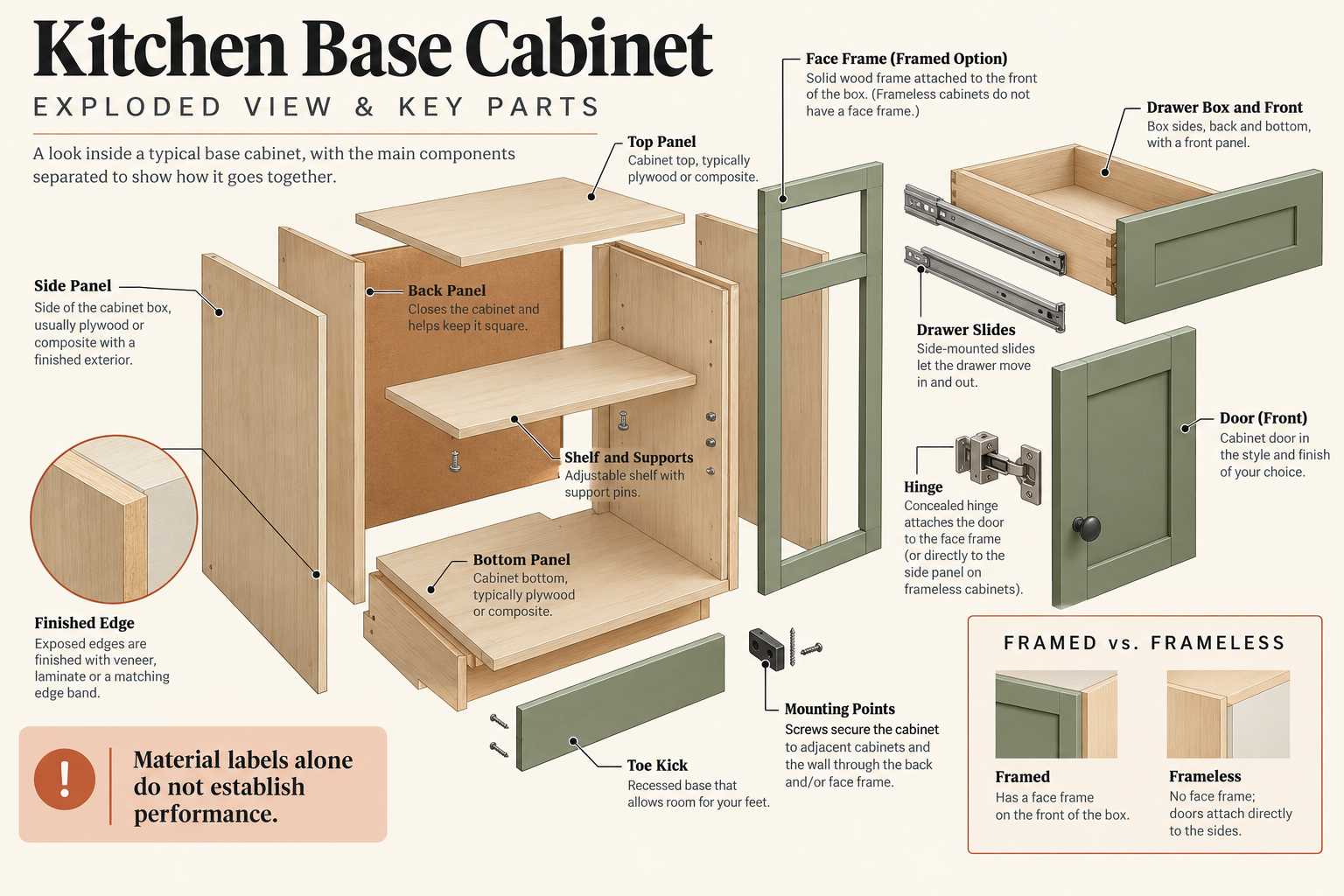
- Box: panels, joints, back, mounting points, interior finish, and how the unit handles the intended use.
- Doors and drawer fronts: material, joinery, finish, adjustment, and replacement availability.
- Drawers: box construction, slides, extension, adjustment, and stated load information.
- Hinges and hardware: adjustability, soft-close features if desired, replacement model, and service access.
- Shelves and interiors: span, support, finish, and exposure to water or cleaning products.
- Panels and trim: finished ends, appliance panels, fillers, toe kicks, and how field cuts are handled.
The question is not whether one feature sounds premium. It is whether the complete system is suitable for the room, installation, use, and maintenance expected.
Framed and frameless are design systems
Framed cabinets use a face frame around the box opening. Frameless cabinets expose more of the box front and use the box to establish the opening. Each can be well made or poorly specified. Compare usable dimensions, hinge layout, drawer capacity, filler needs, installation tolerances, and repairability instead of treating the construction name as a durability ranking.
Moisture deserves specific attention
The sink base, dishwasher side, plumbing penetrations, and countertop seams see a different environment from a dry pantry. Ask how exposed edges are finished, how leaks are detected and repaired, and whether panels, hardware, and replacement parts are available. No cabinet construction makes an active leak harmless; correct the water source before cosmetic repair.
What the KCMA standard does—and does not—tell you
KCMA A161.1-2022 is a voluntary performance and construction standard for factory-assembled kitchen and vanity cabinets. It evaluates expected performance when cabinets are properly installed, normally used, and maintained. It does not specify design, appearance, materials, legal compliance, price, fit in a particular room, or guaranteed lifecycle economics.
Certification or compliance can be one useful comparison question. It should be read alongside the actual product specification, installation method, warranty, exclusions, and the conditions at the property.
Keep emissions documentation separate from construction quality
In Canada, Health Canada’s composite-wood guidance describes formaldehyde-emissions rules for specified products used in cabinetry, furniture, and trim, including certain plywood, MDF, thin MDF, particleboard, and laminated products. Applicable finished goods and components have labeling and compliance requirements. If the cabinet material or its source matters to your decision, ask the seller or importer for the product identification and relevant compliance information rather than trying to infer it from words such as “laminate,” “engineered,” or “low emission.” The exact product definitions and exemptions control.
This documentation addresses regulated emissions and traceability; it does not establish cabinet strength, moisture resistance, workmanship, price, or a homeowner-measured indoor-air result. Health Canada’s source also explains that a plastic layer glued to particleboard is not itself covered by the laminated-product provisions, while the composite-wood core may still matter as part of a finished good. Do not treat a material marketing label as a substitute for checking what the product is made of or which rule applies.
For a fair comparison, keep separate records for structural/performance claims, emissions or compliance documentation, and warranty/service terms. A cabinet can meet one set of requirements without being the best fit for a damp sink base, heavy storage, or the installation conditions in a particular home.
Ask for a specification you can keep
Request a written product schedule for the cabinets being quoted, not just a brochure for the collection. It can identify box and back construction, exposed-edge treatment, door material and finish, drawer construction, hinge and slide models, shelf supports, finished ends, and installation requirements. For parts that matter to a heavy-use location, ask for the manufacturer’s stated load or use information and compare like for like. If a feature is not specified, do not assume it is the same across two product lines.
For the sink and dishwasher zone, ask how the cabinet system handles exposed edges and how the seller expects water damage to be addressed. For a tall pantry or broad shelf, ask how spans and supports are specified. For a frequently used drawer, identify the slide and whether that model is replaceable. These questions connect the material and hardware to actual use without claiming that one label guarantees durability.
Separate the kinds of proof
Keep performance documentation, material/emissions compliance, installation instructions, and warranty terms in separate files. KCMA A161.1 information concerns performance of factory-assembled cabinets under its scope; it does not identify every material or guarantee a particular room installation. Canadian composite-wood labeling addresses regulated emission and traceability requirements for defined products; it is not a strength rating or indoor-air test. A marketing claim such as “premium,” “custom,” “water resistant,” or “low emission” should be connected to the specific product documentation that supports it.
If the cabinet is imported, modified on site, or assembled by a separate installer, ask who remains responsible for documenting the product and the work. Keep product names, model numbers, finish codes, instructions, and contact information with the home records. Those details can matter when a door, hinge, drawer slide, or panel needs a replacement later.
Compare two quotes fairly
Ask both sellers to identify box, door, drawer, hardware, shelf, finish, end-panel, filler, trim, delivery, assembly, installation, and warranty details. Confirm whether each quote includes the same cabinet quantities and the same countertop, appliance, utility, and finish assumptions.
Do not pay for a material name that does not solve a stated problem. Pay for measurable fit, performance, serviceability, moisture-appropriate detailing, and a complete installed scope.