
Cabinet installation is the labor and coordination required to turn delivered units into a usable, aligned run. It is separate from cabinet product cost and may also be separate from assembly, delivery, removal, countertop work, and finish carpentry.
What installation can include
- confirming measurements and the installation sequence;
- assembling RTA units when that service is included;
- locating runs and identifying conflicts;
- leveling and shimming against uneven walls or floors;
- fastening units appropriately to the building structure;
- installing fillers, panels, toe kicks, trim, shelves, doors, and hardware;
- making limited field modifications for pipes, ducts, outlets, and appliances;
- coordinating final cabinet dimensions for countertop templating.
The exact boundary varies by installer and cabinet system. A labor-only quote should say whether it assumes assembled units, clear rooms, sound walls and floors, no removal, no utility changes, and no finish restoration.
Canadian price context
HomeStars reports a source-defined Canadian professional installation signal of $1,000–$6,000, with size and complexity affecting the result. The same guide reports $200–$1,000 for cabinet removal. These are specialist market observations, not a universal rate and not a U.S. estimate. Confirm what assembly, delivery, modifications, taxes, disposal, and trim work are included.
Fixr’s 2026 U.S. guide separately lists installation labor at $50–$200 per linear foot or $40–$100 per hour. These are alternative source statements, not rates that can be converted into one another from the information provided. The same guide’s cabinet-class table may combine product and installation costs ambiguously, so do not add these labor figures to its stock, semi-custom, or custom ranges. They are a secondary estimate for quote context, not a labor-only schedule for a defined cabinet list.
Why labor varies
Installation slows when walls are out of square, floors are uneven, cabinet runs are fragmented, fillers must be custom-fit, access is restricted, or appliances and utilities conflict with the drawings. Tall units, finished end panels, crown, islands, and small isolated jobs can carry more setup and handling per unit.
An installer may quote by project, cabinet count, linear foot, day rate, or a bundled percentage. None is comparable without the same unit list and assumptions. A lower rate with more exclusions may not be a lower installed cost.
Assembly is not installation
RTA or flat-pack cabinets need assembly before they can be installed. Factory-assembled cabinets may cost more to purchase or deliver but reduce on-site assembly. Ask who is responsible for damage inspection, missing parts, replacement lead time, and correcting a damaged unit before installation proceeds.
Questions for the labor quote
- Are units delivered assembled and to the correct room?
- Are removal and disposal included?
- Are leveling, shimming, fastening, fillers, panels, toe kicks, and trim included?
- What modifications are allowed, and who handles utility conflicts?
- Does the price include island anchoring or floor patching?
- Who coordinates countertop templating and sink or cooktop cutouts?
- What wall, floor, electrical, plumbing, gas, or appliance work is excluded?
- What happens if a cabinet is damaged or the site is not ready?
Retail installation services have different price bases
Two current IKEA examples show why a retailer service price needs its own label. IKEA U.S. reports about $2,500 as the typical installation amount for its approximately $5,500 average kitchen purchase excluding appliances. The service description includes assembly and cabinet installation, prefabricated countertops, integrated lighting, and handles/interior components. This is a bundled retailer example, not a labor-only benchmark or a ratio to apply to another cabinet purchase. The service is location-dependent; delivery is typically separate, demolition is not offered, and the provider says its installation warranty depends on IKEA Home Services completing the work from start to finish. Ask whether the exact offer accepts your cabinet system and what independent trades remain outside it.
IKEA Canada publishes a different basis: a kitchen-installation starting price of $699, with a required $199 pre-installation visit credited to the final amount if the customer proceeds and non-refundable otherwise. The page presents the fee in a Canadian service context but does not state an ISO currency code, so this article retains the source’s dollar notation. Supplementary work may be separately quoted by the installer, and the exact amount depends on the individual kitchen plan. It is a starting fee, not a typical-project total or maximum.
For either retailer or an independent installer, request the dated written quote for your measured plan. Confirm service area, product eligibility, assembly responsibility, delivery, site preparation, removal, countertop scope, plumbing/electrical work, patching, warranty conditions, and supplementary-work rates. Then compare it with an independent labor-only quote that uses the same cabinet list and exclusions. A low starting amount cannot be compared with a complete service package until the missing work is priced.
Follow the installation from delivery to template
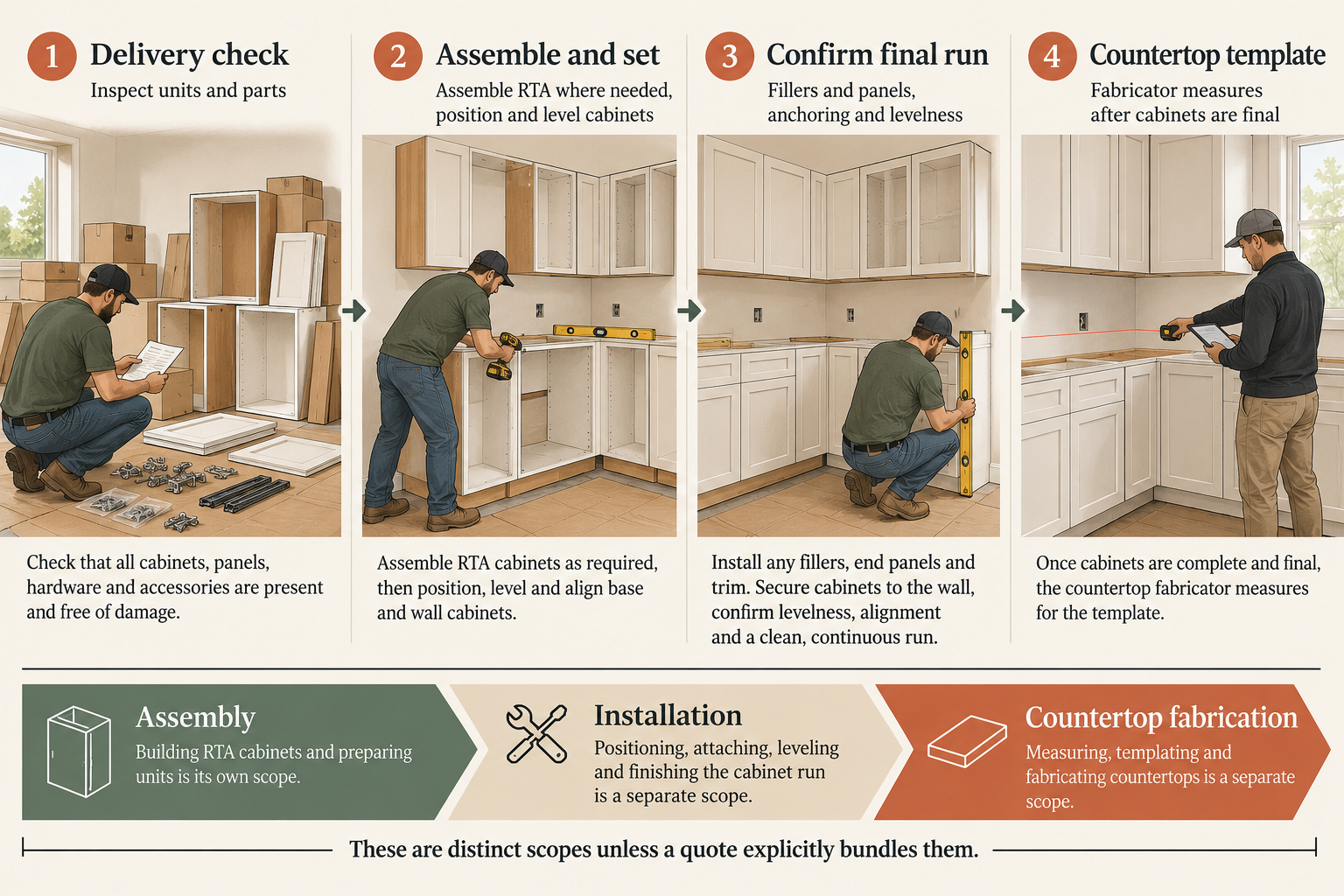
Installation starts before a cabinet is fastened. Confirm who checks the delivery against the order, reports damage, stores units, brings them into the room, and confirms the site is ready. Ask what the installer expects of walls, floors, power, plumbing, and appliance openings. If units arrive incomplete or a product is damaged, the quote should say whether labor and a return trip are additional.
The next handoff is countertop measurement. The cabinet run needs to be installed in its final position and condition before a fabricator can rely on dimensions. Confirm who verifies levelness, adjusts fillers and panels, resolves a wall gap, and signs off that the base is ready for templating. A cabinet bid that ends with installation may not include countertop coordination or correction needed for another trade.
Price the crew and the responsibility
Ask whether the estimate is for one installer or a crew, how small-job minimums and travel are handled, and how a return visit is priced. A daily rate can be useful when site conditions are uncertain, but agree on the expected crew, workday, tasks, and what counts as extra time. A project amount can be easier to compare if the same drawings and exclusions are attached.
If the provider bundles assembly, installation, countertop, or lighting services, value the scope actually included rather than dividing the package total by the cabinet count. If hiring separate trades, assign one party to coordinate the sequence and document who owns gaps between cabinet delivery, installation, and template. This is where a clear scope can prevent repeated visits and disputed change orders.
Performance and safety boundary
The KCMA A161.1-2022 standard evaluates factory-assembled cabinet performance under stated installation, use, and maintenance conditions. It does not provide a universal fastening method or installation price. Building attachment, electrical, gas, and structural questions should be handled by the appropriate qualified professional and local requirements.
Bottom line
Price cabinet installation from a measured unit list and a clear site condition. Separate assembly, delivery, removal, modification, trim, countertop, and utility work. The installer’s total responsibility matters more than a standalone per-cabinet number.