
Ready-to-assemble (RTA) or flat-pack cabinets can have a lower product price, but the finished project cost includes assembly, delivery, damage handling, installation, modifications, and the value of time. Preassembled cabinets shift more work to the factory or supplier and may change handling and delivery costs.
Compare the whole installed path
| Cost element | RTA or flat-pack | Preassembled |
|---|---|---|
| Product | Often sold in compact packages | More factory labor and finished volume may be included |
| Assembly | Homeowner or paid assembly before installation | Usually limited to unpacking and inspection |
| Delivery | Many packages and damage inspection | Larger, heavier units and more handling space |
| Modification | Some changes are possible but may be labor-intensive | Factory construction may limit field changes |
| Replacement | Individual parts or boxes depend on the supplier | Replacement may be simpler or more expensive by product line |
Neither format is automatically stronger or better. Evaluate the actual construction, hardware, finish, documentation, and installation responsibility.
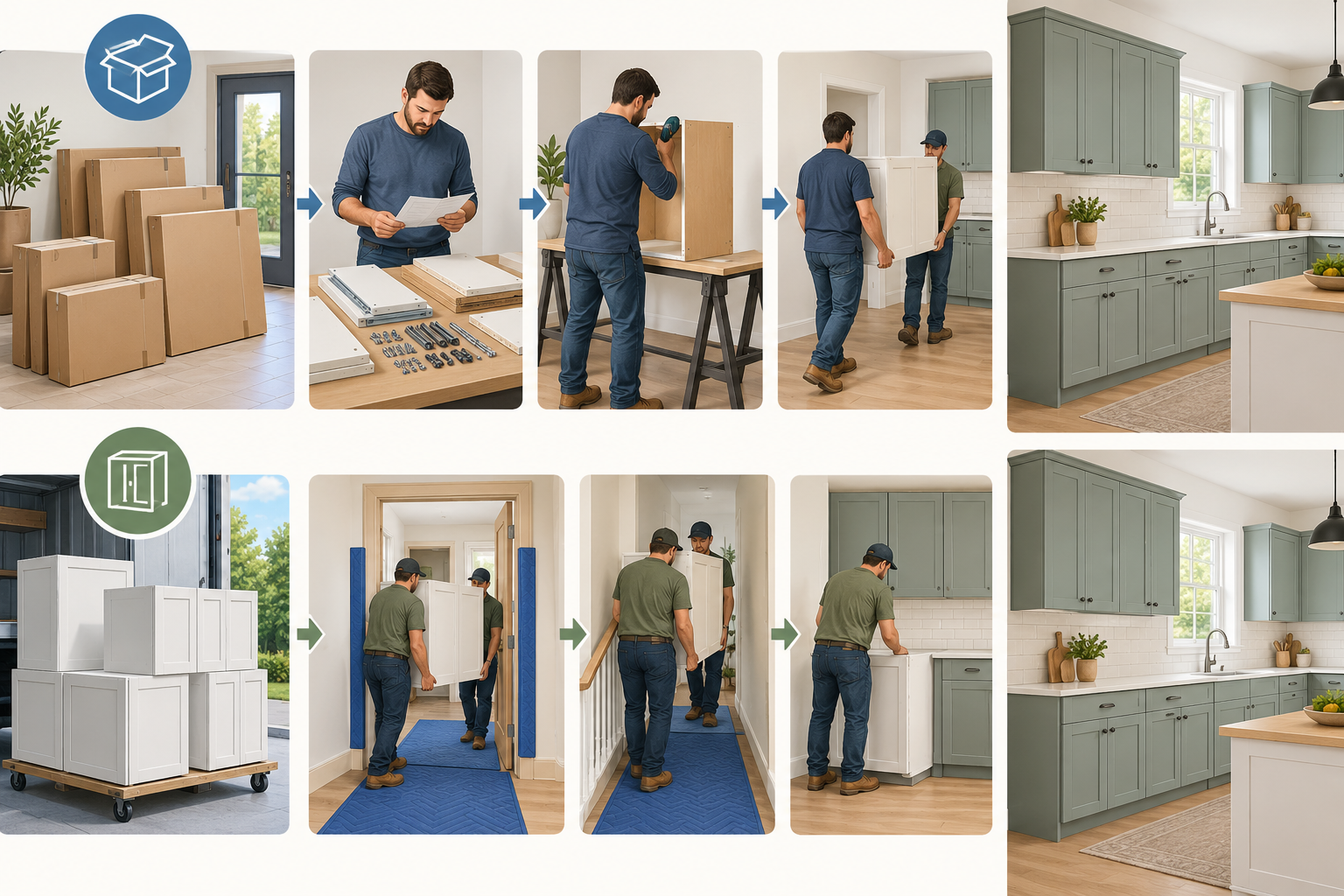
The labor people forget
Assembly requires sorting, checking, joining, fitting hardware, handling damage, and storing units before installation. If a damaged panel is found after assembly, the schedule may stop while a replacement is shipped. A homeowner’s unpaid time is still part of the project economics, especially when the kitchen must remain usable.
Ask for separate prices for assembly, delivery to the room, installation, fillers, panels, trim, modifications, removal, and disposal. A “cabinet price” that excludes all of these cannot be compared with an installed package.
Fit and filler consequences
RTA systems often use a defined set of widths and depths. Standard units can work well in a regular room, but fillers and panels may consume space at walls, corners, appliances, or tall units. A preassembled or semi-custom system may reduce field modification, but only if its sizes actually solve the room’s constraints.
Canadian market context
HomeStars lists stock/RTA as a source-defined Canadian market class and reports a broad stock/RTA signal of $100–$300 per linear foot. This is a specialist estimate, not a universal installed price. Determine whether assembly, hardware, installation, delivery, taxes, panels, fillers, and countertop coordination are included. U.S. availability and pricing need direct local research.
Quality and documentation
Request the cabinet construction, door and drawer specifications, hardware model, finish-care requirements, loading information, installation instructions, warranty, and replacement process. The KCMA A161.1-2022 standard evaluates performance under stated conditions for factory-assembled cabinets; it does not make every RTA or preassembled product equivalent or guarantee lifecycle savings.
Check the installation and warranty boundary
Assembly responsibility can affect more than labor. Before ordering, ask the cabinet seller and installer to identify who inspects cartons, records transit damage, assembles the boxes, corrects missing parts, accepts field modifications, and carries the workmanship warranty. Keep the answer in writing because the installer may reject units assembled or altered by another party.
For example, IKEA U.S. currently says a homeowner who assembles its SEKTION cabinets and then hires the service provider for installation would void the installation warranty; the service must be completed start to finish by IKEA Home Services for that warranty to apply. That is a retailer- and product-specific term, not a rule for all RTA cabinets. It illustrates why a low-priced self-assembly option should be checked against the intended installation path before the product is purchased. Confirm current service eligibility, written warranty terms, and local availability for the actual order.
Compare a realistic RTA and preassembled quote
Use the same unit list, hardware, panels, fillers, finish, countertop assumptions, and removal scope for both options. For the RTA route, add the supplier’s carton delivery, receiving and damage checks, assembly labor or time, staging area, moving assembled units into the kitchen, and any correction if a part is damaged. For the preassembled route, include larger-unit handling, access through doors or stairs, protection, and any added delivery equipment. Ask both providers when the room must be ready and whether late or missing parts trigger a return visit.
Then compare the finished responsibility: who makes units square, secures them appropriately, adjusts doors and drawers, installs trim, and resolves a defect found during installation? A self-assembled set may be a sound choice when the layout is regular, the supplier provides clear instructions and parts support, and the homeowner has suitable time and space. A preassembled or bundled route may be preferable when schedule certainty or one accountable installation chain matters more than the lowest visible product price. Neither conclusion follows from format alone.
Include homeowner time and receiving space
RTA economics depend partly on whether the homeowner has a dry, secure area for receiving and assembling cartons, enough time to check each piece, and a plan for moving the completed units safely. Count the time for sorting, assembly, adjustment, packaging, and managing missing or damaged parts. If assembly will happen over several weekends, include the effect on the schedule and temporary kitchen access. A labor-free line item is not necessarily a zero-cost task.
Preassembled cabinets use more delivery volume and may need a clearer path through doors, halls, stairs, and tight turns. Confirm measurements for the largest assembled unit, staging space, and whether the delivery price includes placement in the kitchen. An inaccessible run may need to be split, assembled on site, or carried by additional workers, which can change the comparison.
Compare the exact system warranty
Ask whether product defects, assembly workmanship, installation labor, finish damage, and countertop interfaces have separate warranty terms. Note who must inspect a problem, where replacement parts ship, whether disassembly is required, and how long service remains available. A long product warranty does not necessarily pay for taking apart an installed cabinet or fixing surrounding finishes. Compare the remedy and responsible party rather than the warranty duration alone.
When RTA can make economic sense
RTA can be sensible for a regular layout, a capable assembler or affordable assembly labor, straightforward delivery, and a supplier with reliable replacement parts. Preassembled cabinets may be worth the extra product and handling cost when time, alignment, finish responsibility, or installation risk matters more than the lowest catalog price.
Bottom line
Price the route to a functioning, aligned kitchen. Include assembly, delivery, damage, modifications, installation, trim, and schedule risk before treating a lower RTA sticker price as a saving.