
Backsplash cost depends on the surface area and on the preparation needed to make that area ready. Removal, wall repair, material, layout, cuts, outlets, windows, edges, labor, protection, and coordination with cabinets and countertops can matter more than the tile price.
One U.S. project range for context
Angi’s 2026 U.S.-oriented guide reports a source-defined $1,000 average and $480–$1,500 typical range for a 35-square-foot backsplash project. It also lists per-area, material, labor, and removal estimates as separate rows with possible overlap. Treat the 35-square-foot example as scale context, not as a price for every tile, slab, or sheet project; do not add those other rows to it without a quote confirming what is included.
What installation can include
- removing an existing backsplash or preparing a painted wall;
- assessing and repairing the substrate;
- measuring coverage and selecting tile, slab, or sheet material;
- laying out patterns and making cuts around outlets, windows, cabinets, and corners;
- installing, grouting, sealing, edging, and finishing;
- protecting counters and cabinets and restoring adjacent surfaces.
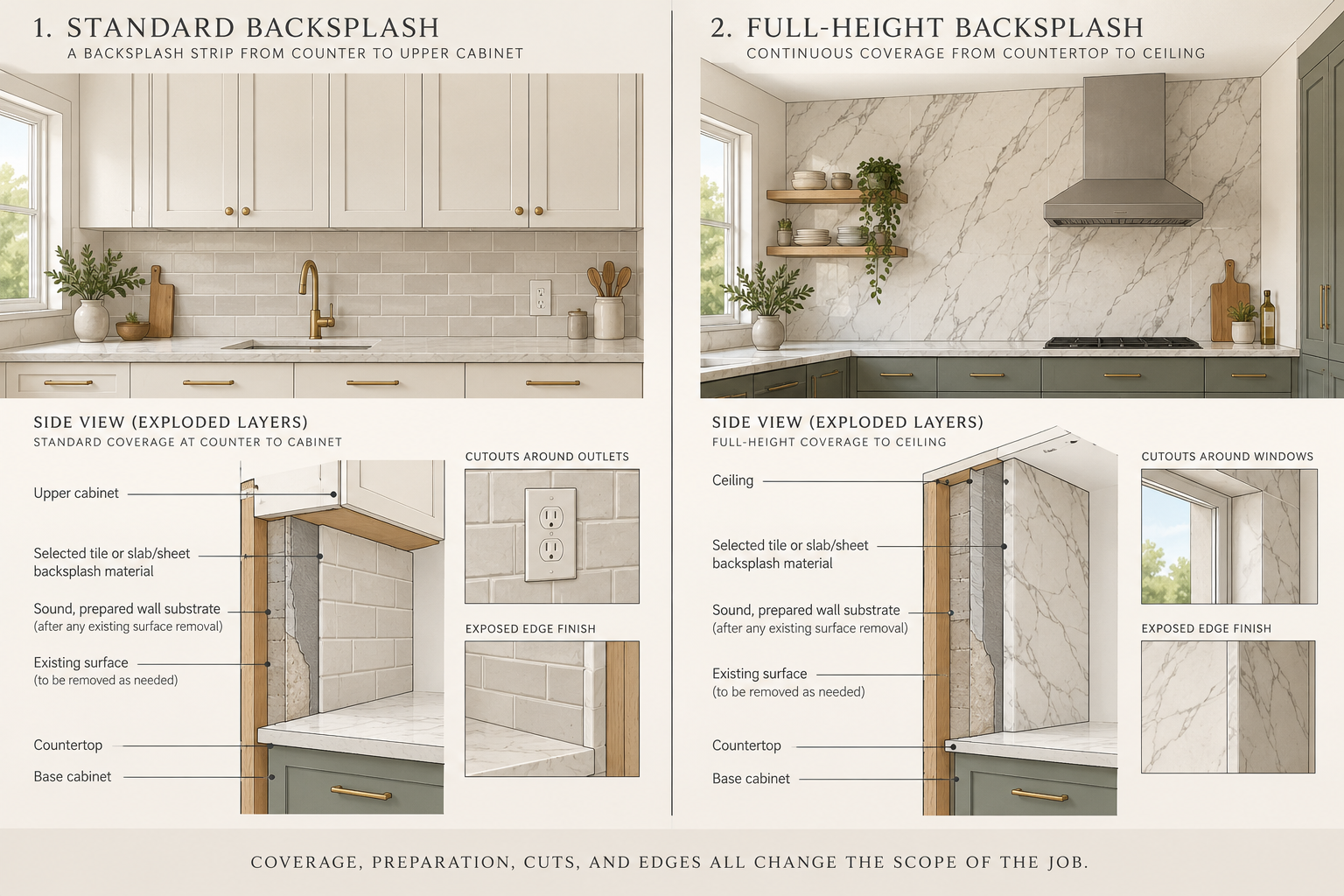
Tile and slab or sheet systems use different fabrication and installation paths. A full-height backsplash has different quantity, cut, and edge exposure from a limited counter-to-cabinet strip.
Why small projects vary
Small jobs can carry travel, setup, protection, minimum labor, and cleanup charges. Many corners, outlets, windows, patterns, mosaics, thick materials, and uneven walls add layout and cutting time. Ask for coverage dimensions and the number of penetrations rather than comparing a generic per-square-foot rate.
Wall condition and material set the work path
A backsplash installed over a sound, prepared surface is a different scope from removing old tile and repairing damaged wallboard or plaster. Ask the installer what condition the wall must meet, how it will be checked after removal, and whether repair is priced as an allowance or a separate change. If the substrate is uneven or deteriorated, the bid should say whether preparation is included and what happens if more work is needed.
Tile, a slab, and a sheet product also use different estimating details. Tile requires layout, cuts, grout joints, corners, and transitions; a slab or sheet may require a separate template, fabrication, handling, and carefully planned seams. A full-height wall changes coverage and edge exposure compared with the strip between counter and upper cabinets. Ask for the measured boundary and a drawing that shows outlets, windows, corners, and exposed edges.
Coordinate the sequence
The final countertop and cabinet elevations often determine the backsplash boundary. If the countertop is being replaced, decide whether the old backsplash is removed, whether the new counter goes in first, and who repairs the wall. A backsplash should not hide an active leak or damaged substrate.
Older surfaces and electrical work
Removing or sanding older painted material can disturb lead paint. EPA guidance addresses paid renovation work in many pre-1978 U.S. homes; Health Canada provides separate lead-paint guidance for older Canadian homes. Screen and use qualified professionals where appropriate. Outlet relocation or circuit work belongs to the electrical scope when independently meaningful.
Compare quotes
Ask for material, coverage, removal, substrate preparation, cuts, edge treatment, grout or adhesive, sealing, protection, labor, electrical exclusions, cleanup, taxes, and warranty. Canadian marketplace pricing is a local market signal, not a universal rate; U.S. and Canadian prices must be obtained separately.
Compare the complete finished area
Use the same coverage dimensions and material in each bid. Identify the surface preparation, removal and disposal, cuts, edge or trim pieces, adhesive or mortar, grout or finish treatment, sealing if specified, outlet coordination, protection, cleanup, taxes, and warranty. Ask whether the estimate assumes the old counter remains and whether the installer is responsible for gaps after a new counter changes the height or depth.
Small backsplash jobs can have a minimum charge that makes a per-square-foot comparison misleading. A complicated pattern, many penetrations, or difficult removal can dominate the area. Ask the contractor to show the base setup or mobilization cost and the variable work separately. Then compare a simple material and layout alternative if reducing cost is important; do not remove a required substrate repair or electrical coordination item merely to lower the visible material line.
Separate design upgrades from the preparation required
A straight tile layout with few edges can have a different labor profile from a mosaic, diagonal pattern, full-height run, multiple windows, or frequent outlet cuts. A slab or sheet material can require a different template and handling plan. Ask the estimator to show which pattern or edge choices change the labor or material amount and whether the estimate uses a waste factor or a minimum order.
If the quote assumes removal of the old backsplash, ask what happens if the wall beneath it needs more than routine patching. If it assumes installation over an existing surface, ask whether that method is approved for the selected product and substrate. Keep wallpaper, loose tile, active moisture, or damaged wall surfaces out of a simple finish allowance until their condition is assessed.
Compare a fixed strip with a larger coverage change
A standard counter-to-cabinet backsplash and a full-height installation may use the same material family but require different measured quantities, finished edges, cuts, outlet coordination, and prep. If the upper cabinets are changing, check their final position before choosing the backsplash boundary. If the countertop is changing, decide whether the old backsplash is removed and how the wall will be repaired before the new surface is installed.
For a material choice, ask for the actual product and pattern rather than a broad per-square-foot amount. A tile layout with many small cuts has a different labor path from a simple sheet, while a large slab has different handling and seam questions. Price those alternatives against the same coverage drawing and state whether the existing surface is included in removal.
Bottom line
Price the finished backsplash surface and the wall beneath it. Preparation, access, cuts, penetrations, coverage, and sequence explain why two material quotes can differ substantially.