
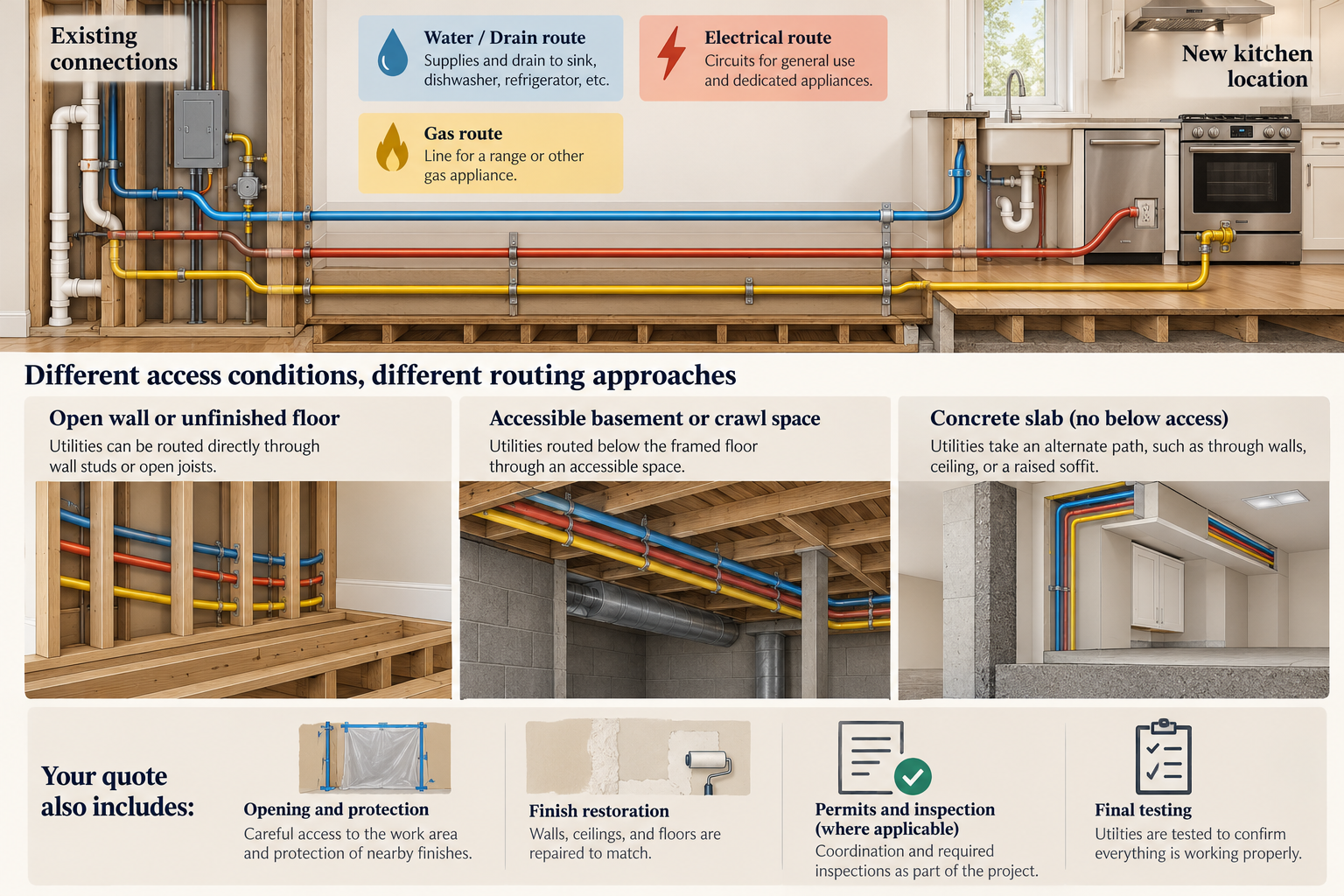
Moving a kitchen utility is priced by the route, access, existing capacity, finish restoration, professional scope, and local requirements. The distance between the old and new fixture is only one variable.
Water and drainage
Moving a sink or dishwasher can involve supply lines, a drain, venting, cabinet changes, countertop cutouts, and access through a floor, wall, basement, crawl space, or slab. The existing system, slope, structure, and local requirements determine feasibility. A plumbing quote should state what is opened and restored.
Electrical and cooking equipment
New or moved appliances may need different circuits, outlet locations, disconnects, or service capacity. A receptacle change can be a small coordination item or part of a broader wiring or panel project. NFPA material concerning island and peninsular countertop receptacles is code-development material, not a complete adopted rule; local code controls.
Gas and ventilation
Moving gas equipment requires a qualified professional and product- and jurisdiction-specific review. A new cooking location may also need a different exhaust route, exterior termination, cabinet integration, or makeup-air analysis. EPA guidance describes outdoor kitchen exhaust and possible makeup-air concerns but does not establish one universal code or installation price.
Access is the multiplier
| Access condition | Why it matters |
|---|---|
| Open wall or unfinished floor | More direct routing and less finish restoration |
| Accessible basement or crawl space | May reduce opening and patching |
| Concrete slab | Routing may involve sawcutting, trenching, or an alternate path |
| Finished ceiling or adjacent room | Protection and restoration add coordination |
| Tight or occupied site | Slows delivery, staging, and trade sequencing |
These are construction-path distinctions, not house-size permutations.
Compare the quote
Request separate lines for design, demolition, utility rough-in, equipment connection, access, permits, inspections, drywall/floor/ceiling repair, countertop and cabinet changes, and final testing. Keep independent plumbing, electrical, gas, ventilation, appliance, and capacity projects visible when they become the main intent.
U.S. and Canadian uncertainty
There is no reliable universal North American relocation price. Requirements vary by state, province, territory, municipality, adopted code, building, and equipment. U.S. and Canadian estimates should be obtained independently in their local currencies.
Local permit examples show why the full scope matters
Permit examples differ even when the visible cabinet work looks similar. They are useful prompts for questions, not a permit ruling for another city or a substitute for reviewing the complete scope with the local authority.
| Local example | Published guidance | What it means for the estimate |
|---|---|---|
| Toronto | The City lists cabinetry and millwork installation among examples that do not require a building permit; it separately lists material alterations and plumbing/heating-system work as permit triggers. | Do not treat a cabinet example as deciding the status of a wall, plumbing, electrical, or other accompanying scope. |
| Montréal | The City lists replacing cabinets, counters, and a sink among minor aesthetic work, while structural, foundation, or room changes may require review. | Separate cabinet/counter work from changes to the room and from provincial trade requirements. |
| Seattle | Cabinet installation is a usual no-permit example, while load-bearing, envelope, egress, ventilation, and fire-resistance triggers apply regardless of project size. | Confirm which work is genuinely cabinet installation and which changes another regulated feature. |
| Calgary | Structural interior changes can require a building permit; the City separately requires electrical permits for electrical installations/renovations and plumbing permits for new or altered plumbing. | A kitchen estimate with utility moves should identify the responsible trade and permit path. |
| Vancouver | Moving or installing interior walls is listed in home renovation work requiring a building permit; most construction may also need separate trade permits. | Include the building-permit process, trade submissions, and inspections where they apply. |
| New York City | Most kitchen renovations with multiple types of work require an ALT2 application; installing new cabinets is also listed as a minor alteration example. | Ask whether the combined project changes the filing route even when cabinet installation alone is minor. |
Calgary’s current fee table separately shows $205.92 for a renovation to an existing house or developed basement, and $116.50 each for homeowner electrical and plumbing permit rows. These are City fee examples, not kitchen-only totals, contractor charges, or universal eligibility amounts; the page uses $ without an ISO currency code. Keep official application and permit fees separate from installation labor, design, trade work, inspections, and any contractor’s application-coordination charge. Verify current fees and classifications for the actual project.
For every bid, ask who checks the local requirements, prepares plans or applications, applies for each permit, schedules inspections, pays municipal fees, and corrects work that fails inspection. Record those responsibilities and costs separately. A permit line in a contractor’s quote is not self-explanatory: it may cover a city fee, administrative time, consultant drawings, or more than one of these.
Bottom line
Budget utility relocation as a route-and-restoration project. Confirm feasibility and approvals before ordering cabinets, counters, appliances, or finishes, and use qualified trade professionals for the work itself.