
An installed countertop price is the cost of a surface that fits the room, not just the price of raw material. Templating, slab or sheet yield, cutouts, seams, edges, supports, removal, delivery, plumbing or appliance coordination, and installation can change the total substantially.
One U.S. replacement estimate for scale
Fixr’s 2026 U.S. guide gives a source-defined $3,000 average and $1,400–$5,250 range for standard-material countertop replacement, illustrated around 35 square feet. The guide also lists separate area, labor, removal, and edge estimates, which are not automatically additive and do not describe one uniform kitchen layout. Treat the overall range as one secondary planning signal; a complex material, additional slab, unusual access, or premium finish can fall outside its stated standard-material example.
Start with the measured surface
Ask for the measured countertop area, backsplash or side-splash boundary, sink and cooktop cutouts, edge profile, overhangs, seams, waterfall or finished ends, and any island sections. A simple square-foot calculation can miss slab minimums, waste, handling, fabrication, and small-project minimum charges.
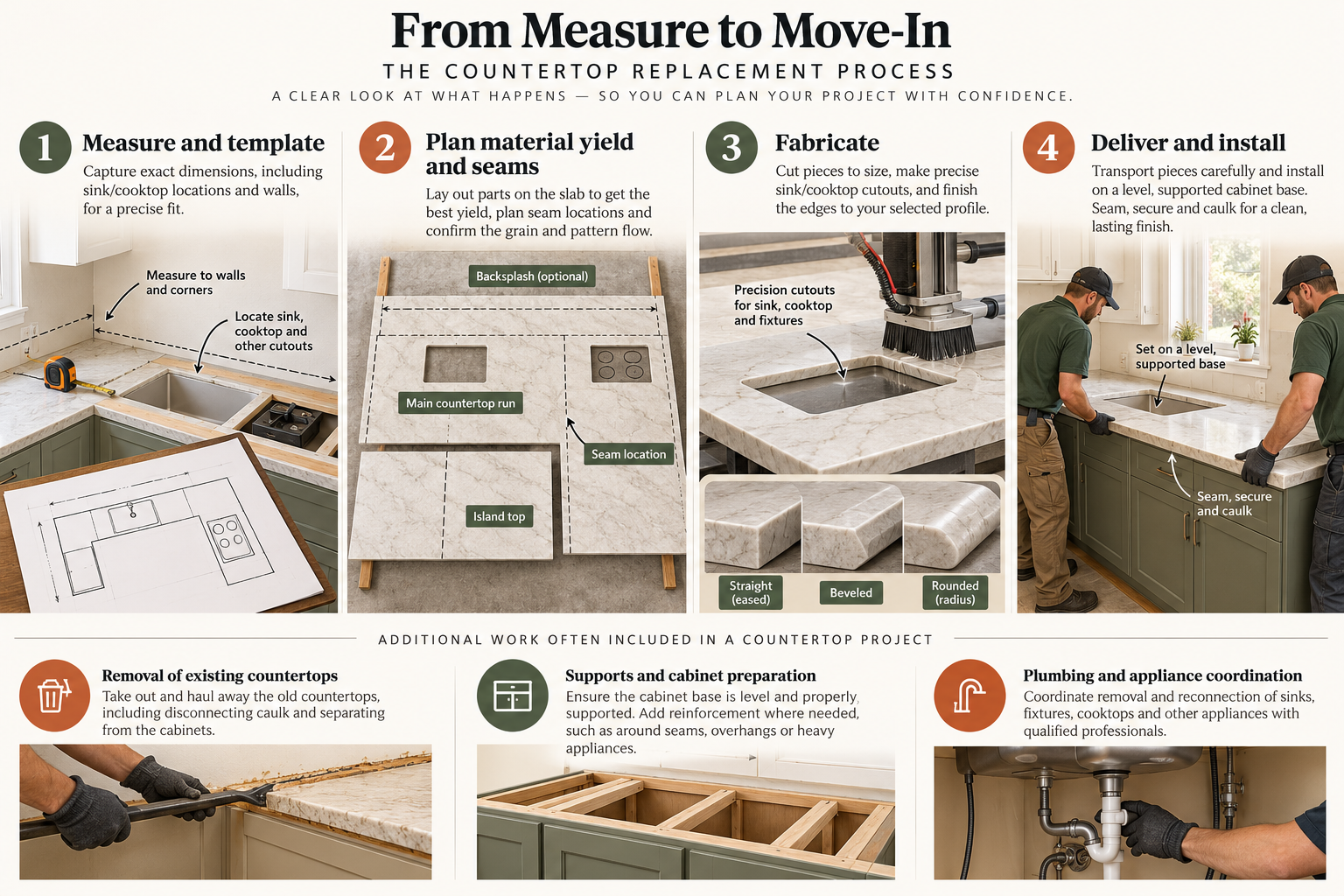
Typical quote components
- disconnecting or protecting sinks, faucets, cooktops, and appliances;
- removing and disposing of the existing countertop;
- site measurement and templating;
- material, slab or sheet quantity, waste, and delivery;
- fabrication, cutouts, seams, edges, supports, and finish work;
- cabinet inspection, leveling, shimming, or repair;
- installation, reconnecting components, backsplash interfaces, and cleanup.
Caesarstone’s fabrication guidance describes templates that account for appliances, overhangs, edges, slab quantity, seams, and supports, followed by cutting, finishing, and installation checks. That workflow is useful for understanding quote structure but is quartz- and vendor-specific. Requirements differ by material and fabricator.
Price uncertainty by market
The available research supports scope-based U.S. and Canadian comparisons rather than one normalized installed range. Canadian marketplace guides use their own material and installation definitions; U.S. costs should be sourced directly. Do not convert a U.S. number into CAD. Ask each fabricator for a local quote using identical measurements and specifications.
What raises the quote
Many seams, large or fragile slabs, complex edges, thick or laminated profiles, sink and cooktop cutouts, tight access, long delivery paths, island overhangs, supports, countertop removal, and cabinet repairs all add coordination. A small kitchen can still be expensive if it requires a full slab, difficult handling, or custom fabrication.
Existing cabinets matter
New counters need a suitable, level, adequately supported base. If the boxes are damaged or the layout will soon change, the new surface may be a short-lived investment. Read whether you can keep existing cabinets before ordering.
Read the estimate as a set of separate bases
Fixr’s 2026 guide separately lists $450–$900 for countertop installation labor and $50–$300 for removing an old counter. Those figures are not necessarily additive to its $1,400–$5,250 standard-material replacement range; a contractor’s total may include some or all of those tasks. Use the extra amounts to ask what the local quote includes, not to calculate a new total from overlapping rows.
For a small project, ask whether travel, template setup, protection, and minimum fabrication or installation charges are included. For a premium edge or additional seam, request the incremental price on the same drawing. This keeps product selection, fit requirements, and optional appearance choices visible in the budget.
Compare quotes
Give every bidder the same plan and ask for material, measured quantity, fabrication, cutouts, edge, seams, supports, removal, delivery, installation, taxes, plumbing or appliance reconnection, backsplash, and exclusions. Keep optional premium edges and waterfall ends separate from required support or fit work.
Turn the countertop plan into a comparable estimate
Give each fabricator the same current cabinet plan and list the same sink, faucet, cooktop, edge, backsplash, and overhang assumptions. Ask the estimator to identify measured area, material quantity or slab/sheet count, expected waste, seam locations, cutouts, edge treatment, support, templating, delivery, installation, and removal. If a bidder cannot confirm a quantity until after template, ask what could change it and how the change will be approved.
Separate required work from selections. A support change required for the chosen material is not the same as an optional waterfall end or premium edge. Likewise, replacing a sink or changing plumbing is a different decision from making the countertop cutout. List each option with its own amount so you can see what drives the total and what can be removed without affecting fit or performance.
For example, a small counter run with an ordinary edge may still require a full sheet or slab, while a larger straight run may use material more efficiently. A compact kitchen can therefore have a high price per measured area without implying that the fabricator is charging an unexplained premium. Ask whether the quote reflects material yield, small-job minimum, access, or fabrication complexity rather than applying a generic square-foot rate to the room.
Simple and complex projects use different cost assumptions
A straight run with accessible delivery, common cutouts, and a standard edge is a different estimate from a kitchen with a large island, multiple seams, fragile material, special supports, and tight stairs. A small surface can still require a full slab or sheet; a larger surface can also use more of each piece efficiently depending on pattern and layout. That is why measured area alone does not explain the quote.
Ask the fabricator to show the layout drawing or material plan and identify the assumption behind waste, seam placement, and any second slab or sheet. If more than one material is being considered, compare an actual product, thickness, edge, and fabrication route for each. A broad “stone versus laminate” price comparison is too coarse to include the cost of the selected finish.
Bottom line
Budget countertops from the final fabricated and installed result. Material price is one line; templating, fabrication, site conditions, removal, and coordination determine whether two apparently similar quotes are actually comparable.