
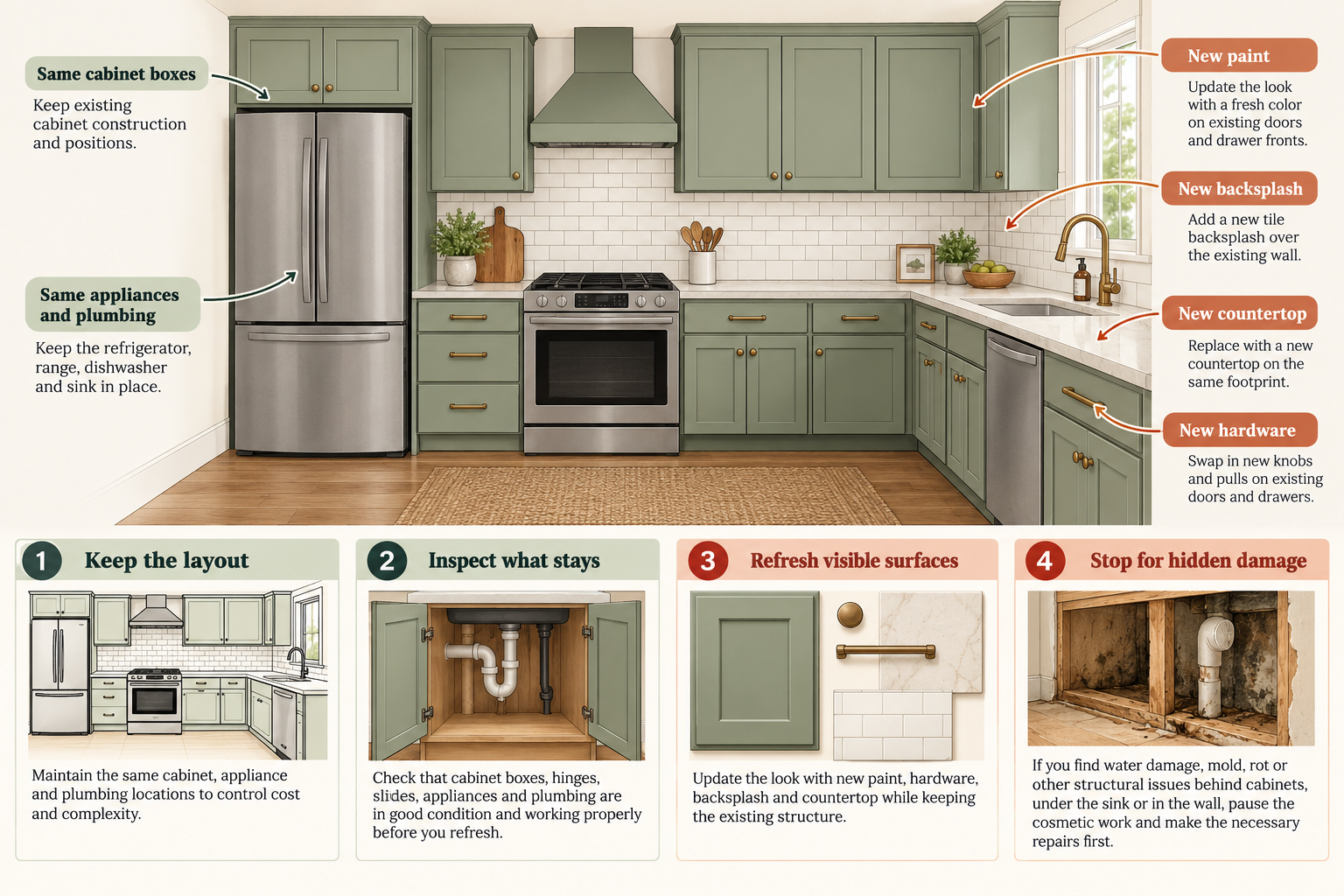
A cosmetic refresh keeps the kitchen’s basic arrangement working while changing selected visible elements. It may include cabinet painting or refinishing, new hardware, backsplash, paint, selected lighting, or a countertop replacement. It becomes a partial remodel when the scope starts replacing major systems or redesigning the room.
What a refresh usually retains
The cost advantage comes from keeping work in place:
- cabinet boxes and most cabinet openings;
- sink, dishwasher, range, and refrigerator locations;
- plumbing, electrical, and ventilation routes where they remain suitable;
- flooring and wall surfaces that are sound;
- the room footprint and circulation pattern.
Retaining these items does not make them automatically suitable. A quote should state which components were inspected and which are simply assumed to remain.
Common refresh packages
| Package | What it changes | Main uncertainty |
|---|---|---|
| Finish refresh | Paint, hardware, selected fixtures, and minor repairs | Preparation and condition |
| Cabinet finish package | Paint, refinishing, or limited refacing | Substrate, existing coating, and box condition |
| Surface refresh | Backsplash, paint, and sometimes countertops | Removal, wall preparation, cutouts, and matching |
| Coordinated refresh | Several of the above during one mobilization | Whether the project still has a coherent retained layout |
The 2026 Houzz study reported a $20,000 median for its source-defined minor U.S. kitchen projects. That is useful scale context, not a standard price for a cosmetic refresh. Canadian costs must be quoted directly in CAD; do not convert the U.S. figure.
For one component rather than a whole refresh, Fixr’s 2026 U.S. guide places cabinet refacing at a source-defined $8,250 average and $3,000–$13,500 range. Its kitchen-size examples and linear-foot prices use separate bases, and the guide does not define one standard cabinet count for the overall range. Treat it as a refacing estimate, not the price of the paint, counter, backsplash, and lighting package described here. It cannot be combined directly with Home Depot Canada’s provider-specific estimate because market, method, and scope differ.
Where the budget goes
Preparation often controls finish economics. Cabinet doors and drawers may need removal, cleaning, surface preparation, repairs, priming, and a finish applied on site or elsewhere. Backsplash work may require removal and substrate repair before any new tile or sheet is installed. A countertop can add templating, cutouts, seams, edge work, and plumbing or appliance coordination.
Small areas also face minimum charges. A limited backsplash, a few cabinet doors, or one lighting change may not receive a proportional per-unit price because setup, protection, travel, and cleanup still occur.
When a refresh is false economy
Pause before covering or refinishing when:
- cabinet boxes are swollen, loose, delaminated, or repeatedly wet;
- the sink-base area has an active leak or concealed moisture damage;
- the layout prevents the function you need;
- countertop support, levelness, or substrate condition is uncertain;
- new finishes would hide a problem that still requires access;
- several separate changes would require opening the same walls or floors later.
Repair the water source and assess the affected assembly before paying for cosmetic restoration. Broader water damage, hazardous materials, or structural deterioration may require a different scope.
Older homes and surface disturbance
In the United States, EPA guidance says pre-1978 homes are more likely to contain lead-based paint and recommends lead-safe certified contractors for paid renovation, repair, and painting that can disturb painted surfaces. Health Canada warns that older Canadian homes may contain lead paint and that major renovation or demolition can expose asbestos-containing materials. These are screening and professional-referral issues, not DIY preparation instructions; local rules still control.
Build a comparable refresh estimate
Start with a room list rather than a shopping list. For every proposed change, write down what remains underneath it, what must be removed first, who prepares the surface, and who restores adjacent finishes. This exposes the difference between a finish allowance and a complete installed scope.
| Proposed work | Retained condition to verify | Quote detail that is easy to miss |
|---|---|---|
| Cabinet finish | Stable boxes, doors, and existing coating | Door removal, cleaning, repairs, masking, finish coats, reinstall, and adjustment |
| New backsplash | Sound wall and known counter elevation | Existing tile removal, substrate repair, outlet cuts, edge finish, grout, and cleanup |
| Countertop | Level, supported cabinets and usable layout | Template, cutouts, seams, support, old-counter removal, and sink reconnection |
| Lighting update | Existing circuit and fixture locations suit the plan | New wiring or controls, cabinet access, patching, and paint |
The smallest-looking line can control the schedule. For example, a homeowner may plan to paint cabinets and replace the backsplash while keeping the counter. If the counter is likely to be replaced soon, the backsplash edge may need to be cut or removed a second time. If the cabinet coating needs substantial preparation, the doors may need to leave the home while the kitchen is unusable. Ask each bidder to identify the sequence and any temporary protection or access assumptions.
Use a stop point before cosmetic work
Before ordering finish materials, inspect the areas that the work will cover or make harder to reach: sink-base panels, appliance-side edges, countertop seams, loose hinges, wall substrate, and floor transitions. A visual inspection is not a guarantee against hidden damage, but it can identify a reason to pause. If a contractor discovers a defect, ask for its location, extent, repair, and price as a separate written change before the finish continues.
This is also the point to decide whether the desired result is truly cosmetic. Replacing several cabinet boxes, changing storage geometry, relocating a fixture, or opening walls can make a partial remodel easier to price and sequence than labeling a growing list of exceptions a refresh. Keep the comparison anchored to the same room result: what will look and function differently, what remains, and what is expressly excluded.
Resolve scope gaps before choosing the low number
If one proposal is materially lower, compare the preparation and retained-condition assumptions before negotiating the total. A cabinet painter may price only doors and frames, while another includes exposed ends, toe kicks, repairs, and hardware removal. A tile estimate may start with a bare, prepared wall while another includes taking off the old backsplash. The lower amount can be correct for its stated scope and still fail to produce the same room result.
Ask both bidders to identify each allowance, exclusion, and possible change-order trigger. A refresh estimate should make clear whether protection, contents removal, cleanup, delivery, tax, and return visits are included. Where the scope remains uncertain, request an inspection or a separately priced repair option rather than folding an unknown condition into a broad contingency.
Refresh, partial remodel, or gut remodel?
Choose a refresh when the layout and underlying assemblies work and the desired result is mainly visible improvement. Consider a partial remodel when cabinets, countertops, or several coordinated finishes need replacement but the room can retain its footprint and major utility locations. A gut remodel is more coherent when most visible work must be removed, hidden conditions are likely, or the layout and infrastructure need a coordinated rebuild.
Ask for a quote that lists retained items, preparation, finish system, removal, protection, and exclusions. That makes the lower-disruption option comparable with the cost of expanding the project later.