
A pressure complaint is a diagnosis problem before it is a regulator-replacement problem. High pressure can damage fixtures and equipment; low pressure can result from a regulator, a restriction, a closed or failing valve, building-side piping, a supply condition, or a private-well system. Replacing the pressure-reducing valve without confirming the cause can leave the symptom unchanged.
Useful pressure context
WaterSense gives 45–60 psi as a recommended incoming range in which fixtures operate best and advises confirming that supplied pressure does not exceed 80 psi, because higher pressure may damage plumbing, fixtures, and appliances. The recommendation is not a universal code statement. Local requirements and the actual system configuration control the repair.
WaterSense describes a pressure check using a gauge at a hose bibb with fixtures off. That is a screening observation, not a complete diagnosis. Pressure can vary over time and at different points in the house. A professional may test static and flowing pressure, inspect the regulator and shutoffs, and distinguish municipal supply from a house-side restriction.

What replacement may include
A regulator project can include diagnosis, isolation, removal of the existing valve, a compatible replacement, fittings, pressure adjustment, testing, access, cleanup, and sometimes a new or repaired main shutoff. If the regulator is in a meter area or a location controlled by the utility, coordination can be a major part of the schedule and cost.
HomeStars reports an illustrative Canadian PRV replacement range of about $325–$455. That is a specialist market observation, not a national price or a statement that every replacement has the same scope. Available market research does not establish a comparable US range. Compare the diagnostic and installation assumptions rather than copying the amount into a different region.
Why price varies
- Access and isolation: a reachable basement valve is different from a buried, cramped, corroded, or meter-adjacent assembly.
- Related valve condition: a seized main shutoff can make isolation difficult and may need replacement.
- Pipe material and transitions: old or mixed piping may require additional fittings and careful compatibility review.
- Pressure-control configuration: bypasses, check valves, backflow devices, and thermal-expansion conditions can affect the final scope.
- Testing: the quote should include proof that pressure is stable after the work, not just installation of a new body.
High-pressure and low-pressure paths
With high pressure, ask whether the regulator is stuck, misadjusted, absent, or affected by another control. Expansion conditions may also be relevant around water heating; do not treat an expansion tank as an automatic answer without local and system-specific verification.
With low pressure, test whether the problem is whole-house or limited to one fixture. A dirty aerator, local shutoff, branch restriction, failed regulator, old piping, municipal supply issue, or private-well system leads to different work. A booster pump is a separate equipment decision and should not be approved merely because a regulator quote is available.
Scenario comparison
Straight replacement: pressure is measured, the regulator is confirmed as the fault, isolation is easy, and the existing pipe connections are serviceable. This is the most predictable case.
Replacement with shutoff/access work: the regulator cannot be isolated or is buried behind a panel. Price the valve, opening, protection, testing, and finish separately.
Wrong diagnosis: pressure is low at one fixture or during peak demand while the regulator works normally. A repipe, branch repair, supply investigation, or private-well evaluation may be more relevant than a new regulator.
Quote questions
- What pressure was measured, where, and under what flow conditions?
- Is the regulator confirmed as the cause or only a possibility?
- Is the main shutoff functional and included if it is not?
- Who controls the meter-side or service-side equipment?
- Does the price include fittings, adjustment, testing, access, cleanup, and restoration?
- Could a booster pump, repipe, or well-system investigation be the better path?
- Are expansion, backflow, or code questions being verified locally rather than assumed?
Pressure work rewards diagnosis. The right budget pays for a stable system and an identified cause, not just for a valve that looks like the component most likely to blame.
Distinguish static and flowing complaints
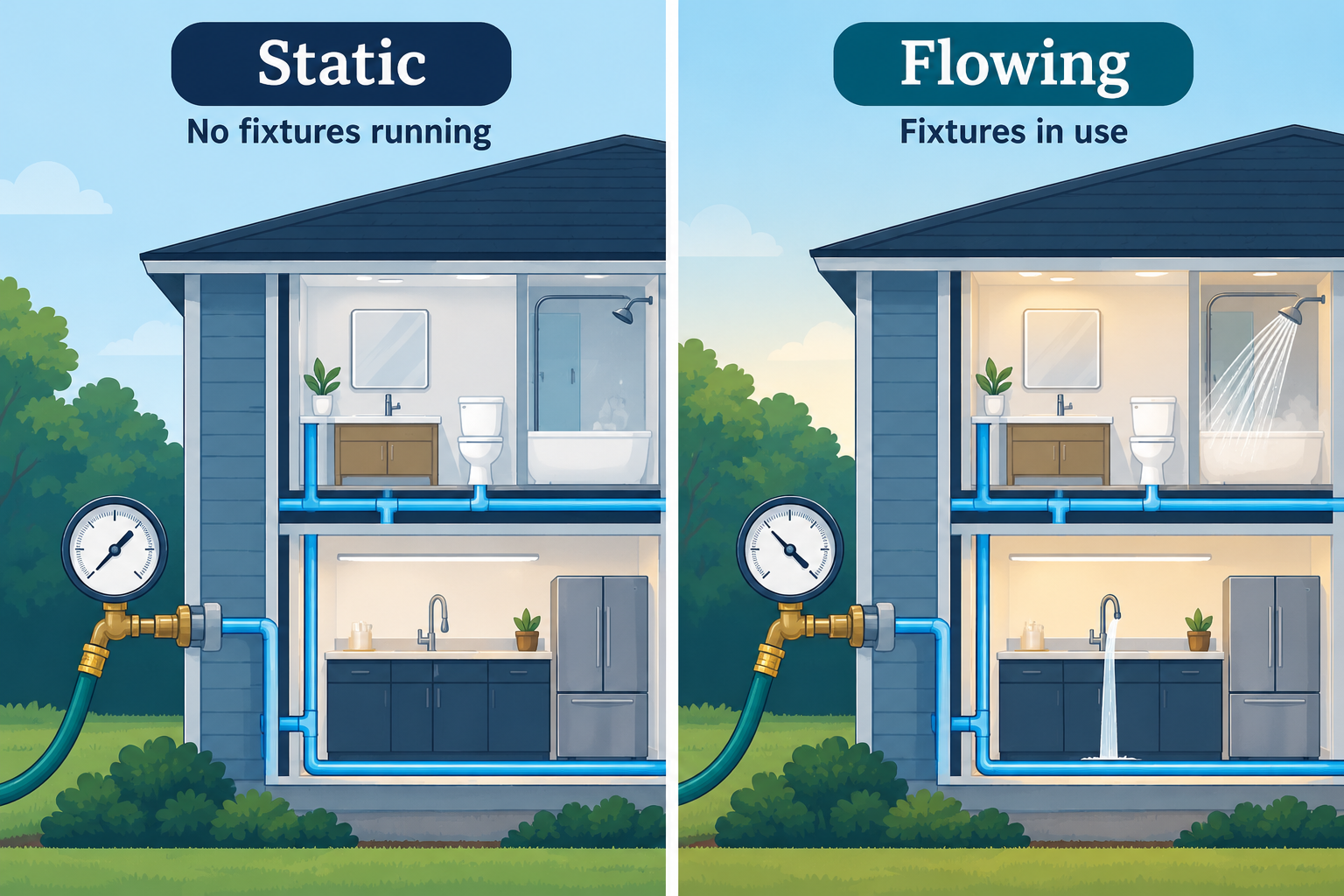
A home can show acceptable pressure when no fixture is running and poor flow when several fixtures operate. That pattern may point to capacity, restriction, piping, or equipment rather than a regulator alone. One weak faucet can have a local aerator, stop, cartridge, or branch problem. Ask for measurements that match the homeowner’s complaint instead of relying on a single gauge reading.
Pressure can also be too high in one condition and too low in another. A quote should explain whether the regulator is missing, stuck, misadjusted, leaking, or being affected by a restriction or expansion condition. Changing the setpoint without understanding the system can create a different problem. Technical and code-sensitive adjustments belong to qualified service.
Compare the finished correction
For budgeting, separate diagnosis, regulator, fittings, main shutoff, access, testing, and finish repair. A basement assembly may be a straightforward replacement; a meter-adjacent or concealed assembly may require utility coordination or an opening. Ask whether the contractor guarantees a pressure result or only replacement of the valve. The distinction matters if the supply itself is inadequate.
If a booster pump is proposed after a regulator replacement, request the measured reason for adding equipment and the expected maintenance and power cost. A repipe may be a better long-term correction when restriction is widespread. The cheapest component is not necessarily the cheapest pressure solution.
Ask for measurements that match the complaint
Pressure work is easier to compare when the contractor records where and when the measurement was taken. Static pressure with no fixtures running can differ from flowing pressure during a shower, toilet fill, or simultaneous use. A whole-house complaint, a single weak faucet, and a pressure spike after a valve closes are different investigations. Ask which condition the proposed replacement is intended to correct.
The homeowner does not need to turn a pressure gauge into a diagnosis. The useful question is whether the measurements support a regulator problem, a local restriction, a supply limitation, or a broader piping issue. If the proposal changes a pressure setting, ask what result is expected and what safety or code checks remain with the qualified installer.
Keep related components visible
A regulator quote may interact with the main shutoff, check or backflow device, thermal-expansion control, water heater, or private-well boundary. These relationships can be legitimate, but each should be named. An expansion tank does not correct excessive supply pressure; a booster pump does not repair a blocked branch; replacing a regulator does not prove that old piping can deliver the desired flow.
Request separate lines for diagnosis, regulator, fittings, isolation, access, testing, and any related component. This allows the homeowner to approve the confirmed correction while holding optional or unresolved work for a second decision. It also prevents two bids from looking different only because one hides the same adjacent scope in a general allowance.
Choose the correction by ownership horizon
For a home with one short-term pressure symptom and sound accessible piping, a focused repair may be the best value. For repeated pressure failures, deteriorated piping, or a planned finish opening, a broader correction may reduce repeated access. For a private-well property, the source system may own the diagnosis and the costs. For a sale or rental, record the measured condition and completed test rather than promising a universal pressure result.
The finished project should state what was measured after the repair, under what use conditions, and what remains outside the scope. A valve replacement with no post-work observation may be a completed invoice but not a completed pressure decision.
Distinguish regulator work from adjacent pressure work
A regulator can influence whole-house pressure, but it does not automatically correct a weak fixture, a blocked branch, a failing well system, or a damaged service line. Ask the contractor to identify the upstream and downstream measurement points, the condition of the main shutoff, and the components that may affect the reading. If a backflow or check device, expansion tank, booster, or water heater is involved, name it separately.
The quote should explain whether the existing body can be serviced, whether a bypass or temporary isolation is needed, and whether the replacement changes the connection size or access. If the regulator is buried in a finished area, include the opening and restoration plan. If it is in a meter or shared area, confirm who has authority to modify it.
At handoff, retain the model, setting, pressure observations, test conditions, and service access. Tell future technicians what was measured and what was not. This keeps a pressure adjustment from becoming an unsupported guarantee about every fixture, appliance, or future plumbing condition.
Compare the setting with household needs
Ask which fixtures and appliances were considered, whether simultaneous use was part of the test, and what condition would indicate a local restriction instead of a central regulator problem. A new regulator should be selected and adjusted for the actual installation by a qualified professional. The homeowner’s useful role is to preserve the baseline and verify that the completed observation matches the complaint.
If the replacement requires a main shutdown, access opening, meter-area coordination, or related expansion control, include those costs and responsibilities. At completion, label the valve and retain a photo before concealment. A documented pressure decision is easier to service than an unexplained component change.