
Lead service-line work should begin with responsibility and health guidance, not with a generic replacement price. A service line can cross property and utility boundaries, and the owner, municipality, utility, association, or another party may control or fund different segments. The relevant rule and program depend on the location and system. Confirm the property-specific process before authorizing excavation or partial work.
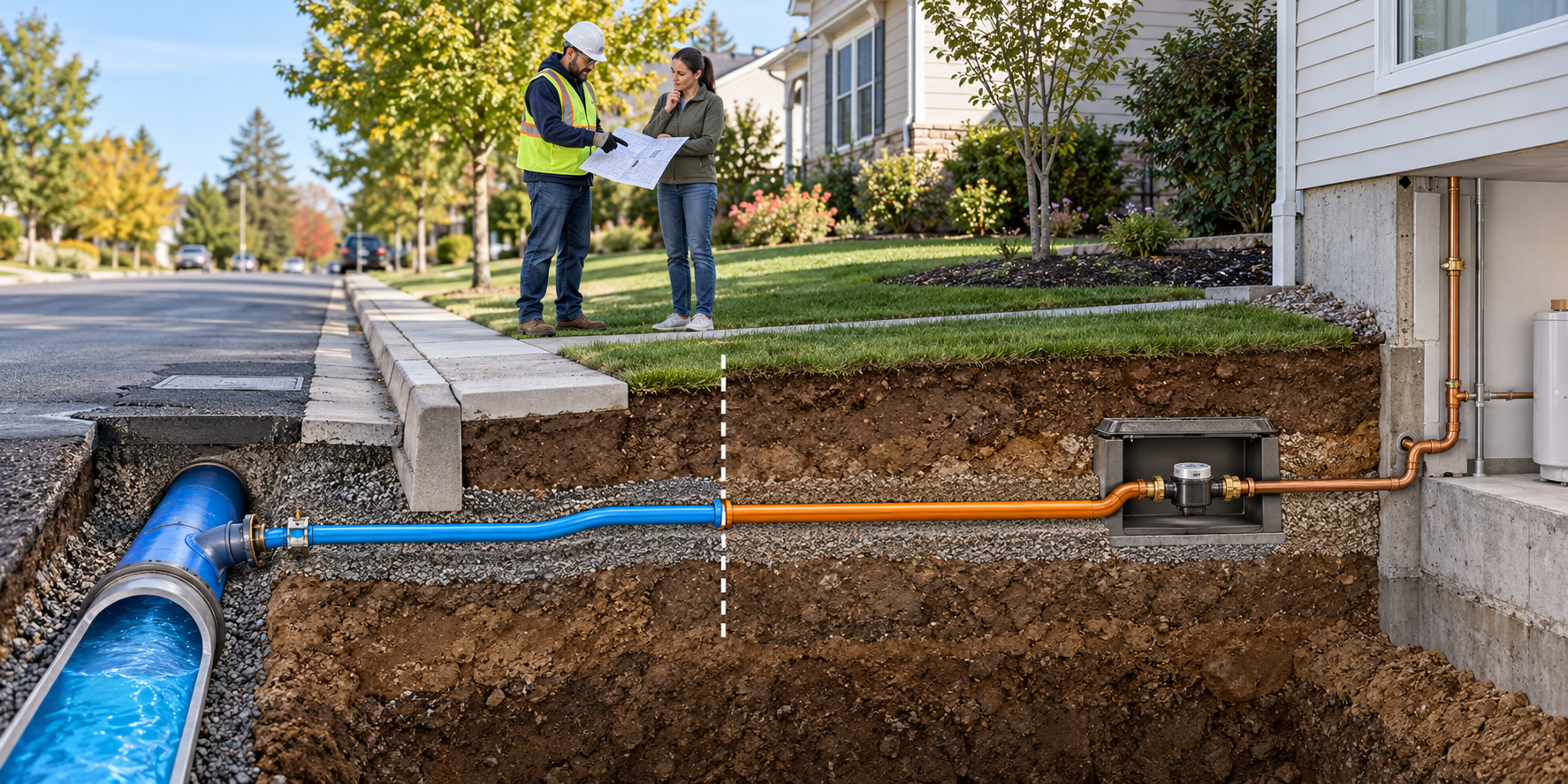
Define the line being discussed
This article concerns the service line that carries potable water between the public system and the home, including the homeowner-side portion where applicable. It is not a municipal water-main project, a general interior repipe, or a broad lead-hazard abatement project. Lead can also enter drinking water through solder, faucets, valves, or other premise plumbing, so replacing one segment does not automatically answer every water-quality question.
EPA and Health Canada both describe responsibility as dependent on the segment and local arrangements. Ask the water utility or municipality how the line is inventoried, who may inspect it, who must approve work, and which costs or programs apply. In a condo or shared property, the association’s documents and local rules may control access and allocation.
Full versus partial replacement
Health Canada identifies full replacement of lead service lines and interior lead plumbing as the most effective permanent approach in its guidance, while warning that partial replacement can leave exposure and disturb lead-bearing material. EPA program guidance also addresses the limitations and requirements around partial replacement in its applicable US context. These are authoritative health and program considerations, not a universal funding or construction rule for every property.
Do not accept a contractor’s statement that partial replacement is always adequate or always forbidden without checking the current local program and utility requirements. Ask whether the proposed scope reaches the public-side segment, what happens to any remaining lead material, how disturbed sections are handled, and what post-work information is provided.
U.S. system timelines and property access
For U.S. water systems subject to the Lead and Copper Rule Improvements, EPA describes a general requirement to fully replace lead and galvanized-requiring-replacement service lines under system control within 10 years, with limited exceptions. Mandatory programs must start no later than November 1, 2027; the cumulative replacement rate is first assessed at the end of program year three, December 31, 2030. A line counts as fully replaced only when its full length, including both customer-side and system-side portions, is non-lead. These are water-system requirements, not a deadline for every homeowner to pay for or replace a private segment.
Under that U.S. rule, a galvanized-requiring-replacement (GRR) line is a service line with a specified present or past relationship to a lead line or unresolved lead history. It is a service-line classification, not a label for every galvanized pipe inside an older home. The utility’s inventory and local records determine whether a particular service line falls into that category.
EPA’s August 2026 access tips explain that system access can depend on consent, state or local law, water-tariff terms, cost-sharing arrangements, and safe physical access. Where owner consent is required, the guide describes four attempts using at least two communication methods as the reasonable-effort standard. The tips are explanatory, and actual access, timing, control, and payment still depend on the applicable rule and local facts. Neither the federal timeline nor the access guide establishes a Canadian requirement or a universal homeowner payment duty.
A U.S. resident can ask the water system whether the address is in its inventory, how the material was identified, whether a program covers the line, what its schedule is, and what written consent or access steps are required. Ask who coordinates customer-side work and restoration and whether the program includes both line segments. An estimated completion date must be confirmed for the property; the system-wide federal deadline is not an appointment for a specific home.
What creates cost
The physical project may include identification and testing, utility coordination, excavation or other access, removal and replacement, connection at the building, traffic or landscape protection, surface restoration, inspection, and temporary water arrangements. A buried line under a driveway or mature landscaping can carry a different access cost from a short exposed run. A line entering through a foundation or finished area may add interior opening and repair. EPA’s U.S. homeowner guide gives a general $15–$100 estimate for a drinking-water lead test; ask a certified local laboratory or utility for the actual price and sample instructions.
Available market research does not establish a reliable US or Canadian national price. A local estimate can change with excavation length, street or driveway access, traffic protection, the building entry, and restoration of landscaping or interior finishes. Ask the bidder to tie each cost to a mapped segment and identify any local permit or inspection assumption. Compare any program contribution separately with the full project price in the net-cost analysis below.
A cautious health boundary
Lead in drinking water is a high-consequence topic. Testing is the way to confirm lead in water; smell or taste cannot establish whether it is present. A non-lead service line also does not rule out lead from interior piping, solder, faucets, or valves. Use a certified laboratory and its current sample instructions rather than treating an online checklist or product label as a household test result.
For U.S. households, EPA’s 2026 consumer pamphlet advises using cold water for drinking, cooking, and infant formula and says boiling does not remove lead. It also says to follow a filter maker’s cartridge instructions. For a lead-reduction filter, verify the exact model and claim in the relevant product listing; NSF’s U.S. listing identifies lead-reduction products under NSF/ANSI 53 and reverse-osmosis products under NSF/ANSI 58. Health Canada’s filter guidance advises Canadian consumers to check for an accredited certification mark and a lead-reduction claim, and says provincial or territorial requirements may differ. Certification and filter maintenance do not prove that the home’s water is lead-free or replace local testing and post-work instructions. A product marketed as “lead-free” also does not prove that existing pipes or water contain no lead. Follow the relevant utility and public-health direction for the property; this article does not prescribe sampling, plumbing disturbance, or a universal flushing schedule.
Low, expected, and difficult project cases
Coordinated straightforward replacement: The line is identified, responsibility is clear, access is open, and a utility or municipal program coordinates the work. The quote should still identify restoration and any homeowner-side connection.
Split-responsibility project: The public and private segments require separate approvals, contractors, or schedules. Compare the total sequence, not just the homeowner-side invoice. Ask who owns testing, restoration, and final connection.
Uncertain or shared-property case: The line material is unknown, the property is attached, or an association and utility both have claims over the work. Spend first on documentation and responsibility confirmation. Excavation before authority is clear can create avoidable cost and dispute.
Questions for the utility and contractor
- What material evidence and route endpoints support the proposed work?
- Which utility or property approvals and access steps must happen before scheduling?
- What segments and restoration are included, and what remains outside the price?
- Which party pays each charge, when is confirmed assistance applied, and who handles testing or inspection?
- What current local health guidance and post-work record will the household receive?
The key economic decision is not “What does a service-line replacement cost?” in isolation. It is “What complete, locally authorized scope protects the household, satisfies the applicable program, and identifies my share of the work?” That answer cannot be generalized safely across the US and Canada.
Build a responsibility map
Before comparing bids, write down the route from the public main to the home: public main, service connection, public-side segment, property-side segment, building entry, and interior plumbing. Ask the water utility or municipality how it identifies the line, which party controls each portion, who may authorize work, and what current program covers. A condo, shared lot, easement, private road, or rental can add approval and access questions.
Keep the map tied to the property rather than assuming a curb, meter, or property-line boundary. If material is unknown, ask whether the utility offers identification or testing and what evidence it accepts. A homeowner-side bid may depend on public-side work happening first, while a full replacement proposal may include coordination the other quote omits. Mark that difference before comparing totals.
Net cost is not the same as contractor price
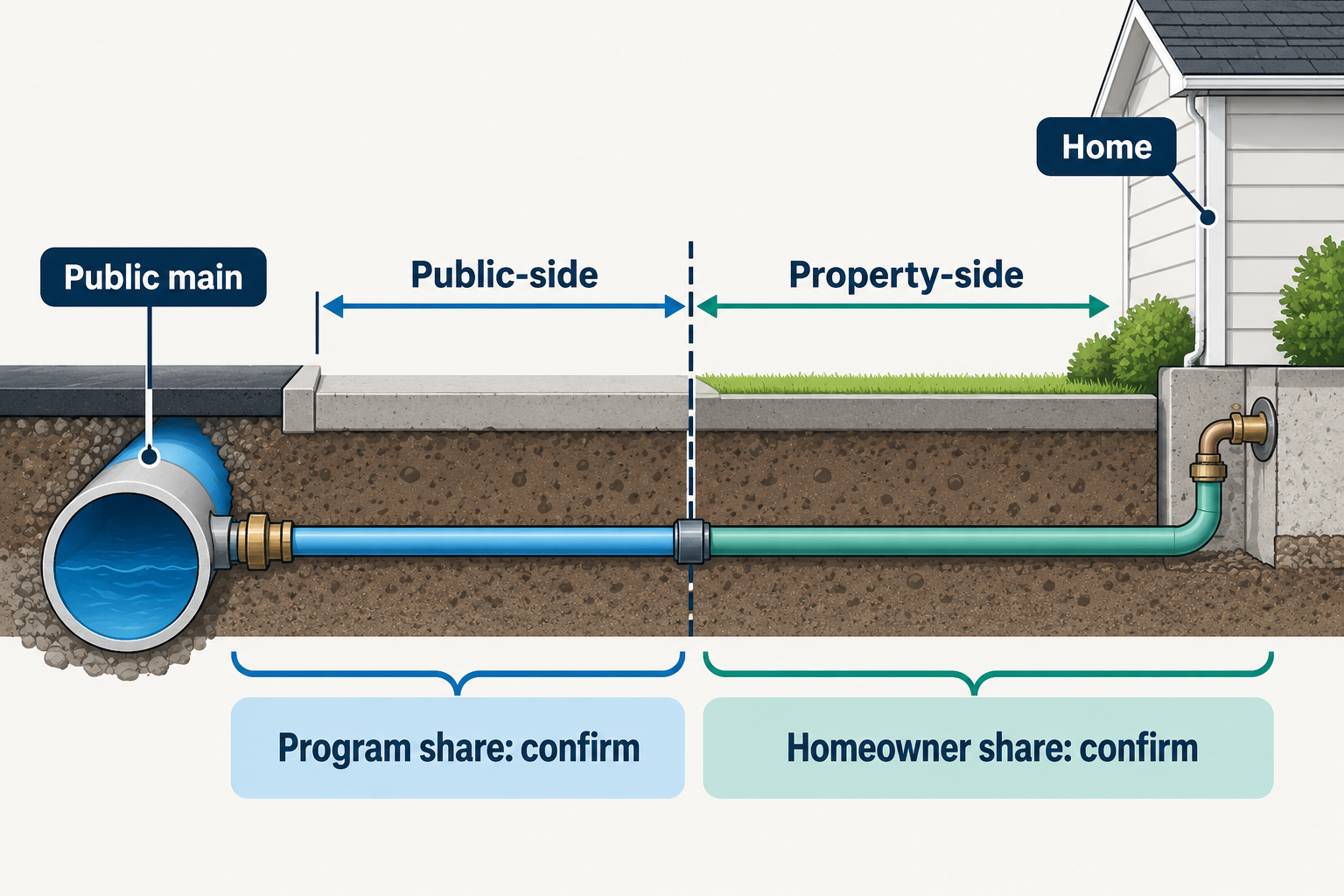
The household’s exposure may include identification or testing, interim measures recommended by a public-health authority, utility coordination, excavation, replacement, inspection, and restoration. A utility or grant contribution may cover only a defined segment or approved scope. Put the contractor invoice, expected contribution, payment timing, and any amount the homeowner must pay first on separate lines; do not call a program contribution guaranteed until the administrator confirms eligibility and funding.
Ask who restores sidewalks, driveways, landscaping, walls, and other disturbed areas. Confirm whether the quote is before or after assistance and whether the utility or homeowner pays for the public-side connection. Ask whether the program pays the contractor directly or reimburses the owner, what documents and milestones trigger payment, and whether the homeowner must pay the full amount first. Keep a confirmed contribution, an expected contribution, and an unresolved application in separate columns; they do not create the same cash-flow obligation.
There is no reliable national price in the available evidence, and no current U.S. or Canadian rule assigns every property the same share. A clear net-cost estimate lists the contractor total, each party’s confirmed responsibility, assistance conditions, payment timing, and any separate interim measure. That makes a local proposal possible to compare without assuming every subsidy covers both sides of the line.
Local programs show why the contribution must be confirmed address by address. Milwaukee Water Works’ 2026 owner-request pathway selects up to 200 properties per year and is limited to owners of one- to four-unit residential properties with no commercial use. For a selected property, the owner pays the lower of the actual private-side cost or the program’s stated five-year average of $3,454; the utility pays for the public-side replacement. Philadelphia Water Department’s 2026 pilot offers free replacement to selected eligible properties in listed ZIP-code phases, but a ZIP code alone does not establish selection or eligibility. These are local, capacity-limited examples. EPA’s FY2026 Drinking Water State Revolving Fund announcement describes nearly $2.9 billion in funding distributed to states for water-system work, not a direct homeowner grant or a guaranteed property contribution.
Record the endpoints and follow-up after work
At handoff, request the completed segment, material, connection points, test or inspection records, restoration responsibility, and any follow-up instructions from the utility or public-health authority. Keep the record with the line map and state which lead-bearing sections remain, if any. A clear record helps the next owner, utility, and contractor understand what changed and where a future question should go.