
A booster pump is an equipment solution for a genuinely inadequate building-side supply, not a shortcut for every low-pressure complaint. Before installation, confirm whether the cause is a failed regulator, closed valve, clogged component, undersized or deteriorated piping, a municipal supply condition, or a private-well system. The last case belongs with the source-water system rather than an interior plumbing booster article.
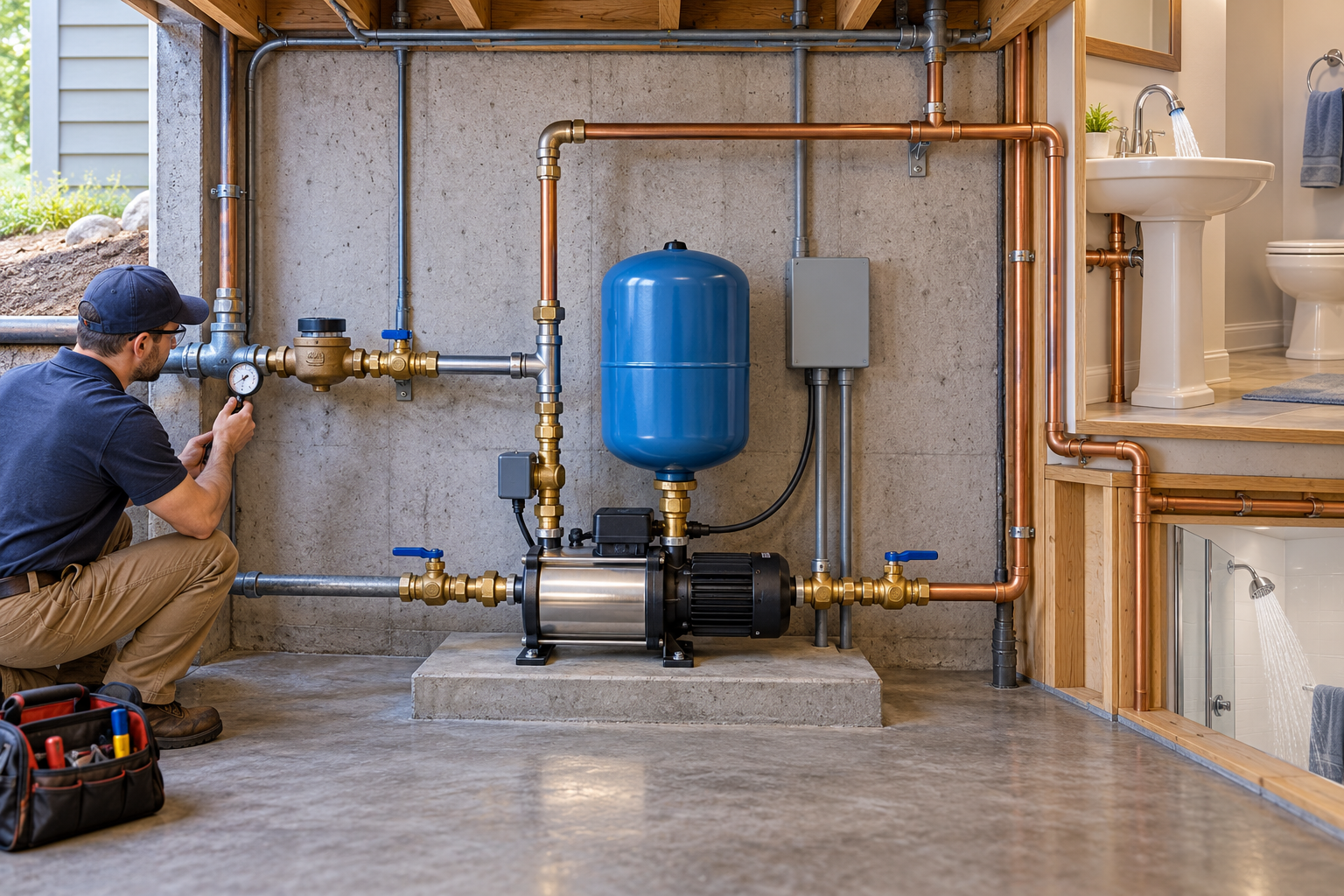
What a booster project can contain
Depending on the design, a quote may include the pump, controls, pressure tank or accumulator, isolation valves, bypass, sensors, plumbing changes, electrical connection, mounting, noise treatment, commissioning, and service instructions. Ask bidders to separate the pump and controls from site work and from any electrical scope. That makes it clear whether a lower equipment price depends on an existing circuit, usable space, or a plumbing change priced elsewhere.
The system must be selected for the home’s demand and incoming supply, but the evidence does not establish a universal pump model or capacity. WaterSense recommends incoming pressure in a stated range and provides screening guidance; it does not say when a booster is appropriate or how to size one. IAPMO’s efficient-fixture demand study estimates fixture-group demand from historical measured flows, but it does not diagnose a pressure complaint or select a pump. A professional should measure pressure and flow and explain the intended delivery condition before proposing equipment.
Why cost is uncertain
Available market research does not provide a reliable installed-cost range. Cost depends on equipment size, location, plumbing alterations, controls, electrical prerequisites, noise constraints, access, and whether a tank or additional protection is required. An indoor utility-room installation with a nearby circuit is materially different from a pump in a cramped or remote mechanical space. The diagnostic visit and the installation are separate cost decisions: ask whether testing is credited toward the work, what measurements it includes, and whether a written result is provided even if no pump is recommended.
Request a site-specific proposal rather than a pump-only number. Have it separate pump and controls, any pressure tank or accumulator, isolation and bypass work, electrical supply, mounting, noise treatment, permits where applicable, and commissioning. Mark work that depends on a confirmed circuit, pipe size, or source condition as an allowance and ask how it will be approved. If a new circuit or panel work is independently required, coordinate that scope with an electrician. A low equipment price is not comparable with a tested, installed system when one quote excludes these prerequisites.
Scenarios
Correction without a pump: Testing finds a defective regulator, closed valve, clogged component, or other restriction. Price the diagnosis, correction, and retest as a separate path. It avoids adding a powered system but does not address a confirmed low-pressure supply condition that remains after the restriction is removed.
Straight building-side installation: The incoming condition is stable, a booster is appropriate for the measured need, the equipment can sit near the service entry, and water and electrical connections are available. The quote still needs the pump and controls, valves, mounting, connection work, start-up, and a pressure/flow check. A nearby circuit or accessible plumbing may make the route simpler, but must be verified for the selected equipment.
More involved installation: The location is remote or confined, a pressure tank or bypass is part of the design, new electrical work is required, or noise and vibration need attention. Those are distinct cost lines, not a generic pump adder. Ask how the system will behave during a power failure and what maintenance or service access the arrangement requires.
Private well or shared source: Do not use an interior-booster quote to price a source-water problem. The well, storage, controls, or shared system may own the diagnosis and installation; a building-side pump cannot compensate for an inadequate source.
Location, noise, and access
A pump location affects plumbing route, electrical work, vibration, sound, and future service. A unit placed beside the incoming line may need less re-routing than one placed in a remote closet, but the actual system layout determines that choice. Ask how the equipment will be mounted, whether vibration can transmit through a wall or floor, and whether a technician can reach the controls and isolation points without removing stored items or finishes. If the proposed location is near a bedroom or occupied workspace, discuss operating sound and service access before the room is closed up.
These are site questions, not a universal placement rule. Include any new circuit, supporting base, sound treatment, rerouted pipe, or access opening as its own priced item so the owner can see how the location changes the installed total. State whether the equipment warranty covers parts, labor, or a return visit.
Alternatives and tradeoffs
If one fixture has weak flow, investigate its aerator, stop, branch, or local restriction before adding a whole-home system. If several fixtures lose flow together, price correction of a confirmed regulator or piping restriction alongside a booster proposal. A private well’s pump, pressure tank, controls, and source belong to the well-system decision rather than an interior booster alone.
Compare those paths over the expected ownership period. A local correction may avoid maintaining another powered system; a booster can be reasonable when a stable building-side supply condition has been measured and the household needs the delivery it can provide. Include electricity, service, control replacement, and any tank or bypass in that option. Do not choose a pump merely because a symptom is inconvenient: it will not repair a leak, remove a restriction, or create source water. There is no evidence here for a universal target pressure, pump-size rule, or installed price.
Quote questions
- What measured pressure and flow justify a booster?
- Which other causes were ruled out?
- What pressure and demand is the system designed to deliver?
- What pump, tank, controls, valves, and bypass are included?
- Is electrical work included, and is the proposed circuit verified?
- Where will noise, vibration, drainage, and service access be handled?
- What happens during a power outage or pump failure?
- Is this a municipal/building-side problem or a private-well problem?
The best booster-pump budget starts with a measured deficiency and ends with a complete, maintainable system. A pump quote without diagnosis is a risk allowance, not a resolved pressure decision.
Commissioning, service boundary, and acceptance
Before work, record the pressure and flow conditions that produce the complaint. Agree on an acceptance check: which fixtures and concurrent demand will be tested, what readings will be recorded, and what conditions remain outside the contractor’s control. At handoff, compare the result with the baseline and retain the model, settings, readings, service interval, and limitations. A pump that starts is not proof that it solved the household’s delivery problem.
The proposal should state the intended pressure range, control behavior, noise expectations, and what the system does during power loss. Label isolation and bypass points; explain whether delivery falls back to the incoming condition; and identify who is qualified to service the controls. For a shared or rental property, record who owns the pump, pays for electricity and maintenance, and can authorize a shutdown. This record should help a future service call distinguish source supply from pump, regulator, or interior-branch trouble.
Separate pressure from flow
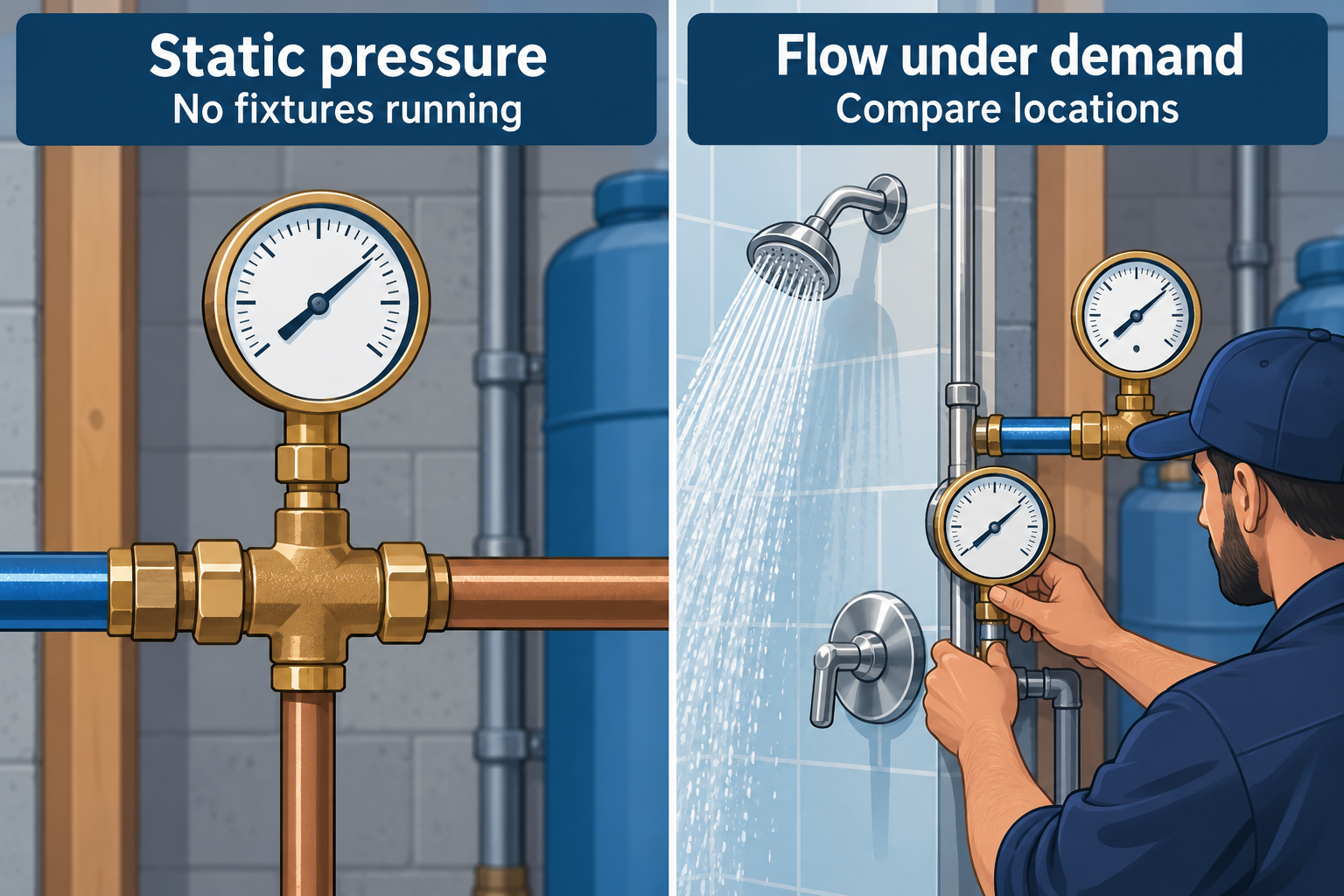
Acceptable static pressure can coexist with weak flow from a restricted valve, clogged component, undersized branch, corroded pipe, simultaneous demand, source limitation, or private-well issue. Have a professional measure pressure and flow when the complaint occurs and, where practical, compare the incoming condition with a point near the affected fixtures. Note whether another fixture is running and whether the reading changes across a regulator, filter, softener, or long branch. A convenient single reading may not explain why a shower weakens during simultaneous use.
Identify whether the supply is municipal, shared, or private and which equipment owns the diagnosis. If the proposal depends on well yield, storage, filtration, or a shared connection, make that dependency and the upstream limit visible. These measurements guide diagnosis; they do not establish a universal pass/fail threshold or pump size. The pump cannot create more source water than the upstream system provides.
The design should state the pressure and demand it intends to support, the incoming condition it assumes, and what remains unresolved. If supply is variable or restricted, source-side correction or storage may be needed—or a booster may not be suitable. Have the installer state this limit before equipment is ordered. For an occupied home, ask how installation and testing affect water availability, whether any isolation or bypass can keep service available, and what temporary interruption the household should plan for. These schedule and access details belong in the quote because they affect how the project can be completed.