
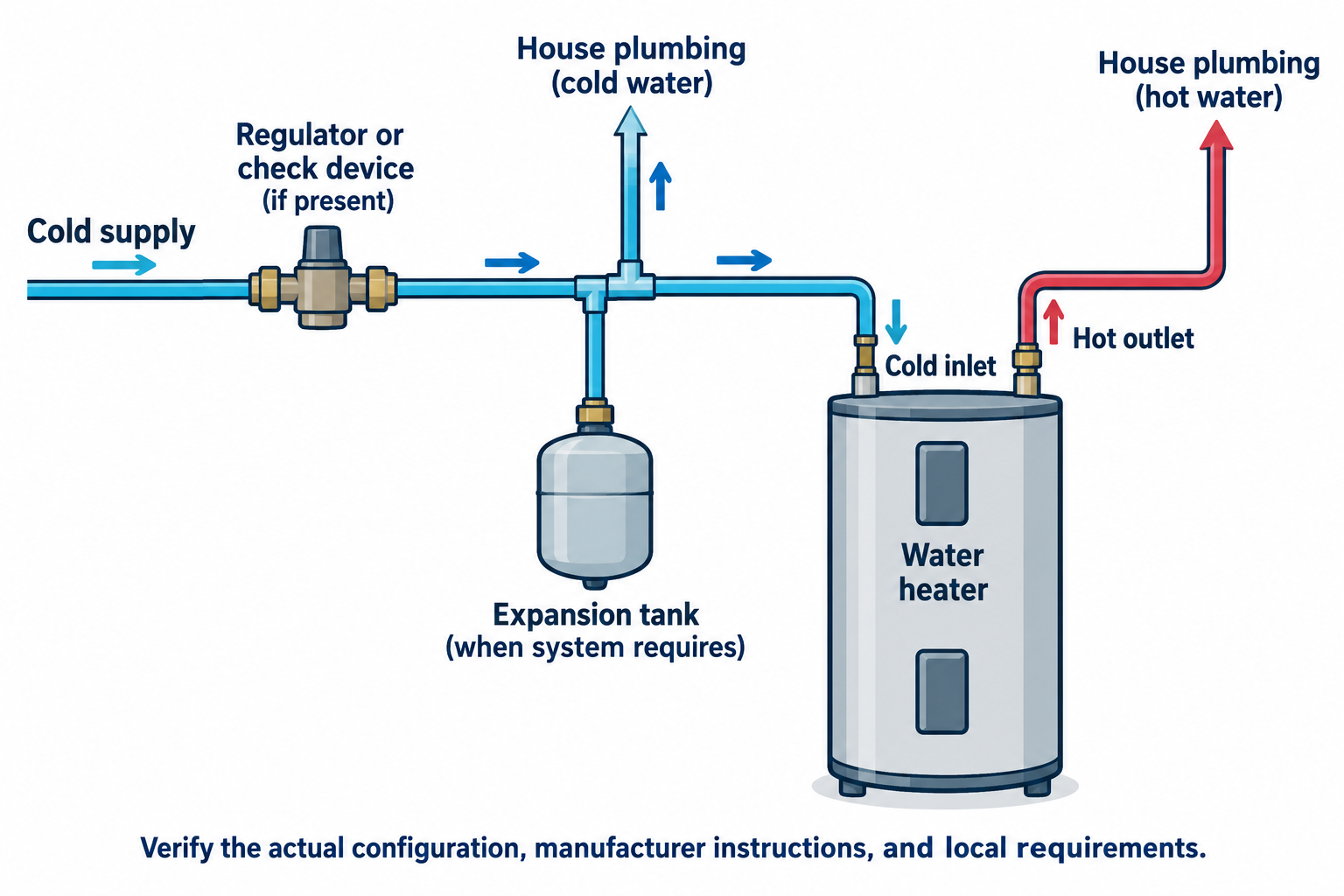
An expansion tank is a pressure-control component that may appear on a water-heater quote when the system’s configuration means heated water has limited room to expand. It is not an automatic add-on for every home. WaterSense connects pressure-reducing valves with closed-system and thermal-expansion considerations, while local code, the actual piping, and manufacturer instructions determine what applies.
Why it appears on a quote
A contractor may recommend an expansion tank during a water-heater replacement, after installing or replacing a pressure regulator, or when a check or backflow device changes how the system behaves. The reason should be stated. “Required by code” is not a sufficient universal explanation because code adoption and system conditions vary by jurisdiction.
Ask whether the proposal is replacing an existing failed tank, adding one to a changed configuration, or correcting a measured pressure problem. DOE’s modeled water-heater installation analysis includes expansion-tank replacement in selected changeout scopes, but it does not establish a universal requirement or price.
Minnesota illustrates why the connected system matters. The state’s 2020 plumbing code §608.3, effective December 17, 2021, addresses systems where a check valve, backflow preventer, or other normally closed device prevents pressure from dissipating back into the water main. The code text calls for an approved expansion tank or similar approved control on the building side, sized and installed under manufacturer instructions, regardless of water-heater type. The 2025 Plumbing Board comparison reproduces that 2020 text but is not itself the promulgated code. This is a Minnesota example, not a universal rule; verify the adopted edition, local amendments, system, and authority having jurisdiction.
The 2021 International Plumbing Code model text gives another example, requiring thermal-expansion control for a storage water heater supplied through a check valve, pressure-reducing valve, or backflow preventer. That is model-code language; local adoption, amendments, the applicable edition, and the actual system determine whether it governs a project.
What the project includes
An installation may include the tank, connection fittings, support or mounting, isolation, pressure checks, access, and testing. Sizing is a professional and manufacturer issue; do not choose a tank from a generic internet chart without the system information. Location, pipe orientation, corrosion, access, and whether the water heater or regulator is being replaced at the same time affect labor.
Available market research does not establish a reliable national installed range. Treat expansion-tank prices from a larger water-heater quote as scope context, not a standalone universal amount. Ask for the equipment, labor, and any required access or related valve work separately.
Cost scenarios
Existing tank replacement: The system already contains an expansion tank and the tank, connection, or support needs replacement. Access and isolation may be the main variables.
New installation with water-heater work: A new heater and pressure-control configuration may create a coordinated scope. Ask which work is required for the new installation and which is optional improvement.
Uncertain requirement: A contractor proposes a tank without identifying the pressure, regulator, check/backflow, or local requirement. Pay for a clear explanation or second opinion before treating the part as mandatory.
Relationship to pressure
A pressure regulator can protect a house from excessive incoming pressure, but it can also change the system’s ability to absorb expansion. WaterSense recommends a 45–60 psi operating range and warns that pressure over 80 psi may damage plumbing and equipment. Those values are guidance, not a substitute for local code or a diagnosis. An expansion tank does not repair a failing regulator or solve every high-pressure problem.
Quote questions
- What system condition makes the tank relevant here?
- Is this replacement, new installation, or an optional upgrade?
- How was sizing determined, and which manufacturer instructions apply?
- Are pressure testing, fittings, mounting, access, isolation, and cleanup included?
- What local code or inspection requirement has been verified?
- Is the regulator, check valve, backflow device, or water heater changing at the same time?
The useful quote explains why expansion control is needed and prices a compatible, accessible installation. It should not turn a configuration-dependent component into a universal water-heater requirement.
Read it as a system change
If a new regulator, check valve, backflow device, or heater changes the system, ask the contractor to explain the relationship among those components. An expansion tank is not a repair for excessive supply pressure, a leaking water heater, or a failing regulator. It may be part of a coordinated installation, but the reason and responsibility should remain visible on the quote.
Replacement and ownership cases
Replacing an existing tank may be straightforward when the support and connections are sound. A new installation can require more design, access, and verification. A homeowner who is selling may need documentation of the locally compliant installation; a long-term owner may value service access and a protected location. Neither goal permits a contractor to skip model or code verification.
Avoid the cheap-add-on comparison
Compare the expansion-tank line with and without the related heater or regulator work. Ask whether fittings, support, isolation, pressure check, and future service access are included. If the requirement is unresolved, hold the amount as an allowance pending local verification rather than treating an online part price as the finished project cost.
What changes the homeowner decision
The strongest reason to replace an existing tank is a confirmed failure or loss of reliable pressure control, not the age of the component alone. The strongest reason to add one is a documented system configuration or verified requirement. If the contractor cannot explain the condition, ask for the relevant local authority or manufacturer basis before approving the part.
When the tank is installed beside a heater, photograph the arrangement and record the model. Future replacement can then be priced from known conditions. A tank hidden above a ceiling or behind a finished wall may be cheap to purchase but expensive to service; accessibility is an ownership cost worth making visible.
Establish the system condition first
Ask the contractor to identify whether the property has a configuration that makes thermal expansion relevant, what pressure or check condition was observed, and whether the existing tank is waterlogged, leaking, unsupported, or simply old. The quote should distinguish a confirmed failed expansion tank from a precautionary addition. A new tank does not correct excessive supply pressure, a failed regulator, a relief-discharge problem, or an unsuitable support arrangement.
Record where the incoming shutoff, check or backflow device, pressure regulator, heater, relief connection, and expansion tank sit relative to one another. The exact arrangement varies by property and local requirements. A clear diagram or photograph is more useful than assuming that every home needs the same component or setting.
Include installation and service conditions
Price the tank, fittings, isolation, support, pressure check, access, leak testing, and any adjustment to the connected system. Ask whether the location can carry the component when full and whether a future technician can reach the valve and connection without opening finishes. If the tank is above a finished ceiling, behind a wall, or in a tight mechanical room, the access plan is part of the ownership cost.
Do not approve a replacement based only on a connection size. The selected tank, pre-charge or setting, mounting, and system interaction should follow the equipment and local professional requirements. Keep pressure-regulator work, plumbing repairs, finish restoration, and water-heater replacement separate unless they are intentionally included in one coordinated scope.
Verify the result at handoff
The installer should document the model, location, support, isolation, observed pressure condition, leak test, and any instruction the homeowner must follow. Photograph the completed arrangement before insulation or concealment. If the component was added as part of a new heater installation, keep both records together so a future service call can distinguish the expansion control from the heater itself.
The useful outcome is a component that is correctly integrated and serviceable for the property’s verified configuration. It is not a universal promise that pressure fluctuations, heater noise, or all plumbing leaks will disappear.
Keep the component in the service plan
An expansion tank is part of a connected pressure system, so the handoff should identify nearby isolation points, the heater, regulator, check or backflow device, relief path, and any pressure observation. Ask who will recheck the arrangement if the water heater, regulator, or service connection changes later. A component that is correct today can become inaccessible or mismatched after a remodel or equipment replacement.
When comparing bids, request the same assumptions for fittings, support, access, pressure testing, adjustment, and restoration. An allowance for an unknown pressure condition should remain visible rather than being presented as a guaranteed installation total. If the contractor recommends a related regulator, valve, or heater repair, ask for the evidence and price it as a separate decision.
For a rental, sale, or shared property, retain the photograph and model record with the heater documentation. For a long-term owner, label the component and keep the service access clear. The value is not the tank alone; it is a documented, maintainable part of a verified system.
Keep settings and observations together
Ask the installer to record the pressure observation, the component’s setting or pre-charge basis, the connected heater, the isolation point, and the test performed. The homeowner does not need to make a technical adjustment independently. The record simply lets a qualified service person understand what condition the component was installed for and what changed if the system is modified later.
If a relief valve discharges, a regulator changes, a backflow device is added, or the water heater is replaced, treat the event as a reason to reassess the connected system. Do not assume that replacing the expansion tank alone explains every pressure symptom. A scoped follow-up keeps a small component decision from becoming an unsupported whole-house conclusion.
Compare a component quote with the whole installation
Request separate lines for the tank, fittings, isolation, support, access, testing, adjustment, and restoration. If the component is installed during heater replacement, show which labor is shared and which work would remain if the heater project were deferred. This prevents duplicate charges and also prevents the small component from appearing to include unrelated pressure or heater corrections.
At closeout, retain the model, installation location, setting basis, pressure observation, and photos. The record should explain why the component was added or replaced and what future change would require a new assessment. That is a more reliable ownership record than a generic claim that every closed system needs the same solution.