
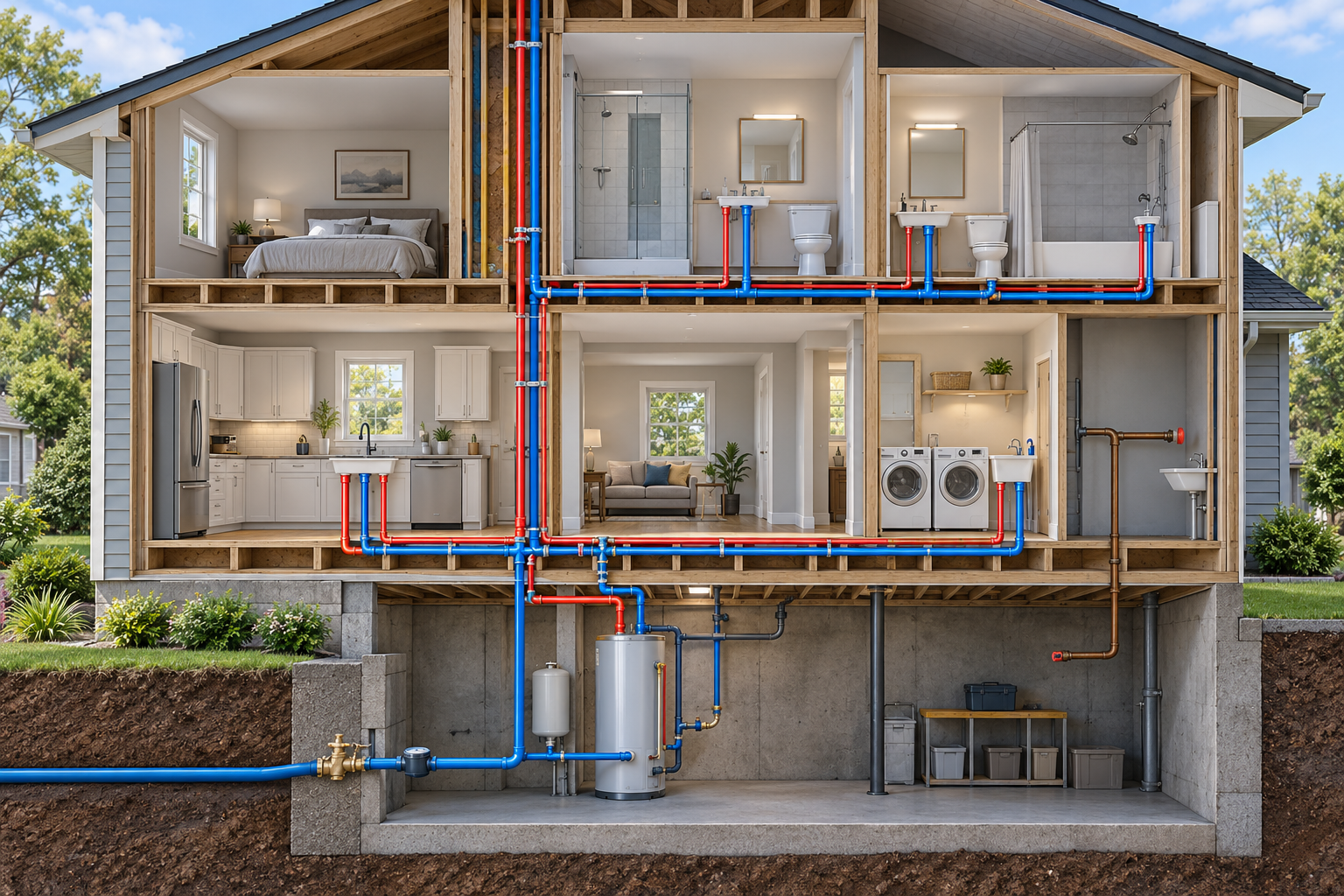
Repiping is a system project, not a larger version of a single leak repair. It replaces some or most of the potable-water distribution so the homeowner is no longer managing isolated failures one at a time. The installed cost depends less on a simple house-size label than on fixture count, routing, access, material, openings, restoration, and how much of the existing system can be abandoned in place.
When repiping becomes a distinct decision
An individual repair is often sensible when the failure is isolated and the surrounding piping is sound. Repiping becomes worth pricing when leaks repeat, the system is visibly compromised, pressure or corrosion problems are widespread, an inspection has identified legacy piping, or access will be opened in several areas at once. An inspection finding alone does not prove that every pipe requires replacement; request a material and condition assessment.
Angi’s August 2026 U.S.-oriented guide publishes two different total-cost measures: its Cost Insights range is $1,250–$22,000, while the article narrative says $1,500–$15,000 with an average near $7,500. The guide does not reconcile the ranges or establish a project-specific inclusion list. Keep both as source estimates rather than choosing one as the corrected figure; neither is a Canadian range or a quote for this house.
Partial versus whole-house scope
A partial repipe can target a branch, floor, exposed area, or problem material. It may lower immediate cost and disruption, but it leaves excluded piping in service and can create transitions or future access constraints. A whole-house repipe offers broader correction but involves more fixtures, routing decisions, and interruption.
Ask each contractor to draw or list the included runs. The map should show the incoming service, main distribution, branches, fixture connections, water-heater connection, outdoor outlets, and any lines left in place. Clarify whether inactive piping is capped, labeled, or removed, and whether the quote covers valves or appliance branches. “Whole house” should describe an actual route and endpoint, not just a fixture count. Have the bidder mark the point where new pipe connects to the existing system and identify any service line, drain, or sewer work expressly excluded. That avoids comparing one quote that ends at the building entry with another that continues to an indoor manifold.
For a partial proposal, ask which fixtures remain on the old piping, how the new and retained sections connect, and whether the transition stays accessible. A partial repipe may be a sound way to correct a confirmed branch, but the remaining sections should be visible on the scope drawing. If future phases are proposed, request a separate price and a description of whether today’s work would need to be opened or altered later. This makes phased work a deliberate budget choice instead of an undefined promise that the rest can be handled cheaply.
The major price drivers
Material choice: PEX, copper, and other materials have different material, labor, routing, and installation characteristics. Local acceptance, manufacturer instructions, water quality, temperature, and the building’s construction matter. Do not treat a material as universally cheaper or universally preferable without comparing the complete installed scope.
Access: Basements, crawlspaces, open framing, and accessible utility chases can reduce labor. Slabs, finished walls, ceilings, tile, cabinets, and tight mechanical spaces can add openings, protection, and restoration. Access is often a larger price lever than the pipe itself.
Fixture count and routing: Each bathroom, kitchen, laundry, outdoor connection, and water-heater connection adds isolation, reconnection, testing, and coordination. A compact layout may be easier than a larger home with dispersed fixtures or long runs.
Restoration and logistics: Wall and ceiling openings, floor protection, disposal, temporary water, water shutoffs, and cleanup may be included, excluded, or assigned to another contractor. Work can become more expensive when the homeowner requires staged occupancy or rapid restoration.
Permits and inspection: Requirements vary by jurisdiction. Include an allowance or state clearly that the homeowner or contractor will verify permits and inspection, rather than treating one local practice as a universal rule.
Low, expected, and difficult scenarios
Favorable: Most piping is exposed, routes are direct, fixtures are accessible, and a like-for-like material strategy avoids major electrical, structural, or finish work. The plumbing scope is easier to measure and compare.
Typical mixed-access: Some runs are open but others require targeted wall or ceiling openings. The quote should identify restoration assumptions and unit prices for concealed access instead of hiding an unlimited allowance.
Difficult: Slab routing, multiple finished areas, old shutoffs, unusual transitions, occupancy constraints, or unresolved water damage make the scope uncertain. A staged plan or exploratory opening may be more honest than a single fixed number.
Repair versus repipe economics
Compare the complete local-repair path over the expected ownership period, not only its first invoice. Repeated service calls can repeat access and finish disruption. A repipe spends more now but may consolidate work and reduce exposure to known weak sections. A repipe can also uncover structural, finish, or code-related work that a local repair avoids. Separate those costs from pipe replacement so the homeowner can see which expenses correct the known distribution problem and which follow from access or another condition. If several leaks have already required openings, compare one coordinated route with repeated visits, but do not treat past repair spending as money that can be recovered by repiping.
The right decision depends on condition, failure history, access, budget, disruption tolerance, and ownership horizon. Avoid a rigid rule such as “one leak means repipe” or a percentage-of-value formula that ignores the actual system. Before choosing, identify which known runs remain in service, what a future local repair would require the home to open, and how much additional pipe the broader quote replaces. A useful bid set prices a plausible affected branch and a whole-system option with their endpoints and restoration assumptions stated.
Pipe-sizing method can change a designed system, but published engineering models do not provide a shortcut to a current repiping price. IAPMO’s 2024 efficient-fixture study estimates peak demand from fixture-use probabilities and measured flow inputs drawn largely from historical home data. A separate 2020 IAPMO/Stantec study compared modeled costs for three new-construction prototypes in selected U.S. cities and methods; those prototype amounts do not price a lived-in-house retrofit or establish savings for this property. Ask the designer or plumber which locally accepted sizing method and fixture assumptions inform the proposed route, while keeping the bid based on current site access and installed scope.
Normalize repiping quotes
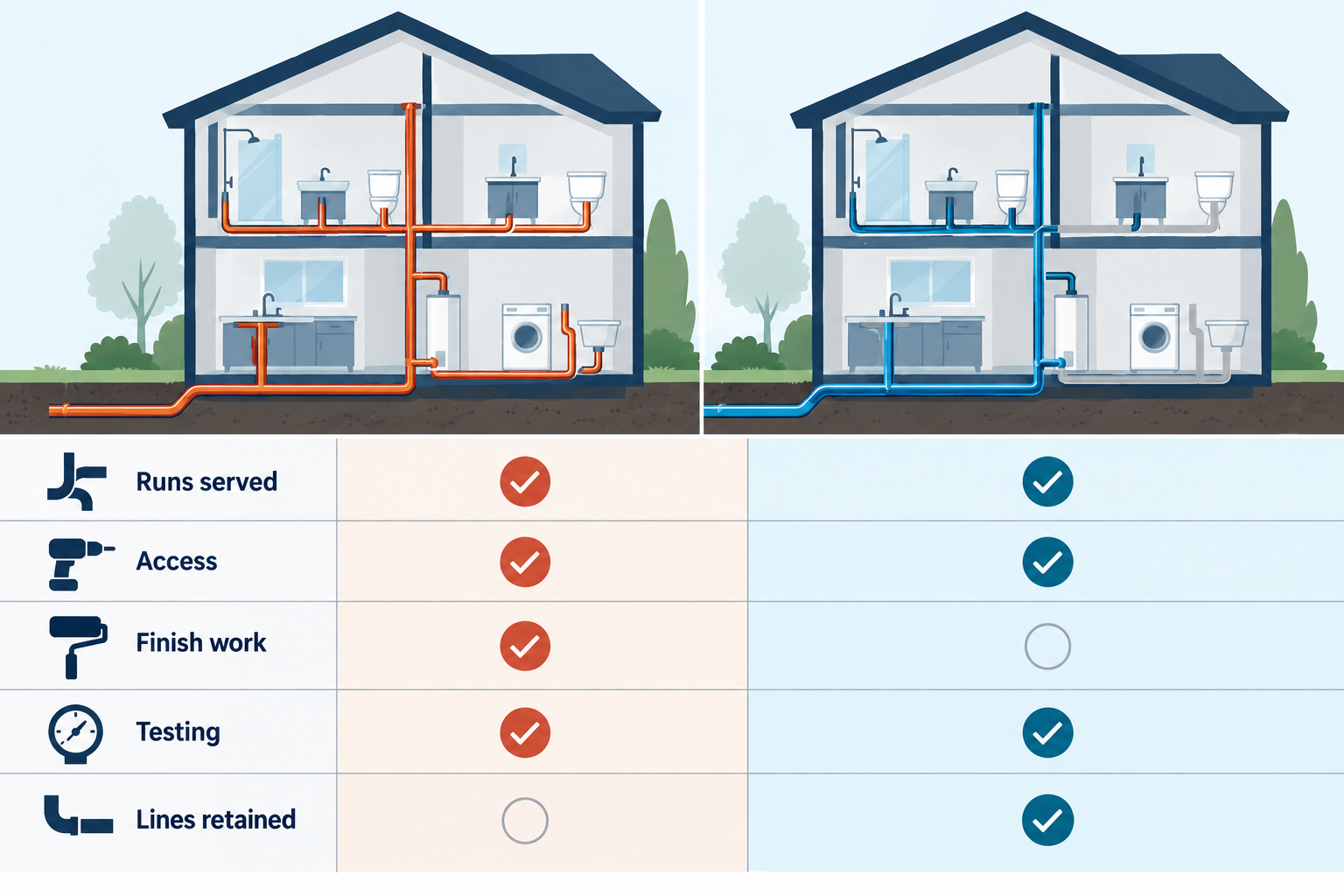
Give each bidder the same room list and ask for the scope in the same order. A simple comparison can mark each item as included, excluded, or an allowance:
| Scope item | What the proposal should identify |
|---|---|
| New piping | Runs and fixtures served, material, transitions, valves, and supports |
| Existing piping | Sections abandoned, capped, labeled, or removed |
| Access | Openings, protection, temporary water, and cleanup |
| Finish work | Rough closure versus finished drywall, plaster, tile, flooring, cabinets, or paint |
| Closeout | Permit and inspection assumptions, testing, warranty, and records |
Compare plumber-only work with a coordinated finish quote carefully. A lower bid may leave the homeowner to schedule and pay another contractor. If a bidder uses an allowance for concealed work, ask what observation triggers it and how the added price will be approved. This makes a change order easier to compare than a single undefined contingency.
Boundaries and related work
Lead service-line replacement has separate health and responsibility questions. Drain and sewer work is not part of a potable-water repipe. Consequential leak restoration and broad old-house modernization belong to related scopes. If an electrical, fuel, or service-capacity change is proposed, price it separately and verify the local requirement.
Repiping is worth a serious quote when the system problem is systemic. The useful budget is the one that shows how much pipe is replaced, how the home is accessed, and what the homeowner will still need to pay after the plumber leaves.
Project planning beyond the pipe
A repipe normally moves through route confirmation, room protection, water isolation, access openings, new-pipe installation, fixture reconnection, testing, and finish work. Ask how the sequence affects kitchens, bathrooms, laundry, and any occupants who need predictable water access. The daily schedule matters: clarify when water is shut off and restored, whether temporary facilities are provided, and which rooms must stay clear.
An opening count is not the same as a finish-repair scope. The plumber may make a rough closure while another contractor restores tile, plaster, cabinets, or paint. Coordinate routes before a planned renovation closes the walls. At handoff, retain a route map, material information, valve locations, test results, photos before closure, warranty details, and a list of old sections left in place. That record defines what the project did and what future service may still encounter.
How to evaluate a material proposal
Compare materials by the complete installed system: labor method, routing flexibility, transitions, supports, isolation, future access, local acceptance, and the contractor’s warranty. “Cheaper pipe” is not enough if it requires more openings or a different finish plan. A premium material is not automatically better if the design, installation, or local service support is unclear.
Ownership-horizon example
An owner planning to sell soon may prioritize a documented, targeted correction that resolves a known defect without opening every finish. An owner expecting a long stay may value consolidating repeated repairs and making future branches accessible. A buyer should use a qualified assessment and priced scope rather than discounting the home by an unexplained whole-house estimate. In every case, compare a defined partial scope with a defined whole-house scope when both are plausible.