
“Water-heater maintenance” is not one standardized service. A storage tank may receive inspection, flushing, anode review, leak checks, and control checks. A tankless unit may need scale-related service, filter or inlet inspection, and manufacturer-specific cleaning. A heat-pump unit adds air filter, condensate, controls, and location checks. The model manual and qualified service instructions should determine the task and interval.
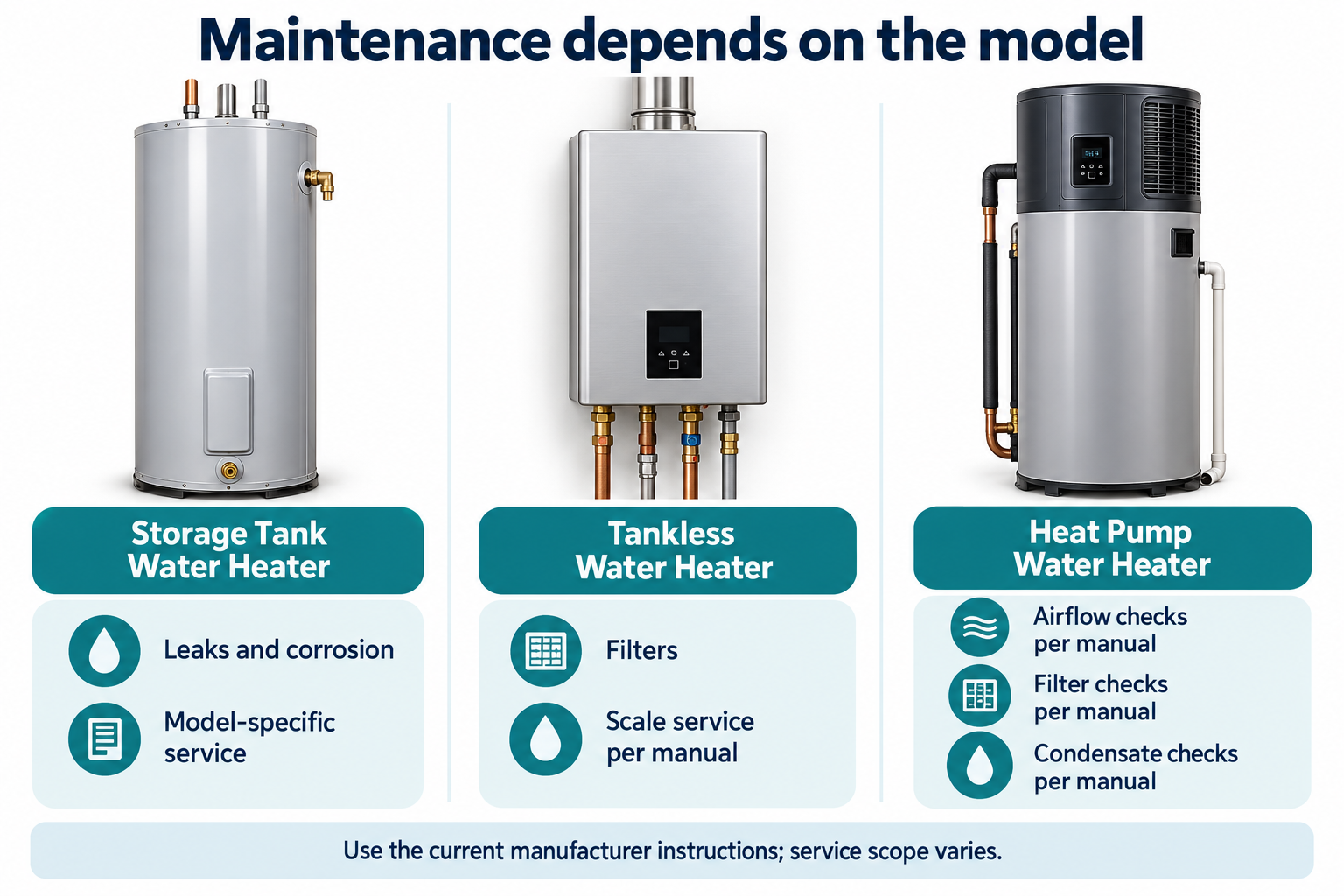
What a professional visit may include
EPA WaterSense recommends professional annual service or maintenance according to the equipment guidance, including inspection for leaks or corrosion and flushing where applicable. This is general maintenance guidance, not a universal DIY procedure or a promise that annual work prevents every failure.
CDC’s U.S. household guidance says many manufacturers recommend flushing annually, before moving into a home, after plumbing work, or when tap water is discolored. It directs homeowners to the model instructions or a professional. These are examples of manufacturer schedules and triggers, not one required interval or procedure for every heater.
Ask the contractor to list the exact tasks: inspection, drain/flush, anode inspection or replacement, tankless descaling, filter cleaning, condensate check, relief and control checks, burner or electrical review, leak observation, testing, and documentation. Some tasks may be inappropriate for a particular model or may require specialized equipment.
Storage-tank service
Storage-tank maintenance may address sediment, corrosion indicators, connections, controls, and the anode as applicable. Flushing can be a maintenance task, but frequency and procedure depend on the equipment, water, installation, and manufacturer. A maintenance visit is not a substitute for repair when the tank body, valve, control, or connection is failing.
Tankless service
Tankless maintenance can be affected by water quality and scale. Ask whether the proposed descaling method is specified for the model, whether filters or inlet screens are included, and how the unit will be returned to service. Do not approve a generic chemical treatment without understanding compatibility and disposal.
Heat-pump service
ENERGY STAR guidance makes airflow, service access, condensate, and location important to HPWH operation. A maintenance quote may include filter and condensate checks, but the model manual controls the actual tasks. A blocked drain, poor airflow, or unsuitable room can be a performance or installation problem rather than routine maintenance alone.
Cost context
Available market research does not establish a universal maintenance or flushing price. Angi’s 2026 U.S.-oriented page lists tankless flushing at $150–$250, but gives conflicting storage-tank ranges in different sections: $110–$200 in Cost Insights and $75–$150 in its table/body. The source does not reconcile that difference or provide a universal model schedule. Treat these as source-specific orientation only; the final amount depends on service minimums, equipment type, access, water condition, task length, chemicals or parts, and whether a repair is found. Specialist repair-cost sources can orient labor, but maintenance and repair are not interchangeable scopes.
Scenarios
Routine documented service: The equipment is accessible, the model is identified, and the technician follows the manual’s inspection and cleaning scope. This is the most predictable maintenance purchase.
Water-quality or scale concern: The homeowner sees reduced performance or has a known scale issue. Price maintenance plus the separate cause—water treatment, filter, or replacement part—without putting source-water treatment in this category.
Maintenance becomes repair: The visit finds corrosion, a leaking connection, a blocked condensate path, failing controls, or another defect. Request a new diagnosis and price rather than allowing an undefined repair allowance.
Quote questions
- What equipment model and maintenance schedule are being used?
- Which tasks are included, and which parts or repairs are extra?
- Is flushing or descaling appropriate for this model and water condition?
- Are leak, corrosion, control, filter, condensate, and access checks included?
- What evidence supports the recommended interval?
- Is water treatment a separate project, and what is the maintenance-versus-repair boundary?
Maintenance is valuable when it is specific, model-aware, and connected to a documented operating concern. Avoid paying for a universal ritual when the proposal cannot explain what it will inspect or change.
Maintenance plan versus one-time service
A recurring plan can be useful for a complex or hard-to-access system, but compare its included tasks, response terms, parts exclusions, cancellation rules, and actual model schedule with a one-time visit. A plan does not turn repairs into maintenance or guarantee a lifespan. Ask whether the technician records findings that can inform a later repair-versus-replace decision.
Water quality without scope creep
Scale and sediment can affect some equipment, but a maintenance visit should not automatically become a water-treatment sale. Ask what evidence shows a water-quality issue and whether the proposed treatment belongs to the source-water system. For tankless descaling or HPWH filter work, the model instructions and safe handling requirements matter more than a generic annual package.
What documentation should say
Keep the model, date, tasks completed, parts installed, observed leaks or corrosion, test result, and recommended follow-up. If the technician finds a defect, request a separate repair quote with urgency and consequence explained. This record is useful at sale, warranty service, or the next maintenance visit and is more valuable than a vague “serviced” invoice.
Decide when maintenance is no longer economical
Maintenance is not a reason to keep an unsafe, leaking, poorly sized, or repeatedly failing heater in service. If the technician finds a core component or tank problem, compare the repair with replacement using the lifecycle framework rather than adding indefinite maintenance visits. A service record is valuable because it shows the condition trend; it does not guarantee remaining life.
When collecting prices, ask whether the visit is a preventive inspection, a cleaning task, or a repair diagnostic. Separate these scopes on the invoice. That distinction makes a low maintenance price meaningful and prevents a routine appointment from becoming an unapproved open-ended repair.
Match the service to the equipment
The same “flush” wording can hide different work. Ask whether the heater is a storage, tankless, or heat-pump model; whether the manual calls for flushing, descaling, filter cleaning, or condensate inspection; and whether any part will be removed or replaced. A technician should be able to explain what the task protects or verifies and what it cannot fix.
Manufacturer instructions illustrate why a calendar-based universal package can misstate the work. The cited Rheem Universal-Connect hybrid guide calls for an annual temperature-and-pressure relief-valve check and filter cleaning when its reminder appears; the A. O. Smith gas guide calls for annual visual inspection of specified components and a professional relief-valve/discharge-pipe inspection at least every five years; the cited Rheem RTGH tankless manual calls for monthly water-filter cleaning and has an optional combustion-hour maintenance notice; the Rinnai KCM manual ties scale service to its model-specific diagnostic guidance. These are examples for the named manuals, not schedules for every heater. Hot discharge and specialized service can create injury or equipment risks, so use the complete current manual and a qualified technician for the actual procedure.
Match the visit to the failure history
Maintenance is more useful when the contractor knows the model, fuel or electrical arrangement, water conditions, service history, age, and current symptoms. A routine visit should not be presented as a substitute for diagnosing a leak, failed control, weak hot-water delivery, unsafe venting, or a relief discharge. If a known problem is present, ask for a diagnosis-first scope and a separate repair or replacement option.
For a storage heater, the visit may involve the drain, anode or other model-specific parts, relief path, connections, temperature setting, pan, or visible corrosion. For tankless or heat-pump equipment, the relevant work may involve filters, heat-exchanger or condensate paths, controls, airflow, or manufacturer-specific procedures. The manual and model determine the proper task; “flush” alone does not.
Include access and disruption
Ask who isolates the heater, where the discharged water goes, how long hot water is unavailable, and whether the installer protects flooring and finishes. A drain valve that has never been opened may not operate as expected, and access to a concealed component may change the scope. Price replacement of a failed service valve or restoration separately rather than hiding it inside maintenance.
For an occupied home, schedule the outage around household use. For a rental or sale, record the model, service performed, date, observed condition, and recommendations without claiming that maintenance guarantees future service. Keep receipts and photographs with the equipment record.
Use the result to plan the next decision
At handoff, ask what was inspected, cleaned, adjusted, replaced, or left untouched; what test was performed; and what condition would justify follow-up. If sediment, corrosion, scale, restricted flow, or recurring faults limit the result, state that plainly. A maintenance visit can establish that a component is serviceable, identify a repair, or show that replacement deserves comparison.
The best maintenance scope is a defined task with a defined observation. It should not promise a universal lifespan, energy saving, or recovery improvement that the visit did not measure.
Distinguish service from replacement planning
If the technician finds corrosion, a failed valve, scale, sediment, a recurring control fault, or a leak, ask for a separate condition report and option. Maintenance can reveal a replacement decision, but the routine visit should not be used to smuggle an unpriced replacement into the homeowner’s approval. Conversely, a recommendation to replace should explain what was observed and whether a repairable component was considered.
The equipment record should include the make, model, fuel or electrical arrangement, installation location, capacity or output, prior work, and known water conditions. Keep the manual and warranty with the service notes. This helps the next technician distinguish normal model-specific maintenance from a new symptom and can reduce duplicate diagnostic work.
Make the next visit easier
Label shutoffs, drains, filters, controls, and service clearances. Photograph connections before insulation or concealment and note any access panel that must remain clear. If the heater is in a tight closet, attic, crawlspace, or finished room, record the protection and delivery constraints. Serviceability is part of the ownership cost even when the maintenance task itself is routine.
At handoff, confirm what was cleaned, tested, adjusted, replaced, or deferred, and what observation should prompt follow-up. A maintenance plan is valuable when it gives the homeowner a clear next action without promising that regular service prevents every leak, failure, or replacement.
Keep the maintenance history useful
Record the service date, technician, equipment condition, parts used, water or scale observations, and any recommendation that was deferred. If the next visit requires a different trade or a replacement decision, say so. A history that only says “flushed” does not show whether the valve, relief path, connections, controls, or condensate were considered.
The homeowner should receive the model-specific instructions and know which symptoms warrant service rather than another routine visit. This makes maintenance a practical planning tool while keeping its claims limited to the work and observations actually completed.