
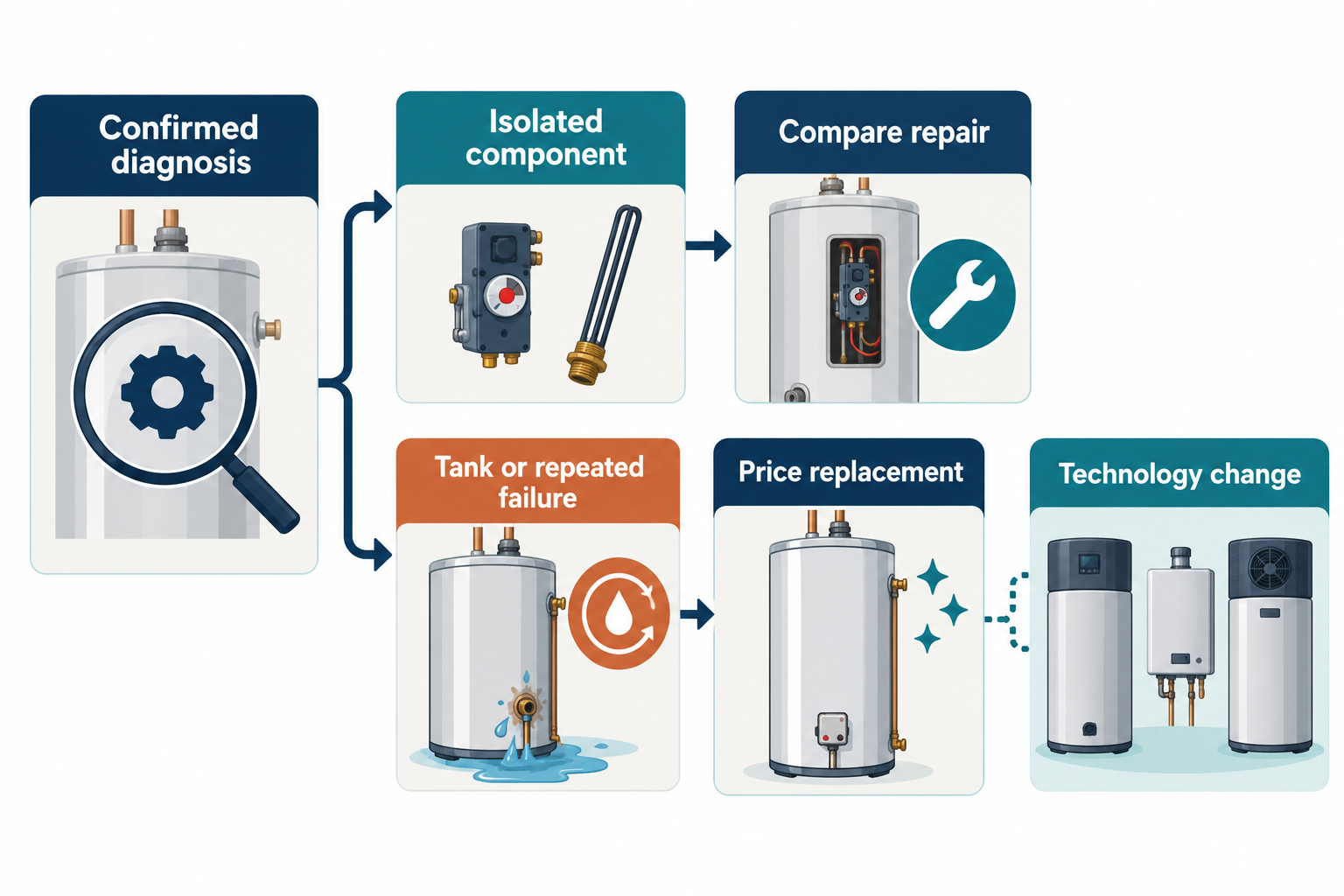
Repair is usually a component decision. Replacement is an equipment, installation, and ownership decision. Comparing only the failed part with the price of a new tank can produce the wrong answer because replacement may add removal, delivery, venting, electrical, condensate, access, permits, or a technology change.
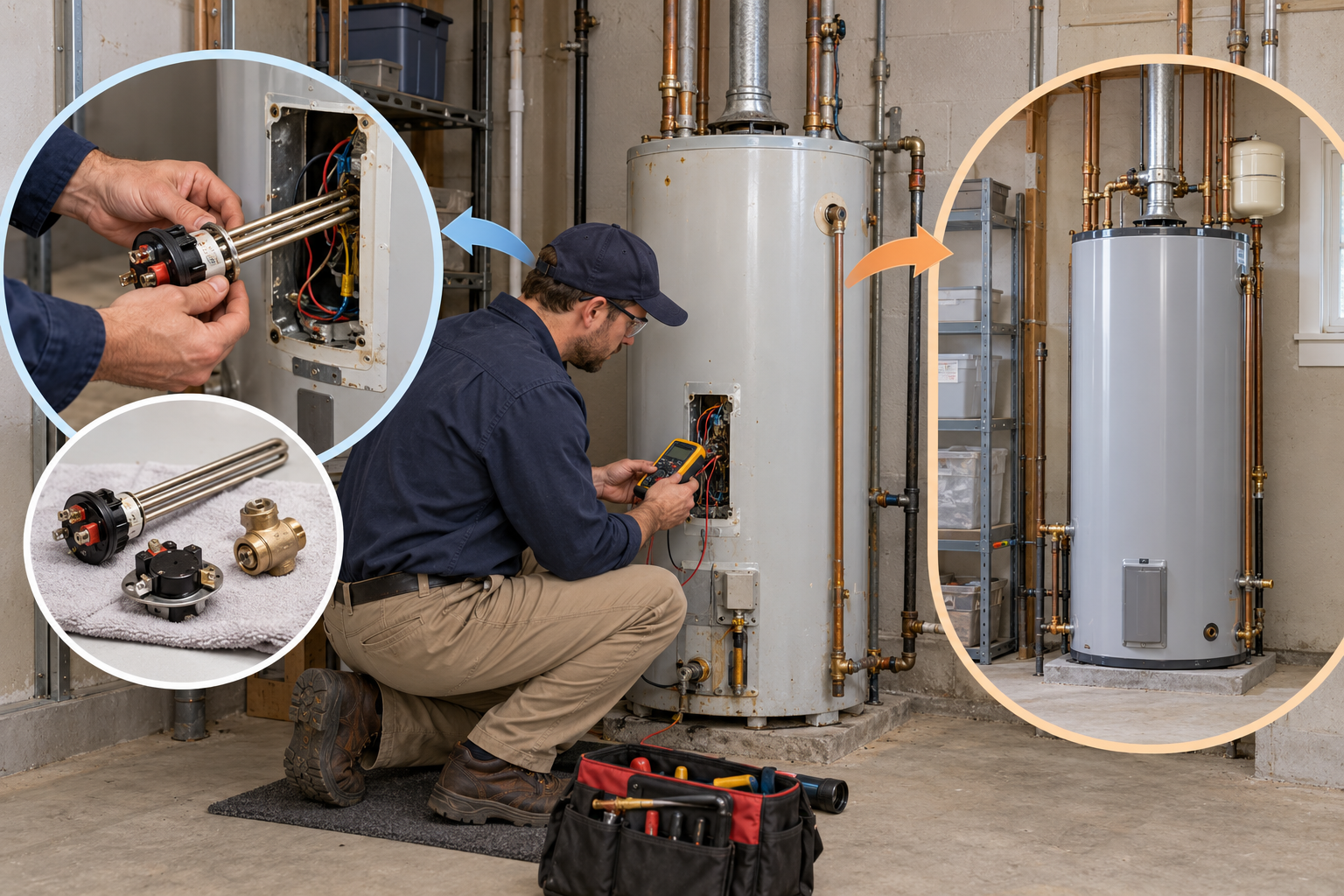
Diagnose before choosing
Start with the symptom and equipment type: storage tank, tankless, or heat-pump water heater. A failed control, valve, ignition component, element, sensor, or connection may be repairable. A leaking tank body, severe corrosion, obsolete or unsupported equipment, repeated failures, or a system that no longer meets demand may favor replacement. Do not assume a leak is a tank failure until the leak location is identified.
Temperature settings need separate health and delivery judgment. Health Canada’s residential guidance for homes up to six units advises storing water at a minimum of 60°C; CDC’s U.S. guidance discusses higher settings for germ control while warning about increased burn risk. The temperature at a tap can differ from the heater setting. Do not change a setting to address a symptom without considering local requirements, the equipment, and household health and scald risks; see the mixing-valve guide for the related decision.
HomeGuide reports illustrative water-heater repair ranges, and HomeStars reports Canadian repair observations around $265–$1,180, but these sources use different scopes and are not a unified U.S./Canadian estimate. Angi’s 2026 U.S.-oriented guide reports $228–$1,017 for most homeowners and a $615 average based on 16,111 verified Angi Pro projects; its page does not give a complete equipment-specific range or detailed sample weighting. Use all of these as source-bound market orientation, not a diagnosis or repair threshold. Request a written diagnosis and a complete repair price before comparing it with a matched replacement.
When repair is stronger
Repair is more defensible when the failure is confirmed, the tank or assembly is in sound condition, parts and warranty support are available, the equipment meets the household’s demand, and access is straightforward. A warranted part can make the initial repair materially less expensive, although labor, travel, diagnostic time, and related components may remain billable.
Ask whether the repair addresses the cause as well as the failed part. If a control fails because of another condition, or a replacement component is not compatible, the part price understates the risk.
When replacement is stronger
Replacement becomes more compelling when the equipment has multiple age-related problems, a failed tank, repeated service history, unreliable parts, poor fit, inadequate capacity, or a likely near-term second installation. Operating energy, noise, location, and future equipment choice may also matter over a longer ownership horizon.
DOE’s modeled US installation analysis includes labor, overhead, materials, delivery, removal, and applicable permits, and identifies access, dimensions, venting, condensate, electrical planning, tempering valves, and relocation as possible adders in selected cases. It is a regulatory model, not a current quote or universal checklist.
A practical decision model
Compare:
- the complete repair today, including diagnosis, labor, parts, access, and warranty;
- the likely cost of another repair during the expected ownership period;
- a like-for-like replacement, including removal and installation conditions; and
- a technology-change option if storage, tankless, or heat-pump equipment is under consideration.
For a short ownership horizon, a reliable repair may protect cash if the surrounding system is sound. For a long horizon, predictable replacement, operating cost, capacity, and service support may outweigh the lower first invoice. There is no evidence-supported universal age cutoff or “repair must be less than half of replacement” rule.
Three scenarios
Repair case: A single control or connection failure is confirmed, the equipment is otherwise healthy, and the repair has a meaningful warranty.
Comparison case: The failed component is out of warranty or the unit is older, but the tank and installation remain serviceable. Compare repair with a like-for-like replacement over the ownership period.
Replacement case: The tank is leaking, failures repeat, capacity is inadequate, or a new technology requires a planned installation. Price the complete installed scope and related prerequisites.
Questions for the contractor
- What failed, and what tests confirmed it?
- Is the tank/body sound, and what other components were inspected?
- What is included in the repair price and warranty?
- What is the all-in like-for-like replacement price?
- What removal, delivery, venting, electrical, condensate, access, permit, or relocation assumptions apply?
- What will change if I choose tankless or heat-pump equipment?
- Which parts of the quote are required now versus optional prevention or efficiency work?
Repair when the failure is isolated and the system’s remaining value is credible. Replace when the repair is one event in a broader decline or when a complete new installation provides a more predictable ownership decision. The evidence supports a framework, not a universal answer.
Compare risk, not just expected price
An economic comparison can use three columns: the known repair total, the likely additional work if the diagnosis expands, and the replacement exposure. For repair, include the chance of another call, a second component, lost use, and the repair warranty. For replacement, include the chance of access, venting, electrical, condensate, permit, or finish work becoming an adder. A low repair invoice can be the better choice only when its uncertainty is also acceptable.
Plan before the failure is urgent
If a unit is still operating but has repeated symptoms, gather model and capacity information and price a replacement before the next failure. Planned work allows technology comparison and may avoid emergency labor. It does not mean replacing equipment solely because it is old. Age is one input beside tank condition, service history, parts support, household demand, operating cost, and ownership horizon.
A quote normalization worksheet
Ask each bidder to state equipment, diagnostic labor, repair parts, removal, delivery, installation, venting or fuel work, electrical work, condensate, expansion or tempering components, access, permits, commissioning, warranty, and exclusions. Ask which assumptions are confirmed and which are allowances. Compare like-for-like replacement first; then compare technology changes whose infrastructure is separately understood.
The decision is strongest when the homeowner can explain what will happen if the repair works, if it fails again, and if the system is replaced. That is more reliable than a universal age cutoff or percentage rule.
Make the diagnosis proportional to the decision
Ask what the first inspection can establish: a failed sensor, element, control, valve, connection, venting issue, condensate problem, or tank condition. If the source or failed part is not confirmed, price diagnosis separately from a repair allowance. An age or efficiency label may influence the comparison, but it does not identify the present failure.
For a tank that leaks from the vessel, a repair may not be the same option as replacing an attached valve or control. For equipment that shuts down, the cause may be fuel, electrical, airflow, venting, condensate, scale, or a component. The contractor should state what was tested and what remains uncertain before recommending a larger scope.
Compare the complete installed alternatives
The repair option should include part, labor, access, testing, warranty, and the condition left behind. The replacement option should include model, capacity, removal, delivery, installation, fuel or electrical work, venting, condensate, controls, pan or drain, expansion or tempering components, commissioning, inspection, disposal, and finish restoration. Technology changes deserve a separate line for infrastructure and service assumptions.
Keep emergency stabilization distinct from a planned upgrade. If a temporary repair buys time, record its limitation and the event that would trigger replacement. If a same-day replacement is chosen, do not let urgency hide optional features or unpriced adjacent work. A like-for-like baseline makes the added value of an alternative visible.
Decide for the ownership horizon
A short-term owner may value a reliable compatible repair or replacement with predictable handoff. A long-term owner may give more weight to service access, operating behavior, equipment support, and future infrastructure. A rental, sale, or shared property adds documentation and responsibility questions. None of these horizons justifies a universal repair-versus-replace rule.
At handoff, keep the diagnosis, failed part, model and serial information, settings, test conditions, warranty, photos, and limitations. The record should make clear what was corrected and what future symptoms would require a new evaluation.
Ask what the decision buys
A repair should buy a defined restoration of operation, leak control, or component function. A replacement should buy a defined remaining service plan, equipment fit, and completed installation. Ask what risk remains after each option, what access will be needed if the symptom returns, and whether the repair part has a warranty. This makes the comparison about the next condition of the home instead of only today’s invoice.
If the contractor recommends replacement because of age, ask which observed condition makes continued repair unreasonable and whether the recommendation is for the tank, attached components, or the entire technology. If the recommendation is a repair, ask what would make replacement the next step. A conditional decision is more useful than a rigid age threshold or a promise that a new unit eliminates future plumbing work.
For an emergency, authorize only the scope needed to isolate, diagnose, or restore safe service unless the broader replacement is already understood. For planned work, allow time to compare access, delivery, infrastructure, warranty, and finish restoration. Keep the chosen baseline and rejected option in the project record so a future owner can understand why the work was done.
Close the loop after the decision
After a repair, observe the original symptom under the condition that caused it and record what changed. After replacement, test the equipment and connected fixtures, then document settings, shutoffs, relief or drain arrangements, and service access. If the result is limited by distribution, pressure, household demand, or another trade, state that limitation instead of attributing every outcome to the heater.
The completed record should retain the model, serial information, failed part or diagnosis, warranty, photographs, inspection or commissioning information, and future service interval. A clear handoff protects the value of either choice and makes the next decision evidence-based if the system later develops a different problem.