
A storage-tank replacement retains a reservoir of heated water, but “replace the tank” can describe anything from a straightforward like-for-like swap to a project involving new venting, electrical work, access, removal, a different capacity, or a changed fuel and technology. Separate the equipment price from the installed price before comparing quotes.
Broad market context
HomeStars reports illustrative Canadian observations of roughly $1,000–$3,500 for water-heater installation, with separate example ranges for tank equipment and tank installation. Its scopes differ from its general plumbing guide and are not a normalized Canadian estimate. Its separate 2026 replacement guide lists lower electric- and gas-tank ranges, but does not disclose methodology, ISO currency, or whether the ranges consistently include installation; its separate standard-tank installation figure should not be added to them. A Canadian plumbing provider publishes installed bands of CAD $1,100–$2,600+ for 40–60 gallon electric storage heaters, CAD $1,400–$3,000 for 40–60 gallon gas storage heaters, and CAD $2,200–$4,200 for 40–75 gallon power-vent gas tanks. That provider does not document a representative quote sample and says its amounts exclude sales taxes and municipal permit charges. An Angi U.S.-oriented replacement guide separately reports $882–$1,826 for a tank-style replacement, with a $1,347 average; its project-level inclusion list and geographic weighting are not disclosed, and it is not directly comparable with the Canadian provider’s bands. These observations are different in scope and method; neither substitutes for a matched local quote. DOE’s installation analysis describes modeled US cost components but does not establish a current homeowner price. Use local bids with the equipment, capacity, fuel, and installation assumptions named.
What the installed price may include
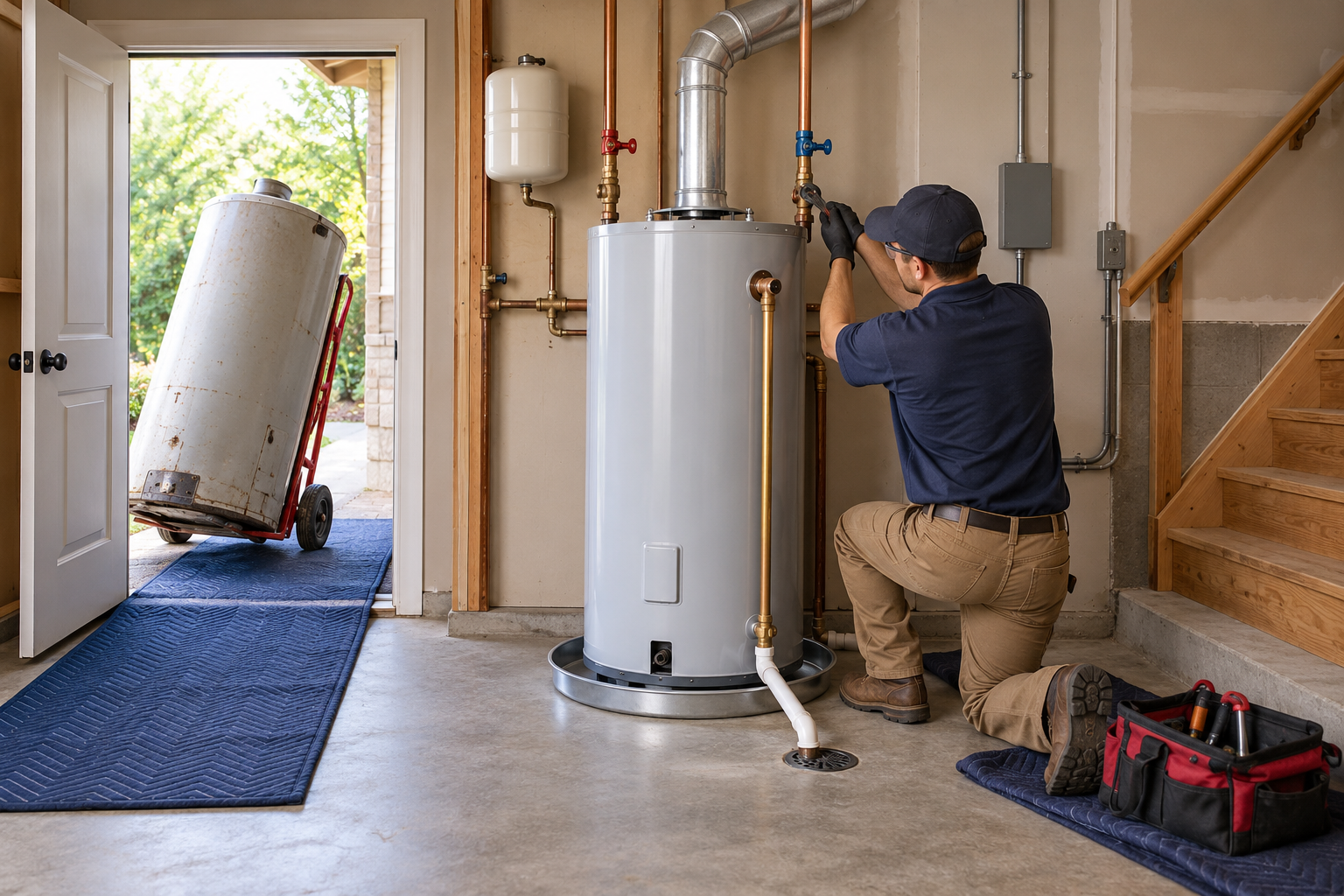
Request separate lines for the tank, delivery, removal and disposal, labor, fittings, shutoffs, relief and drain connections, pan or support where applicable, venting or electrical reconnection, expansion control where applicable, testing, permit/inspection allowance, and cleanup. Local code and manufacturer instructions control which supporting components are required; no universal checklist should be assumed.
Capacity and replacement choice
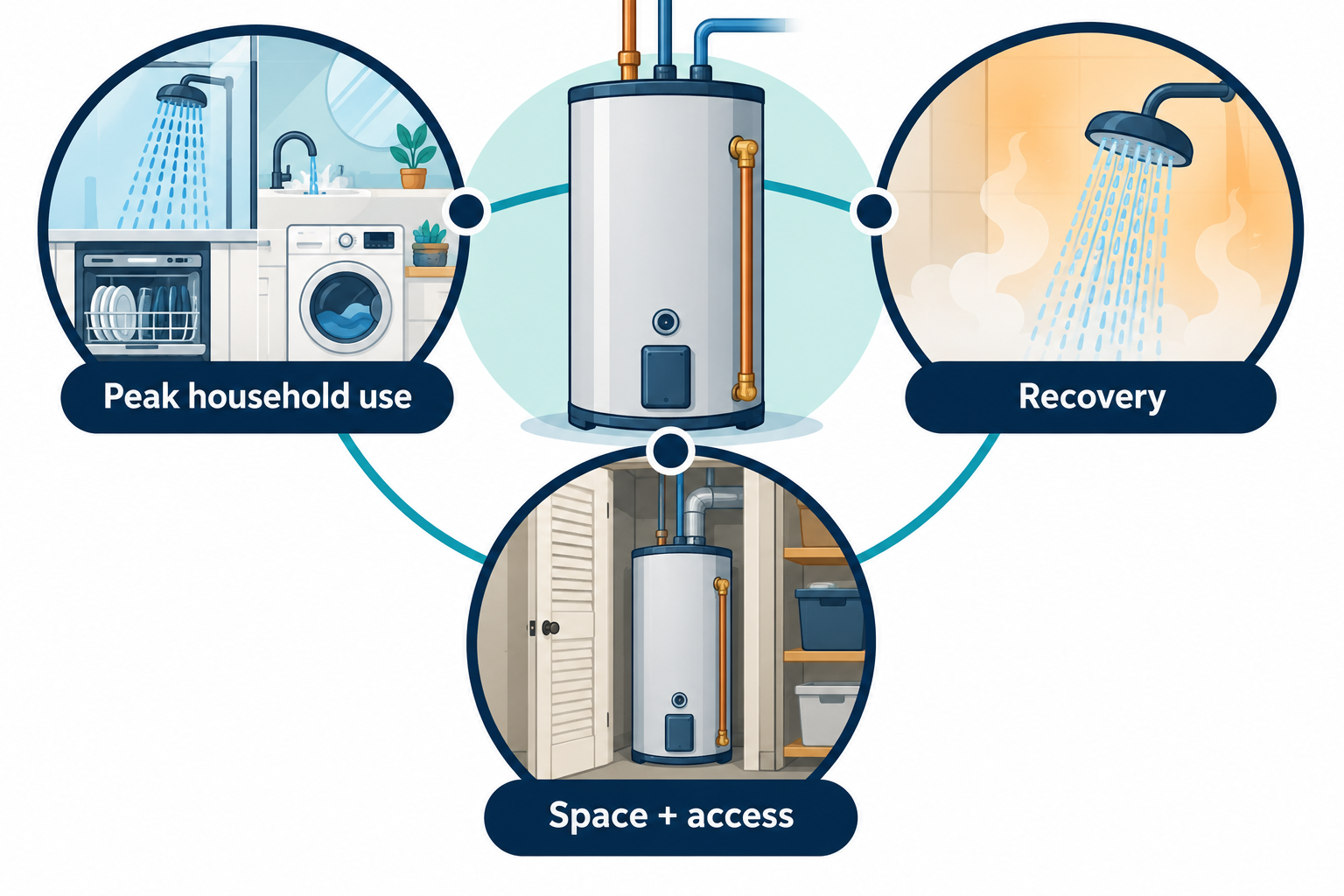
Choose capacity from household demand, recovery, available space, and the replacement technology—not solely from the old tank label. Ask the installer to relate the proposed capacity and recovery performance to peak use: number of occupants is only a rough proxy if schedules, shower length, laundry, or simultaneous fixtures have changed. The relevant comparison includes how much hot water is available after a typical draw and how quickly the model recovers under its stated test conditions. Request the exact model and the assumptions behind the selection rather than accepting “same size as before” as a design explanation.
A larger tank may not fit through the same route or in the same room, and it may not solve a slow-recovery or distribution problem. A smaller or higher-efficiency choice may change recovery behavior, controls, venting, electrical, or operating economics. Ask which household behavior or building condition would make the recommendation different. That gives the homeowner a practical way to compare capacity without guessing from gallon labels alone.
NRCan distinguishes tank, tankless, and heat-pump technologies in its consumer guidance. A storage replacement is often the simplest path when infrastructure and demand already fit, but it is also the moment to compare whether a different technology is worth the installation changes.
Cost drivers
- tank capacity and product efficiency;
- gas versus electric connection;
- existing venting, flue, combustion-air, or electrical condition;
- delivery route, removal, and disposal;
- utility-room or attic access;
- drain, condensate, pan, expansion, and tempering components where applicable;
- permit, inspection, and local requirements; and
- emergency scheduling versus planned replacement.
DOE identifies venting, condensate, access, relocation, and electrical or tempering work as adders in selected modeled cases. These are possibilities, not proof that every tank replacement needs them.
Scenario comparison
Like-for-like planned swap: The same general fuel and capacity fit, the location is accessible, and the existing connections are serviceable. Removal, delivery, installation, testing, and local requirements still belong in the price.
Higher-efficiency or capacity change: New dimensions, venting, controls, electrical, or expansion conditions change the installed scope. Ask the contractor to identify each required change and its basis.
Emergency replacement: The homeowner needs hot water quickly. Compare the emergency option with a planned technology choice, but do not accept an unsafe temporary installation or omit required testing because the old unit failed.
Quote questions
- What capacity and fuel are quoted, and how were they selected?
- Does the price include delivery, removal, disposal, access, fittings, testing, and cleanup?
- Is venting, electrical, gas, drain, pan, expansion, or tempering work included or excluded?
- Which permit or inspection requirements apply locally?
- Is the replacement in the same location, and is the route adequate for the new dimensions?
- What is the repair alternative and what other technologies were considered?
The installed cost is the equipment plus the conditions needed to make it work safely and reliably. Ask whether totals include applicable tax, delivery, emergency scheduling, and disposal, and keep financing or optional warranty charges separate. A matched quote exposes the installation assumptions instead of presenting a tank price as the project total.
British Columbia posted-price context
A September 2026 price page titled for Canada draws its active city observations from 21 British Columbia cities. Its headline range is $1,300–$2,900, with a stated typical price of $1,950. The underlying job rows do not all fit inside that headline: a 40-gallon electric tank is shown at $1,300–$2,300 (average $1,700), a 50-gallon atmospheric-vent gas tank at $1,700–$2,900 (average $2,200), and a 50-gallon power-vent tank at $2,300–$3,800 (average $2,900). The last row extends above the headline, so use the row that resembles the proposed equipment and treat the discrepancy as a reason to inspect the underlying scope.
These are selected company-posted observations, not a survey of completed homeowner invoices. The publisher says its typical installed ranges include new equipment, labor, code-required parts, disposal, and permits. It describes a sample assembled from nine tank sources, supplier cross-checks, local adjustments, and permit information; weighting and representativeness are not established. Its city estimates adjust a BC baseline for local labor and a stated permit fee; the page reports 21 cities. Neither an adjusted city value nor the source method establishes a permit requirement for a particular address. The homeowner still needs a contractor and local-authority check. The page displays a dollar sign without an ISO currency code. Do not silently convert the figures or assume a currency when comparing them with a written local quote. This is regional orientation, not a price promise or a Canada-wide tank estimate.
Confirm the site and included work
Before ordering, record the heater dimensions and capacity, fuel or electrical connection, shutoffs, relief discharge, drain or pan, vent route where applicable, and service clearance. Measure the delivery path through doors, stairs, turns, and finished rooms. A replacement with a similar gallon rating can have a different height or diameter, change the route, or require a different connection. If the route is uncertain, price the needed opening or protection before delivery rather than treating access as an afterthought.
Separate conditions found at the site from the replacement itself. A corroded shutoff, unsuitable vent, missing drain path, deteriorated platform, or inaccessible connection may justify added work, but it should appear as a named correction or allowance. For gas equipment, have the contractor document the venting and combustion-air assumptions; for electric equipment, verify the circuit and disconnect for the selected model. Local requirements and manufacturer instructions govern the final installation.
Compare the replacement path, not just the appliance
An emergency replacement may reasonably prioritize restoring hot water with a compatible storage model; a planned project allows more time to compare capacity, fuel, and another technology. Keep the complete storage installation as the reference option. A tankless or heat-pump choice should earn its premium through a defined household or space benefit, with the separate technology guide used to resolve its additional design questions. Do not delay a needed safety correction just to preserve a like-for-like price.
If the lowest bid leaves finish work or another trade outside its total, include that remaining amount and schedule before deciding which path costs less. A replacement decision is complete when the homeowner can see both the equipment choice and the condition of the home after the last trade leaves.
Commissioning and records belong in the price
At handoff, ask the installer to identify the model and capacity, demonstrate the shutoff, explain the temperature setting and maintenance, and describe what was tested. Retain the warranty, permit or inspection record when applicable, photographs of concealed connections, and a list of work left outside the contract. If a finish opening remains or a second trade must return, record its owner and completion date. These details help the next service call distinguish a heater issue from a vent, electrical, drain, or distribution problem.
A useful replacement budget therefore includes a working heater, safe connections, removal, testing, the route through the home, and a clear finish and service handoff. When two quotes differ, resolve the scope difference before choosing between their totals. Confirm whether each includes applicable warranty labor as well as the appliance warranty.