
A shower or tub valve quote may mean replacing an accessible cartridge or opening a finished wall to replace the valve body. Those scopes have very different labor and restoration consequences. The correct budget starts by identifying the failed component and the access route, not by assuming every temperature or drip complaint requires a new valve.
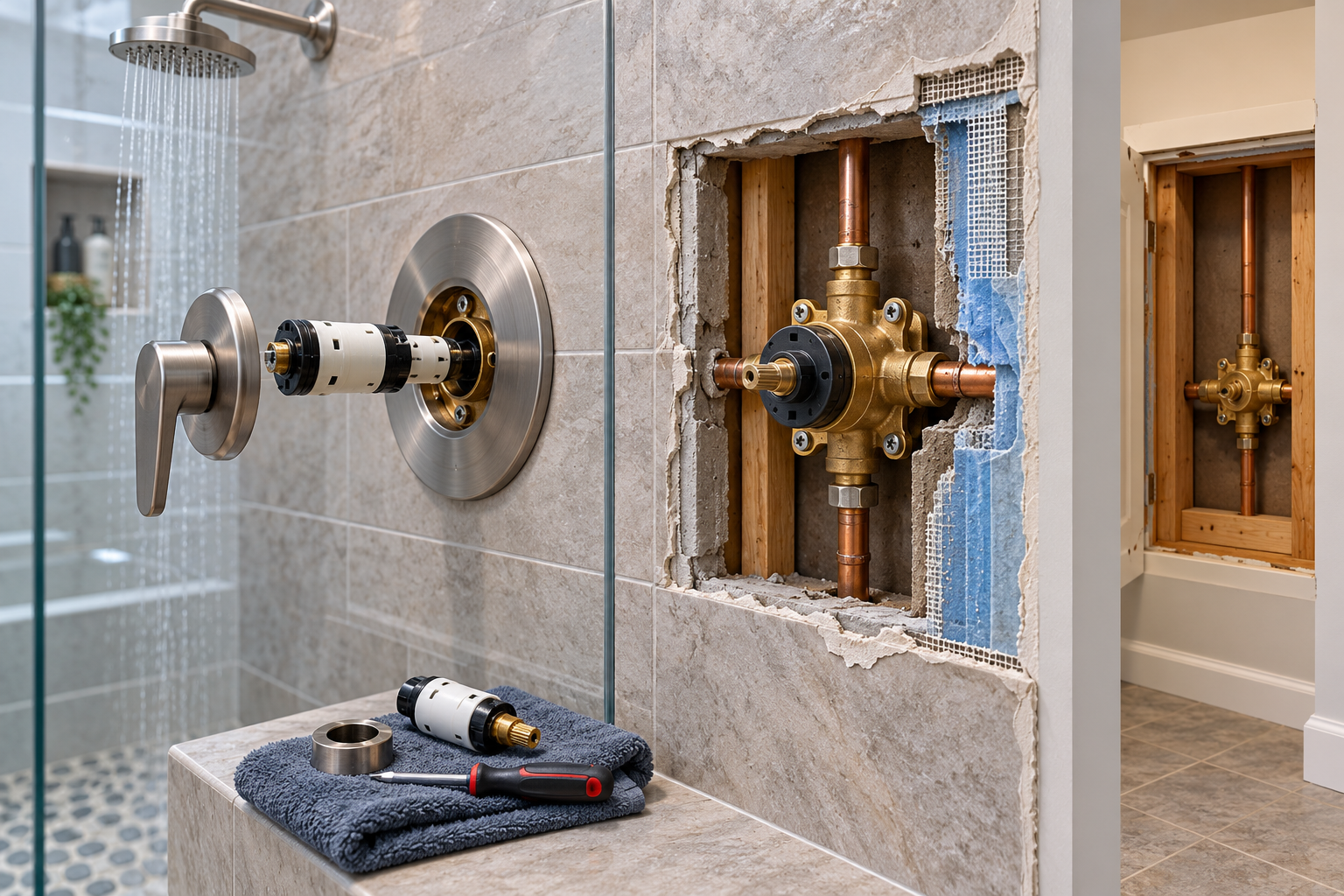
Cartridge versus valve body
A cartridge, seal, handle, or trim repair can be a focused plumbing job when the valve body is sound and the replacement part is identified. A complete valve-body replacement is a larger intervention: the plumber must reach the body, disconnect and reconnect piping, test the assembly, and make the wall or other access area serviceable.
The existing trim and the replacement cartridge or valve must be compatible. Brand names and visual similarity are not enough; model identification and manufacturer documentation matter. If the exact part is unavailable, compare a replacement valve with the cost and disruption of continued searching.
Access is the major variable
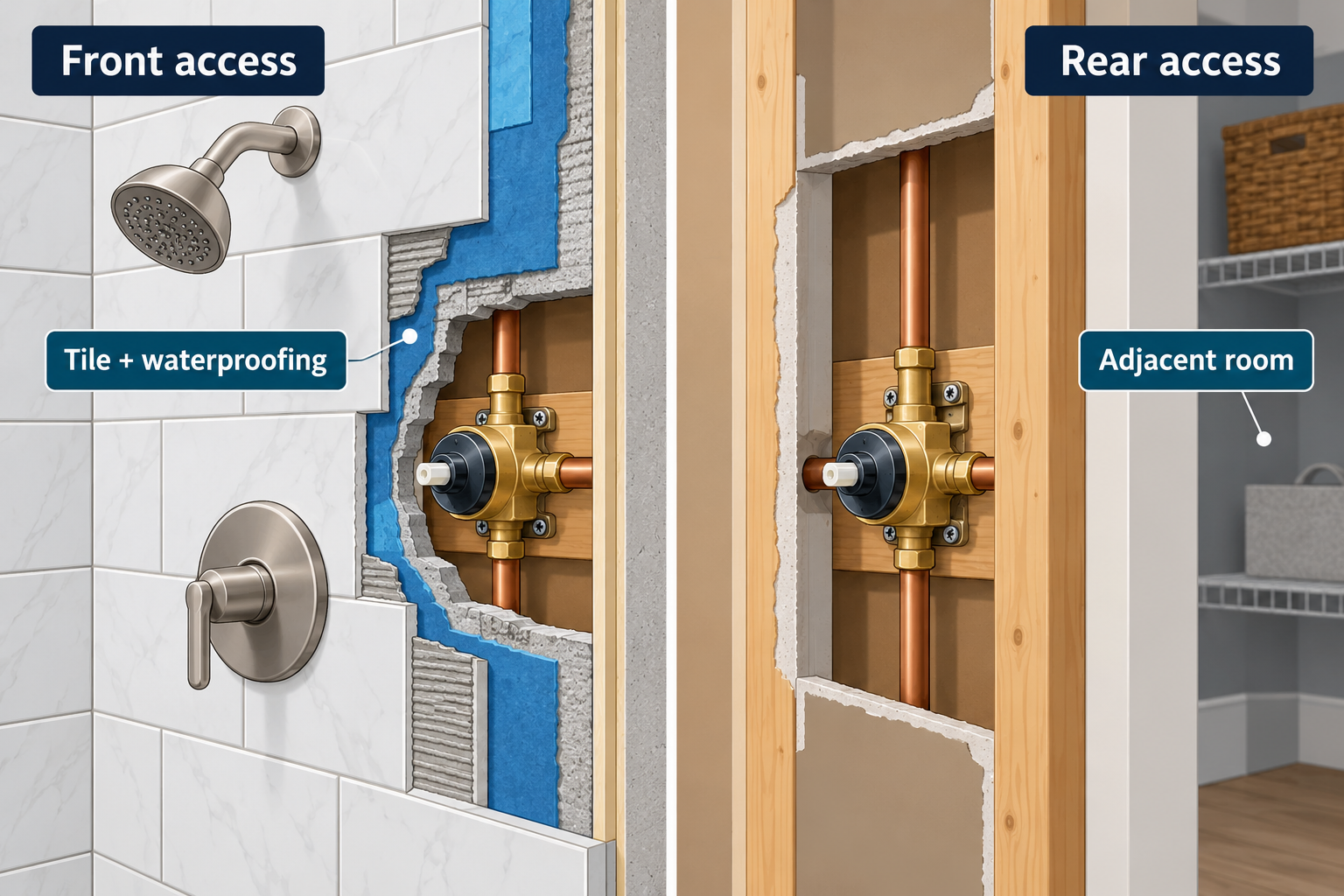
Rear access through an unfinished closet or adjacent room may reduce finish work. Front access through tile, stone, plaster, or a shower surround can require careful opening and a separate patch, tile, waterproofing, or finish scope. An access panel may be practical in one location and unacceptable in another.
Available market research does not establish a universal valve-replacement price. Angi’s 2026 U.S.-oriented guide reports $150–$550, with a $350 average, for shower-valve replacement. It does not establish whether a particular concealed-wall opening, tile or waterproofing restoration, or local permit is included. Ask for the opening assumption, protection, cleanup, testing, and who will restore the finished wet-area surface.
Cost drivers
- confirmed cartridge or valve-body failure;
- model and trim compatibility;
- front versus rear access;
- pipe material, corrosion, and space to work;
- pressure-balancing or temperature-control configuration;
- wall, tile, tub, or shower-surround opening;
- testing and leak observation after the work; and
- whether the bathroom is already being remodeled.
Three project cases
Cartridge repair: The part is identified, access is straightforward, and the valve body is sound. Labor and the replacement component make up the main scope.
Concealed valve replacement: The valve body is confirmed to be the problem. The quote should include opening, plumbing, testing, temporary protection, and a defined finish-restoration boundary.
Wet-area expansion: Corrosion, inaccessible piping, failed waterproofing, damaged tile, or a planned shower/tub change makes this more than an isolated valve job. Route waterproofing, tile, tub, or shower reconstruction to the room-level scope and show the plumbing portion separately.
Safety and temperature-control boundaries
Shower valves can involve pressure balancing or temperature control. Code requirements, product compatibility, and setpoints are not universal. Do not publish a generic temperature adjustment or DIY concealed-valve procedure as if it were safe for every installation. Use qualified service and current local and manufacturer requirements.
Quote questions
- What evidence identifies the cartridge, trim, or valve body as the failure?
- Is the replacement part verified for the existing model?
- Where will access be made, and who repairs the opening or wet-area finish?
- Are piping, supports, isolation, testing, and cleanup included?
- Does the job involve a pressure-balancing or temperature-control requirement?
- Is a planned bathroom renovation the better time to do the work?
The apparent price difference between two quotes often represents two different access assumptions. Normalize the finished plumbing and restoration scope before choosing.
Ask what the valve is expected to change
A cartridge replacement may restore shutoff or temperature control without changing the plumbing body. A complete valve replacement may be warranted when the body is damaged, incompatible, or inaccessible for a durable repair. If the complaint is only low flow at the showerhead, a valve replacement may be the wrong scope; a restrictor, supply, pressure, or fixture issue may be involved. The proposal should connect the diagnosis to the promised result.
Manage the opening risk
Before approving a concealed repair, ask who will locate utilities, protect the wet area, make the opening, remove debris, and restore waterproofing or tile. A plumber’s rough closure is not necessarily a finished waterproof wall. If matching tile is unavailable, the visible restoration can become the homeowner’s largest unexpected cost. A rear access route may be cheaper but can affect another room; price both where the decision matters.
When to coordinate with a remodel
If the shower, tub, waterproofing, and tile are already near the end of their useful life, compare an isolated valve job with doing the valve during a planned wet-area renovation. That does not justify a remodel solely because access is difficult. It does mean the timing can change the economics: opening the wall once may avoid paying twice, while an unnecessary room rebuild can overwhelm a focused repair.
Set a completion standard
The plumbing portion should end with stable operation, leak testing, and a clear handoff for the wall or wet-area finish. Ask whether the contractor will supply photographs and identify the exact cartridge or valve installed. If the finish contractor needs a different opening or a longer lead time, agree on the sequence before demolition begins.
For a rental or sale, document the corrected symptom and the exclusions. For a long-term owner, include future access and parts availability. These details can justify a slightly different scope without turning a concealed valve repair into a generic bathroom remodel.
Make access and finish responsibility explicit
Ask the plumber to mark the proposed opening and state whether the wall, tile, waterproofing, or surround will be left rough or finished. A front opening through a wet area can require a finish trade; rear access can shift the repair to another room. Include protection, debris removal, leak testing, and photographs before closure.
For a valve that is difficult to identify, pay for model confirmation before buying a replacement. If the part is obsolete, compare a compatible cartridge search with a complete valve and finish project. The best scope restores the intended temperature and flow behavior without adding unrelated wet-area renovation.
Diagnose temperature and flow separately
A shower complaint can come from a cartridge, pressure-balance or thermostatic component, stop, diverter, showerhead, supply restriction, or a broader pressure problem. Ask which fixtures were tested and whether the symptom follows the valve or remains elsewhere. A new trim kit may change appearance without correcting a failed internal body, while a complete valve replacement may be excessive if a serviceable cartridge is available.
Record whether the problem is dripping when closed, difficult adjustment, temperature fluctuation, weak flow, or poor transfer between tub and shower. These are useful decision categories, not proof of a particular part. A contractor should explain the first test and the condition that would justify opening the wall.
Price wet-area access honestly
Front access can involve tile, waterproofing, a surround, or a finished wall. Rear access can affect a bedroom, closet, cabinet, or fire separation. Ask who protects the area, who makes the opening, whether waterproofing is restored, and whether finish matching is included. If a remodel is already planned, coordinate the valve work before the new surface is installed.
If the valve body is concealed and the opening location is uncertain, request an exploratory allowance and a defined change-order rate. Do not accept a “complete replacement” price that assumes access is free while another trade owns the surface restoration. A low plumbing number can be a high project total when the opening and closure are omitted.
Commission the finished valve
At handoff, test hot and cold operation, temperature stability, diverter function, shutoff behavior, tub spout or showerhead flow, and visible connections. Record the valve and cartridge model, photos before closure, and any limitation on future service. If the home has occupants with different temperature needs, explain the control range without promising a universal setting.
The completed scope should leave the wet area watertight and the service path understandable. A repair that stops the drip but leaves a damaged surround or inaccessible shutoff is not the same decision as a fully restored bathing area.
Coordinate the valve with the finish schedule
If a wall, tile, surround, or waterproofing system is already scheduled for renovation, set the valve depth, trim, opening, and testing sequence before the finish is installed. If no renovation is planned, compare a service opening with a broader surface replacement only when the additional work provides a clear benefit. Keep plumbing access and finish restoration as visible costs.
For a rental or sale, document the model and the completed temperature and leak test. For a long-term owner, consider future cartridge access, replacement availability, and the location of shutoffs. A compatible repair can be better than a new valve when the body is sound, but a concealed obsolete body may justify the planned disruption of replacement.
At handoff, state what was opened, what was restored, and what was not inspected. This makes a later drip, temperature complaint, or finish issue easier to route to the right contractor.
Keep bathing performance in the scope
Ask whether the test covered the tub spout, showerhead, diverter, hot and cold operation, temperature stability, and the affected shutoff. If the symptom changes with pressure or simultaneous use, the valve may not own the entire complaint. A clear baseline helps compare a cartridge repair, a body replacement, and a broader distribution correction.
Retain the model, trim information, photographs before closure, and finish boundary. If the surround or waterproofing is not part of the plumbing quote, state who restores it. The completed work should be serviceable and watertight for the actual bathing area, not just cosmetically compatible.