
Moving a water heater costs more than replacing it in place because the new location must support the equipment and all of its connections. Depending on the technology, the work can involve hot and cold piping, drain and relief routing, gas or electrical relocation, venting, combustion air, condensate, structural support, access, removal, old-location closure, permits, and finish restoration.
Why location changes the economics
The existing location may already have a suitable water route and fuel or electrical connection. A new location can be farther from fixtures, changing wait time and distribution cost, or may lack the air volume, clearances, drainage, and service access needed by the selected model. ENERGY STAR guidance for HPWHs makes room volume, airflow, condensate, sound, temperature, and electrical supply model-sensitive considerations.
DOE’s tankless-transition guideline notes that placing a unit nearer a central point can improve hot-water delivery, while also warning that moving it can require new plumbing and raise installed cost. This is a project-specific tradeoff: map the route and fixtures served before comparing relocation with recirculation or a different equipment location.
For gas or other fuel-burning equipment, venting and combustion-air conditions require qualified design and current local/manufacturer guidance. For electric or heat-pump equipment, circuit, panel, condensate, and service access may dominate. Do not use a universal per-foot relocation formula.
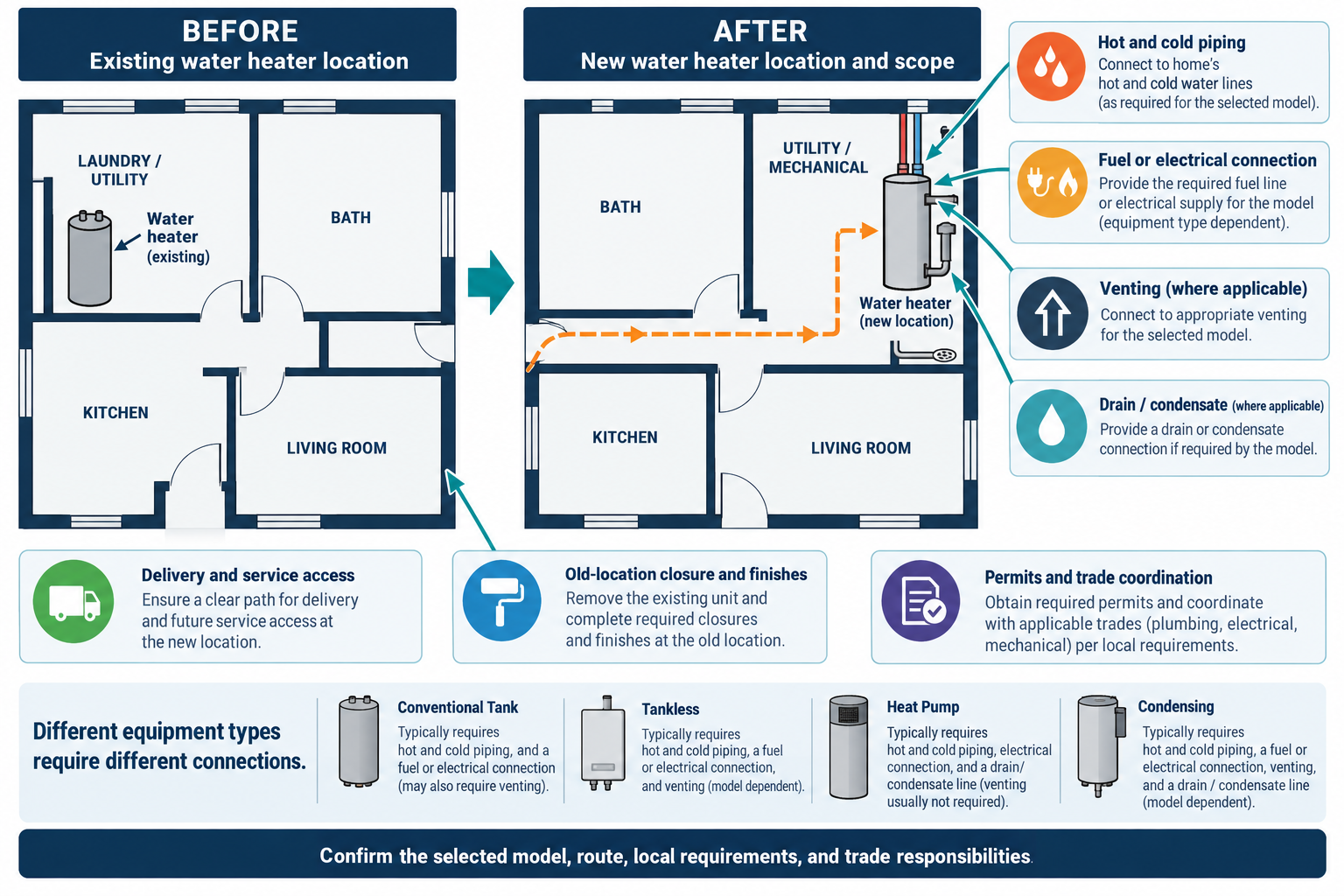
Scope to price separately
Ask the contractor to identify:
- removal, delivery, and route to the new location;
- new hot and cold water piping and shutoffs;
- drain, relief, pan, condensate, or expansion components where applicable;
- gas, fuel, or electrical work;
- venting and combustion-air work where applicable;
- support, platform, access, protection, and finish restoration;
- old-location abandonment or closure;
- permits, inspections, testing, and commissioning; and
- equipment or technology changes made at the same time.
DOE’s modeled analysis includes relocation and the related access, venting, condensate, electrical, and tempering possibilities in selected US cases. It is a partial modeled list, not a universal requirement or current market price. HomeStars provides broad Canadian installation observations but does not isolate relocation.
Scenario comparison
Nearby move with open access: The new location is close, the route is exposed, and the same technology fits. Plumbing and connection changes may be manageable, but verify service access and drainage.
Finished-area relocation: Walls, ceilings, cabinets, or floors must open. Protection, demolition, disposal, and finish restoration can exceed the cost of the new pipe.
Technology change during relocation: A tank-to-tankless or tank-to-HPWH move adds capacity, venting, airflow, condensate, electrical, sound, or control questions. Compare with replacing in place and with a separate technology installation plan.
Major conversion: The move is part of an electrification, addition, basement conversion, or room remodel. Keep electrical service, fuel switching, structural, design, and finish scopes separate so the plumbing relocation does not pretend to contain the whole project.
Ownership and operating tradeoffs
Relocation may improve access, protect the home from a leak, free space, or support a different technology. It may also lengthen hot-water runs, add circulation needs, increase maintenance access requirements, or create new damage if drainage and containment are poor. Ask what problem the move solves and whether a simpler in-place replacement or an accessible enclosure would achieve it.
Quote questions
- Why is relocation needed, and what alternative was priced?
- Does the new location meet the selected model’s space, service, sound, temperature, and drainage requirements?
- Are piping, fuel/electrical, venting, condensate, relief, expansion, access, and finish work included?
- How will the old location be closed and the new equipment commissioned?
- Who coordinates permits, inspections, electrical, gas, and restoration?
- How does the relocation affect hot-water wait time and maintenance access?
Relocation is a multi-trade project whenever the new site changes more than the pipe route. Compare the complete building work and the problem the move solves, not only the length of new plumbing.
Test the proposed location before demolition
Ask the installer to verify the equipment footprint, delivery route, service clearances, drain destination, ambient conditions, sound exposure, and fuel or electrical path before the old unit is removed. For a HPWH, room air volume and condensate are model-specific. For fuel-burning equipment, venting and combustion air require qualified review. A location that looks convenient may be unsuitable after those checks.
Compare relocation with alternatives
Relocation may free a closet, protect the unit, improve service access, or enable another technology. Alternatives can include replacement in place, an accessible enclosure, a smaller compatible unit, a new route without changing technology, or a separate room remodel. Price the alternative that preserves service first, then treat convenience or space recovery as a distinct benefit.
Sequence the trades
The project may require demolition, plumbing, electrical, gas, venting, structural support, finish work, and inspection in a particular order. Ask who owns coordination, temporary water, removal, old-location closure, and final commissioning. If the move is part of an addition, conversion, or electrification plan, keep those broader costs separate. A plumber’s relocation total is not the total cost of changing the room.
Access now and later
The delivery route is an immediate cost; future service access is an ownership cost. Ask how a technician will reach controls, filters, shutoffs, drains, relief connections, and the equipment’s removal path. A location that fits the unit but traps it behind a wall, appliance, or narrow opening can make the next repair disproportionately expensive.
Before work begins, photograph the old location and the proposed new route. Confirm which walls, floors, cabinets, platforms, or finishes will be opened and who closes them. If the move lengthens the run to fixtures, include wait time, insulation, or recirculation in the comparison rather than treating a longer pipe as free.
Define the reason for the move
Relocation may be motivated by a remodel, lost storage, flooding risk, service access, a fuel conversion, noise, or a need to meet the selected equipment’s clearances. State the actual problem and the improvement expected. Moving a heater does not automatically create more capacity, reduce operating cost, or correct a distribution delay. If the reason is access, compare a relocation with an access panel, platform, or route improvement.
Map every connection and trade
The new location can change hot and cold piping, relief discharge, drain or pan, venting, fuel, electrical supply, condensate, expansion or mixing components, controls, and seismic or support details where applicable. Ask the contractor to identify each connection and which trade owns it. A plumber may install the water lines while another contractor handles electrical, fuel, venting, drywall, flooring, or cabinetry.
If the old location is abandoned, state how piping, wiring, venting, fuel, drains, and penetrations are capped or made safe. If the new location is in a closet, attic, garage, crawlspace, or finished room, confirm access for delivery, removal, inspection, service, and eventual replacement. A location that fits today’s unit may not fit the next one.
Price the effect on daily use
Moving farther from fixtures can increase wait time or alter recirculation needs. Moving closer to living space can change sound, heat, drainage, or storage use. Ask for the intended household result and the test that will show whether it was achieved. For a rental or sale, include labeling and a handoff record so a future occupant knows the shutoff and service route.
At completion, document the model, connections, access, testing, finish boundaries, and any temporary or deferred work. A relocation is complete only when the equipment is connected, commissioned, serviceable, and the old and new building conditions are understandable.
Confirm the new location before closure
Walk the proposed route with the installer before walls, cabinets, platforms, or finishes are closed. Mark the heater, shutoff, relief discharge, drain or pan, service clearances, electrical or fuel connection, and removal path. A location can satisfy the initial footprint and still make a future filter change, control repair, or replacement delivery impractical. If the route depends on a removable panel or temporary opening, include that access in the finished design.
Check the effect on the rest of the home. A longer hot-water run can alter waiting time and distribution loss; a location near a bedroom or living area can alter sound; a new drain or vent path can affect another room. Ask the contractor to identify the expected change and how it will be observed. If the move is part of a remodel, coordinate it before the finish plan is final.
The quote should separate plumbing, equipment, electrical or fuel, venting, finish, delivery, removal, and inspection responsibilities. At handoff, retain route photos and a marked-up plan. That record protects future service access and makes clear which old connections were abandoned rather than simply forgotten.
Compare relocation with a smaller correction
If the problem is storage, noise, access, flooding exposure, or a planned remodel, price the focused correction alongside the move. An access panel, platform, improved drain, equipment replacement, or room-level change may solve the stated problem with less new piping and fewer trade handoffs. If relocation remains the best fit, the quote should name the benefit it is expected to deliver.
Before approving the route, confirm how water is isolated, how the heater is drained, how the relief path works, and how the unit can be removed later. Keep old piping, venting, fuel, wiring, and penetrations visible in the closeout record. The new location should be understandable to the next owner and usable by the next service technician.