
Tankless, or instantaneous, water heaters heat water on demand rather than retaining the same storage reservoir as a conventional tank. A like-for-like tankless replacement can still require substantial work, and converting from a storage tank is a different economic decision because capacity, fuel, venting, electrical service, controls, and water connections may change.
Broad market context
HomeStars reports illustrative Canadian ranges of about $1,320–$3,700 for tankless work in one plumbing guide and broader equipment/installation ranges in another. Those guides use different scopes and are not a normalized market estimate. A Canadian plumbing provider separately publishes CAD $3,000–$6,500+ for gas tankless units listed at 6–11 GPM and CAD $2,500–$5,500+ for electric tankless units, with gas/venting/condensate or dedicated circuits/panel capacity identified as cost drivers. The provider does not describe a representative quotation sample; its bands exclude sales tax and municipal permit charges. Angi’s 2026 U.S.-oriented Cost Insights table gives a $1,400–$3,900 tankless replacement range, but it is not a matched comparison with the Canadian provider and does not document a full project-level inclusion list. Treat both as bounded source observations rather than comparable bids; local bids should control the budget.
Replacement versus conversion
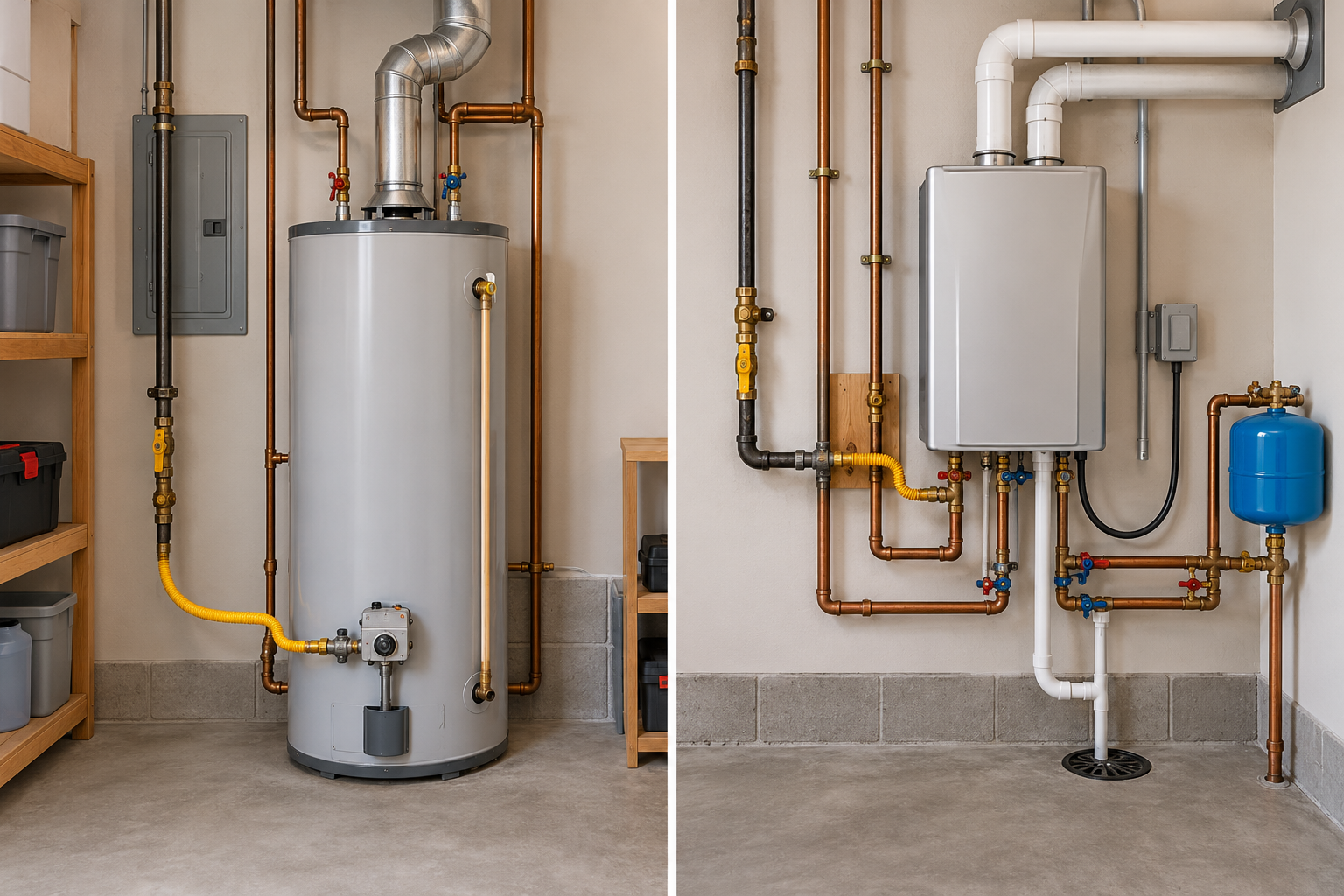
A like-for-like tankless replacement and a storage-to-tankless conversion need separate budgets. In a replacement, some gas, electrical, venting, water, and drain infrastructure may be reusable, but the new model’s input, connections, vent material, clearances, and service requirements still need confirmation. Price removal, reconnection, testing, and any correction to the existing installation. Do not treat the previous heater’s presence as evidence that all infrastructure is approved for the selected unit.
A conversion from storage may change several systems at once. The contractor may need to verify fuel input under simultaneous demand, route a different vent, provide combustion air, manage condensate, add electrical service for controls, move water connections, and create a serviceable wall location. If the existing tank is electric, available service may constrain the options; if it is gas, the existing line may still be inadequate for the new appliance. These are design questions to confirm at the property, not automatic adders for every conversion.
Ask for the two paths in separate columns: equipment and removal; reused connections and verification; added fuel/electrical, vent, condensate, or finish scope; commissioning and permit assumptions; and future service requirements. A storage replacement can remain a useful benchmark even if tankless is preferred. The installation premium should correspond to an explained demand, space, or operating benefit rather than an equipment label. An apparently lower unit price can otherwise produce a higher installed total.
Capacity and delivery are design questions
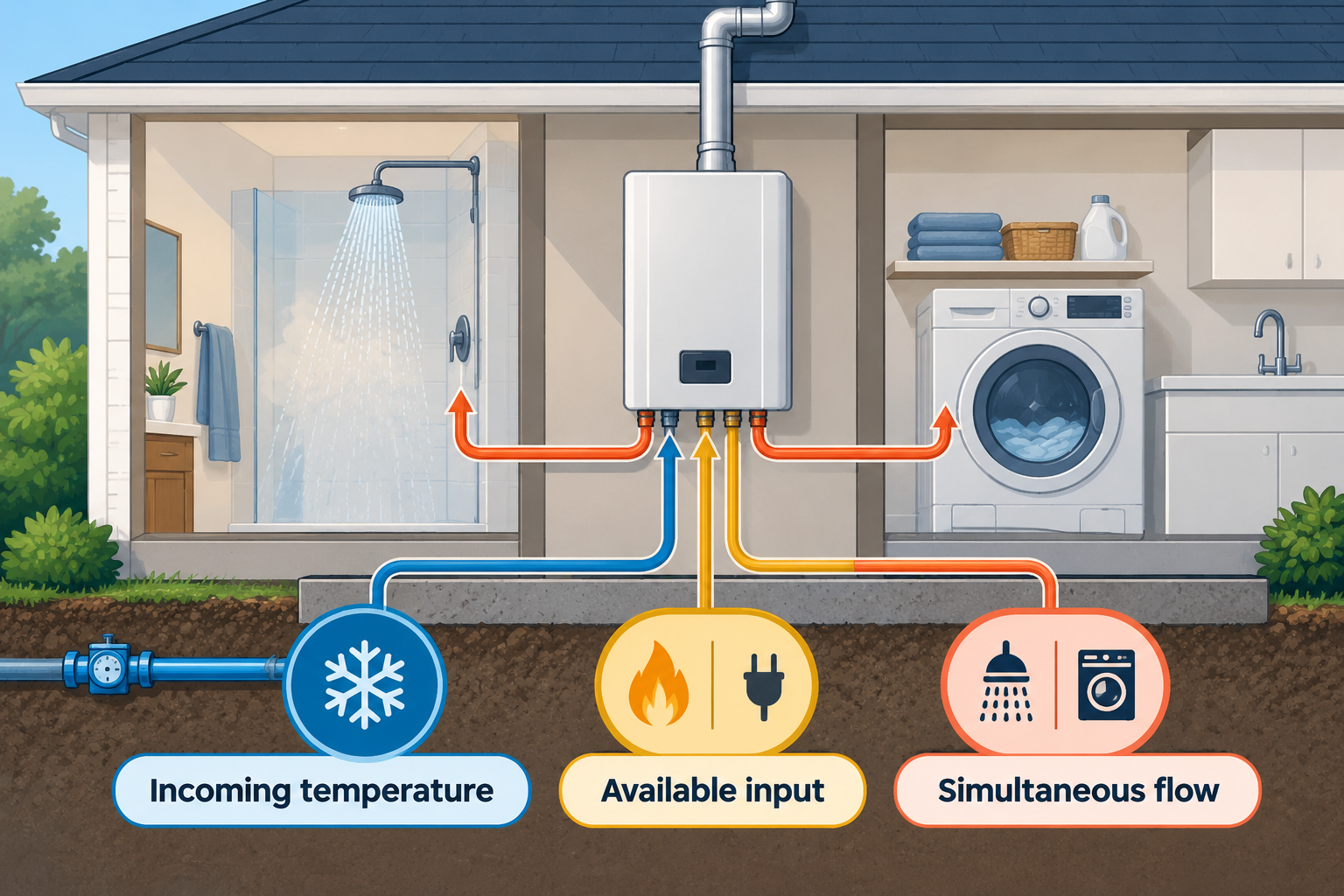
Tankless equipment is sized around simultaneous flow and temperature rise, not the storage tank’s old gallon label or a nameplate flow number without its test condition. Ask the installer to show the fixtures likely to run together, incoming water temperature, desired delivery temperature, and the gas or electrical input available at the property. Several showers, laundry, a large tub, or a recirculation loop can change the design. A multi-unit or staged arrangement may be possible, but adds controls, balancing, isolation, and service questions.
DOE’s tankless-transition guideline explains that maximum simultaneous flow and the required temperature rise determine capacity; colder incoming water requires a larger rise and can reduce available flow. ENERGY STAR likewise recommends estimating the household’s simultaneous demand and checking gas-line capacity, nearby electricity for forced-vent models, exhaust routing, and local permit requirements. Its fixture flows are examples, not a profile of this household. The selected model, qualified installer, and current local rules control the design.
The proposal should say whether it assumes a flow limit or changed household behavior and what happens at peak demand. If pressure, flow, or water quality is a concern, diagnose that condition separately: a tankless heater cannot correct a restricted service or branch, and scale management depends on the selected model and water conditions. The homeowner should be able to compare the promised delivery with a specific demand pattern rather than an advertised output alone.
Cost drivers
- equipment capacity and fuel;
- gas-pipe or electrical-infrastructure changes;
- venting, combustion-air, and condensate requirements where applicable;
- water-quality and scale-management conditions;
- removal and access;
- location, mounting, and service access;
- controls, isolation valves, and commissioning; and
- permits and inspection required by the local jurisdiction.
DOE identifies venting, flue, combustion-air, condensate, and relocation as possible adders in selected US modeled water-heater cases. It is not a universal tankless checklist. Current local code, utility rules, and the manufacturer’s installation documentation control.
Before using a future appliance standard to justify a product or quote, verify the current rule and the model’s coverage. DOE’s Consumer Water Heaters page displays a December 2029 compliance date for a gas instantaneous standard while also stating that the rule was withdrawn in 2025. The page directs readers to current CFR text; do not treat its displayed date as operative without checking the controlling rule and product class.
Operating and maintenance tradeoffs
Tankless equipment avoids storing a full tank but may need regular maintenance in conditions that promote scale, and its performance depends on correct sizing and installation. NRCan’s guidance treats ENERGY STAR status relative to product type; do not use the label to claim that tankless is universally superior to storage or heat-pump equipment. Compare energy source, local rates, demand, maintenance, service availability, and ownership horizon.
Scenarios
Tankless replacement: The existing unit’s model and infrastructure are understood, connections are accessible, and the new unit is compatible. The quote should still include removal, venting or electrical checks, commissioning, and warranty.
Storage-to-tankless conversion: New infrastructure is required. Ask for a line-by-line comparison of equipment, capacity, gas or electrical work, venting, condensate, access, permits, and restoration.
Poor-fit proposal: The home has low incoming pressure, difficult water quality, inadequate infrastructure, or demand that does not match the selected unit. Fix or evaluate the underlying condition before comparing the tankless price with a replacement.
Quote questions
- Is this a replacement or a conversion, and what infrastructure can be reused?
- How was capacity calculated for simultaneous use and incoming conditions?
- Are fuel, electrical, venting, combustion-air, condensate, and water-quality assumptions documented?
- Are delivery, removal, access, permits, testing, and warranty included?
- What maintenance does the model require and who will service it?
- How does the complete price compare with storage and heat-pump alternatives?
Tankless can be a strong fit in the right home, but the economic decision is installation-dependent. Compare complete capacity and infrastructure scope rather than the boxed unit or a generic promise of energy savings.
British Columbia posted-price context
A September 2026 British Columbia page lists a $3,500–$7,000 headline range and a typical gas-condensing installation of $5,200. Its job table gives a mid-range tier of $3,800–$6,500 (average $5,000), a premium tier of $4,300–$7,500 (average $5,800), and a storage-tank conversion tier of $4,500–$8,000 (average $6,000). Those tiers extend beyond the headline and describe different work. Use the conversion row only as broad context when the project actually changes from storage to tankless; obtain a local scope for the home’s fuel, vent, condensate, and capacity conditions. A city-adjusted estimate is still a regional guide, not a bid based on this building’s existing connections and access.
The same page lists $350–$1,400 for a single-fixture electric installation. That is a different service and is not comparable to a whole-home gas-condensing unit. The publisher says its installed ranges include equipment, labor, code-required parts, disposal, and permits. Its methodology describes seven tankless contractor-source pages, supplier equipment checks, city adjustments, and municipal/Technical Safety BC permit information; it does not establish a weighted survey of completed invoices. Its dollar sign has no ISO currency code. Treat these observations as a bounded local reference, not a guaranteed or representative quote, and do not silently convert the currency. The conversion row is especially sensitive to the existing home’s gas line, vent route, condensate path, and finish access. The publisher describes added gas-line and venting work in that category, but the row does not show which dimensions or site conditions apply to an individual job. Obtain a written scope before comparing the headline or row with an installed bid.
Compare the conversion premium and service plan
Keep a complete storage replacement as the benchmark for a conversion, then compare the extra installed investment with the benefit the household expects from changing systems. Mark costs as confirmed or allowance and identify which trade owns unresolved work. Do not count a circuit or finish project twice if it is already part of another renovation. For a like-for-like tankless replacement, ask which existing components the selected model can actually reuse at this address.
Serviceability is part of ownership cost. Ask what model-specific cleaning, filter care, or descaling the manual requires, who can perform it locally, and what routine visits cost. Check that controls, isolation points, filters, and service clearances remain accessible. If only one local contractor services the selected model, ask what response time and replacement-part availability the homeowner can reasonably expect; do not price routine maintenance as if emergency repair were included. At handoff, retain the model and serial number, settings, test conditions, warranty, service interval, and photographs before finishes close. Ask whether warranty coverage depends on a particular water condition, maintenance schedule, or documented commissioning step.
A conversion is strongest when its premium buys a defined space, demand, or coordinated-infrastructure benefit and the household accepts the resulting maintenance and service path. An efficiency label or nominal output does not establish savings or performance for this home.