
An integrated heat-pump water heater (HPWH) uses heat from surrounding air to heat water in a tank. That makes it a distinct replacement from an ordinary electric tank: the installed price depends on the equipment, room, airflow, condensate path, sound, electrical supply, tank size, access, and climate. A rebate or energy-saving claim must also be current and property-specific.
Why the location matters
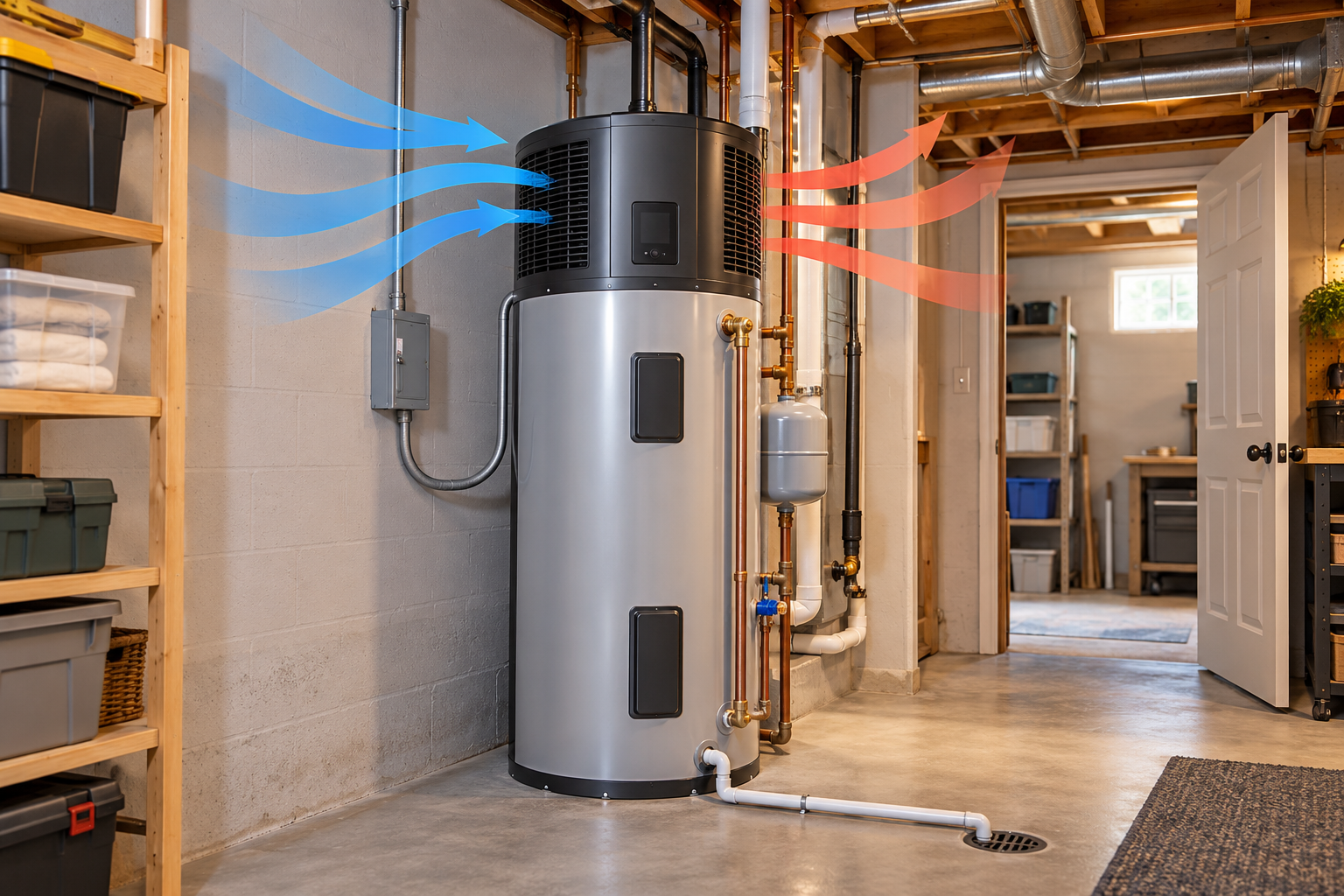
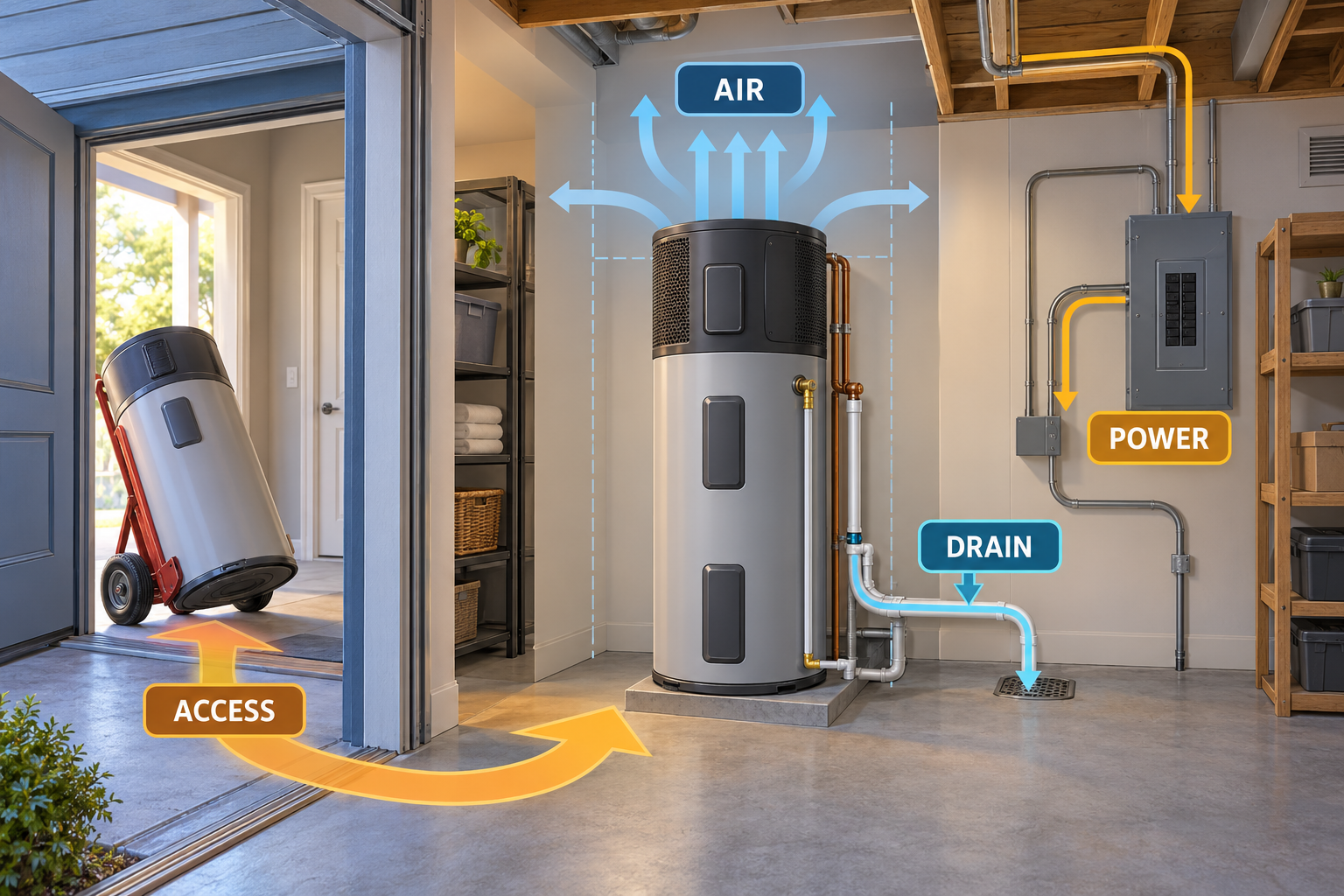
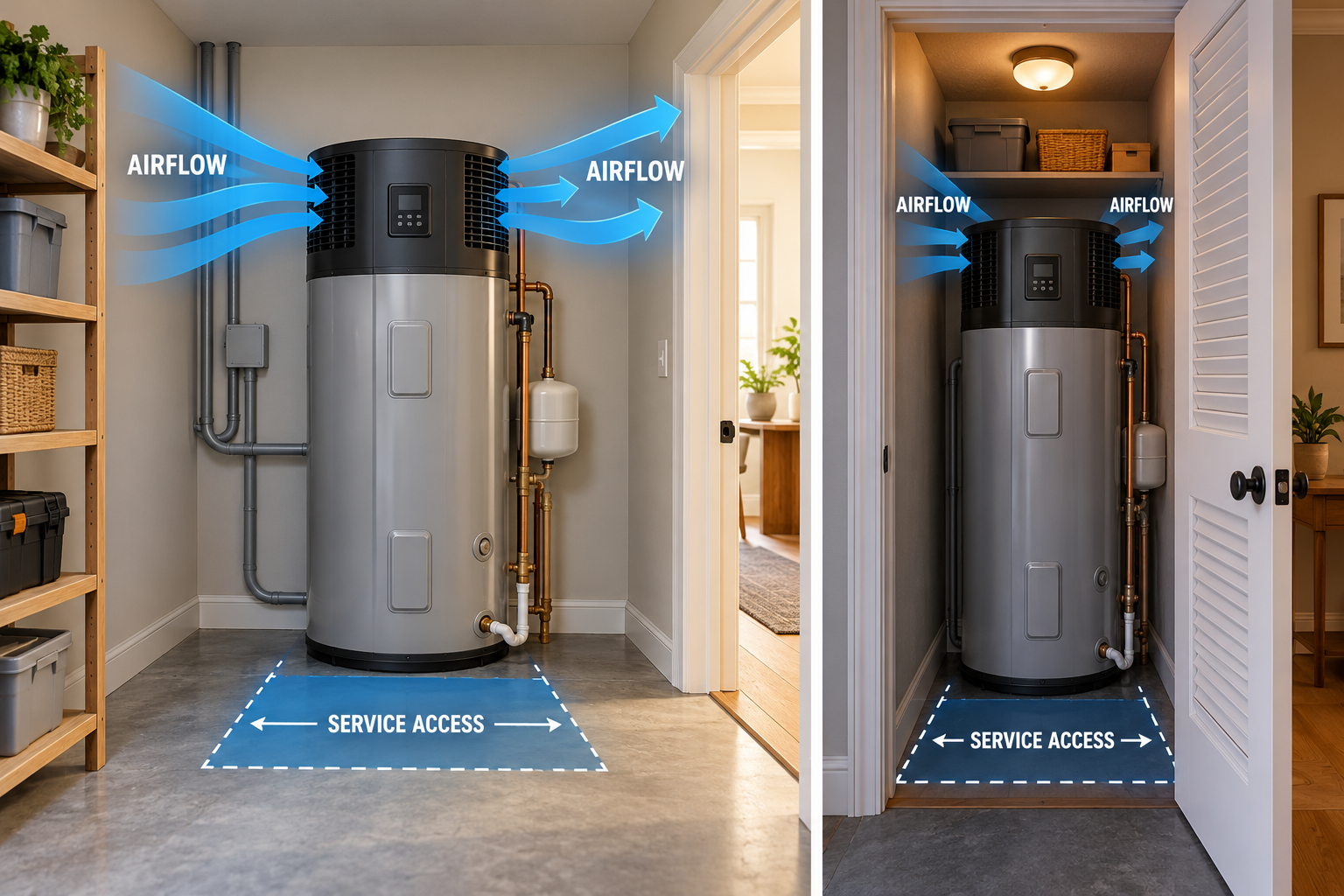
ENERGY STAR guidance says manufacturers commonly require about 450 or 700 cubic feet of free air, plus installation and service access. The exact model manual controls. A small closet can be unsuitable even when the old tank fit. A cold or non-conditioned location, a door or partition, or a planned relocation may require ducting or another design response, and some cold-climate arrangements can reduce efficiency or trigger resistance operation.
Condensate must be drained. Gravity routing, drain destination, freeze protection, and whether a pump is needed are site and model questions. Sound varies by product; ENERGY STAR’s stated Version 5.0 context uses a below-55-dBA specification, but product ratings and perception differ. Price the room and drainage work rather than assuming the appliance is a drop-in replacement.
Electrical and capacity planning
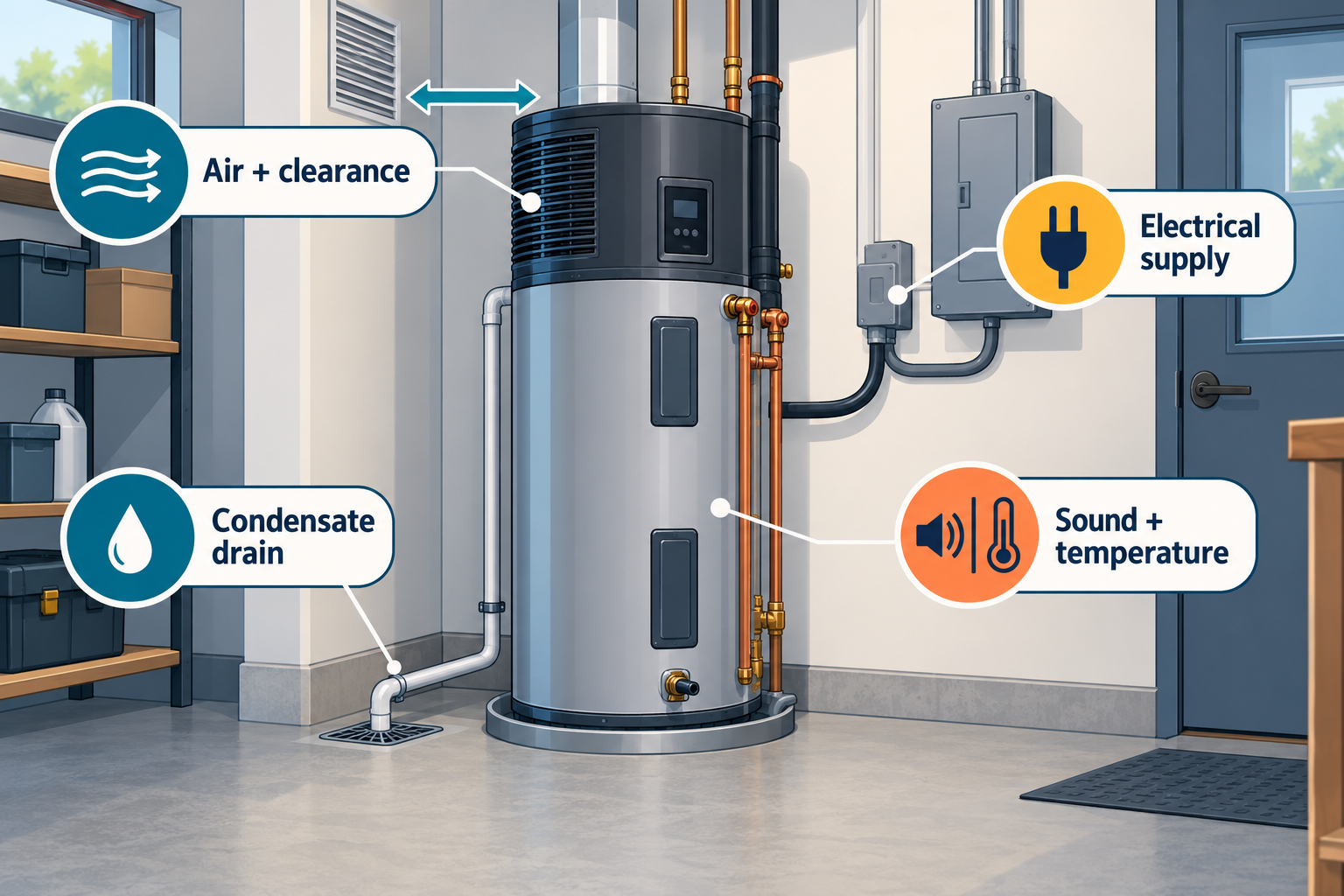
Some ENERGY STAR guidance describes 208/240-volt, 30-amp service for a new-construction context while noting that 15-amp products also exist. Follow the selected model and local electrical requirements. Do not assume a spare breaker means the existing circuit is suitable, and do not turn this article into a whole-home panel or service-capacity plan. An independent circuit or service upgrade belongs with the electrical/electrification relationship.
Tank size should reflect household demand and recovery behavior. A heat-pump unit may have different operating modes and recovery characteristics from the old tank. Ask how the installer selected capacity and whether a mixing valve or other component is required for the design; neither is universal.
Cost context and adders
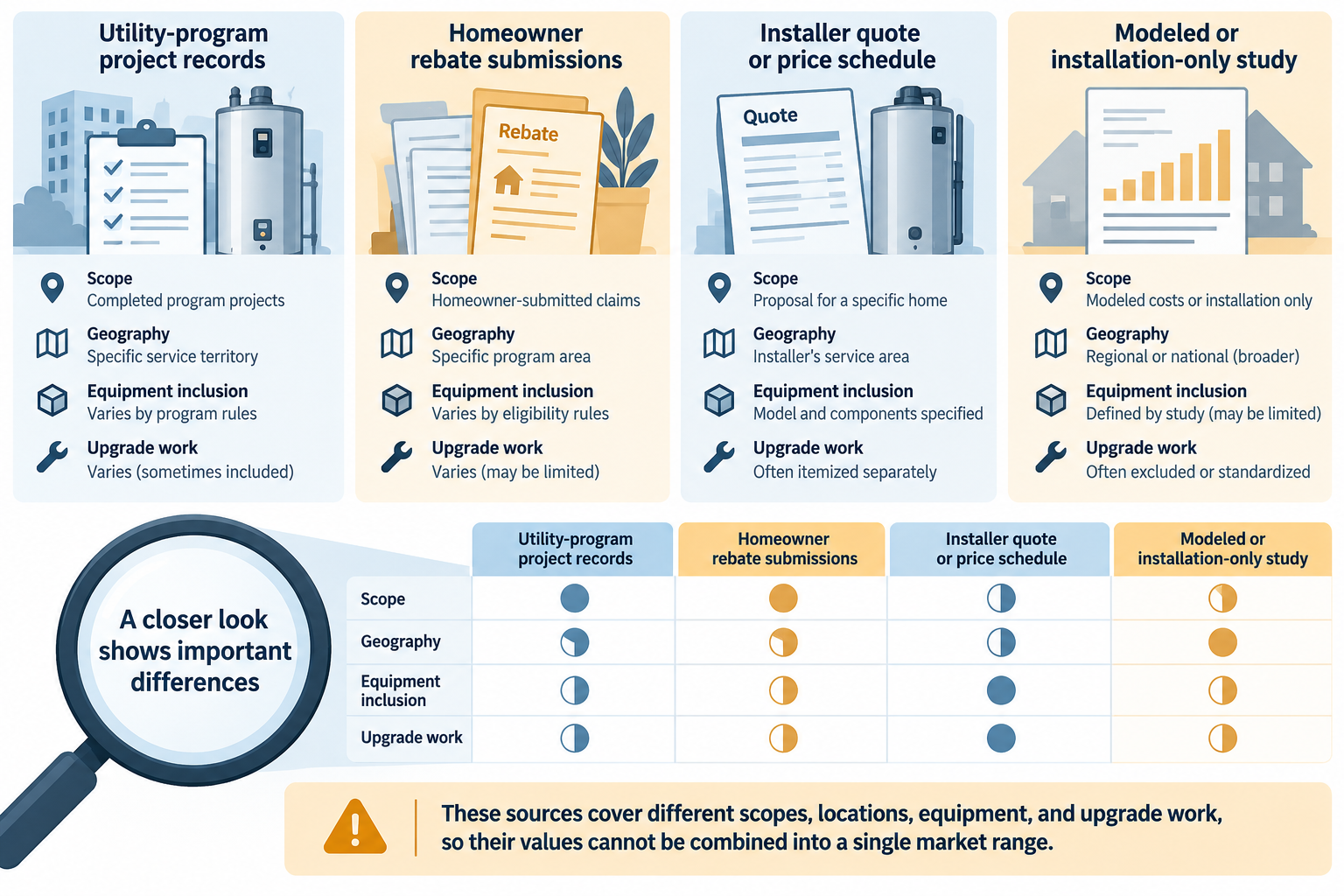
Available market research does not establish a representative HPWH-specific national US or Canadian installed range. A Canadian plumbing provider publishes CAD $3,200–$5,500+ for 50–80 gallon heat-pump models; it does not disclose a representative price method or geographic sample, and excludes sales taxes and municipal permit charges. Treat this as one dated provider observation, not a national estimate or a matched bid. HomeStars provides broad Canadian water-heater installation observations but does not isolate HPWH pricing. DOE’s US regulatory analysis identifies modeled adders such as larger-unit access, door-jamb work, tempering valve, relocation, condensate removal, ductwork, and freeze protection in some non-conditioned spaces. These are examples, not a universal installation list or current quote.
Several newer US cost sources show why unlike figures should stay separate. California’s TECH program data, summarized by CalMTA, report mean total project costs of $5,800 for 120 V projects and $7,667 for 240 V projects; the full single-family dataset averages $9,077 for projects flagged with a panel upgrade and $6,764 without one. These are program cohorts with different project mixes, not matched households, so the difference is not a causal upgrade price. WestLight separately reports $6,400, $7,200, and $7,500 average project prices for 50-, 65-, and 80-gallon systems from 1,508 customer rebate submissions. Rewiring America’s national ranges are model-derived from TECH data and location adjustments, not an independent national quote sample. A Metro Vancouver provider lists $4,500–$5,800 for 50-gallon systems and $5,500–$6,800 for 65–80-gallon systems, with removal, commissioning, permit/inspection, and other stated work included; its dollar sign has no ISO currency code and the schedule represents one provider. These observations use different project populations and scopes. Dollar signs without ISO currency codes remain as the sources display them and are not converted. They do not create a single US or Canadian range, a matched technology premium, or a quote for a particular home.
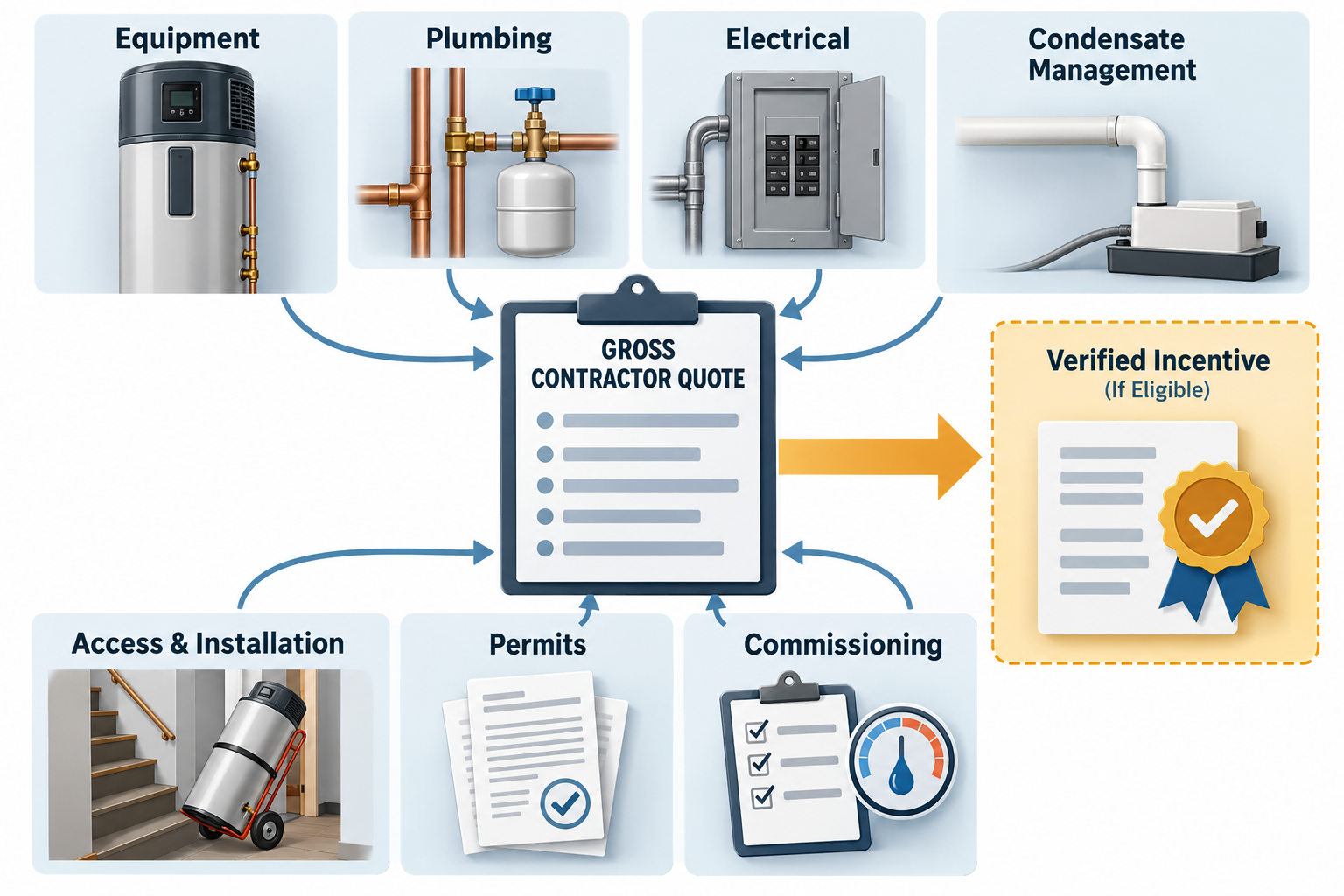
Separate the equipment price from delivery, old-unit removal, plumbing, electrical, condensate, access, drain, controls, permits, and commissioning. A quote that is cheap because it assumes an unsuitable room is not a fair comparison.
Operating context
NRCan reports “up to” comparisons for ENERGY STAR heat-pump water heaters, including up to four times more efficiency or up to 70% less energy on average than standard electric in its stated Canadian context. Those are qualified product/program comparisons, not a promise for every household. Operating cost depends on local electricity rates, usage, settings, climate, backup operation, and the actual model.
For a household estimate, start with its current water-heating energy use or a transparent hot-water-use assumption, the local marginal electricity price, and the proposed model’s rated performance in conditions resembling the installation. Then show how colder room temperatures, resistance backup, a different operating mode, or new usage changes the result. Keep the comparison in energy and cost per year, and state the billing period and rate used. If the current heater shares a fuel bill with space heating, isolate the water-heating portion rather than attributing the whole bill to the replacement decision.
This does not require a precise savings forecast. A low, central, and high-use scenario can show whether the decision depends on one optimistic assumption. Keep energy savings separate from the installed-price quote, and only subtract a verified incentive after eligibility and timing are confirmed.
A field study tested predictive control on a 50-gallon heat-pump-only setup in one Indiana home and reported lower energy cost under two time-based price cases but about 5% higher cost under its flat-rate case. Its extra sensing, flow measurement, data collection, and computing setup do not establish a current mass-market product, typical household savings, or an installation-price reduction. Treat it as evidence that tariff and controls can change the operating comparison, not as a generic rebate or savings estimate.
Scenarios
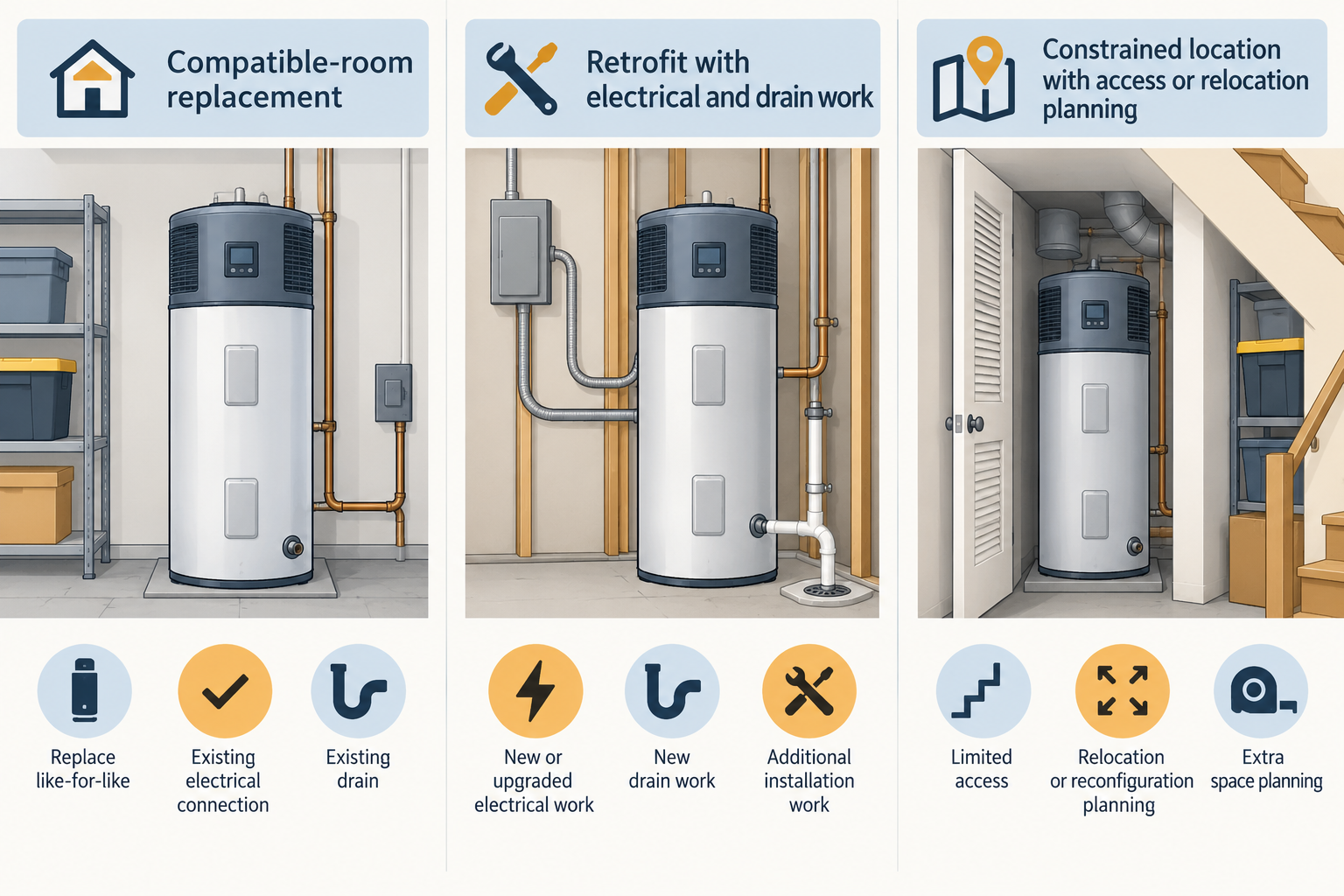
Ready-room replacement: The room has adequate air volume, service access, drainage, and a suitable circuit. Installation is closer to a planned equipment swap, though removal and testing remain in scope.
Retrofit with prerequisites: The room is tight, condensate has no route, or a circuit and drainage must be added. The project cost and schedule are driven by the building, not just the HPWH.
Poor location or coordinated electrification: The proposed location is too cold, too small, noisy for the household, or part of a broader service-capacity change. Evaluate a different location or technology and coordinate major electrical work separately.
Federal incentives and proposal status checked September 27, 2026
For US property placed in service after December 31, 2025, the federal Section 25C energy-efficient home-improvement credit is unavailable under the current law summarized by the IRS. In Canada, the Canada Greener Homes Grant is closed to new submissions; the related loan program is closed to new applications. The separate Oil to Heat Pump Affordability program is not evidence that a domestic HPWH installation qualifies. These federal facts do not establish whether a state, province, municipality, utility, or manufacturer currently offers help.
Canada’s June 2026 Amendment 19 was published as a proposed regulation in Canada Gazette Part I. As of this check it remains a proposal, not a final Part II regulation and not a homeowner installation mandate. Do not price a project as if a proposed product standard were already in force. Before signing, verify any local offer, exact model, applicant, installation date, and required paperwork with the program administrator; keep the comparison viable without support that has not been confirmed in writing.
The U.S. Department of Energy’s May 2026 HOMES and HEEHR notices are instructions to state and territory grantees, not direct household offers. HOMES includes a narrow example for central heat-pump water heaters in a multifamily disadvantaged-community incentive; it does not establish a single-family rebate. HEEHR’s revised guidance does not itself determine whether a state’s current program includes a domestic HPWH. Canada’s October 2026 National Heat Pump Rebate announcement concerns eligible air-source space-heating equipment; it does not establish HPWH eligibility. Confirm that the administering program explicitly lists domestic hot-water equipment before counting any of these initiatives toward a water-heater quote.
Selected local incentive examples checked October 11, 2026
These examples show why incentive eligibility belongs in the project worksheet; they are not a complete program directory and cannot be combined by assumption.
| Program | Published example | Conditions that change the net price |
|---|---|---|
| BC Hydro Home Renovation Rebate Program | $1,000 for an eligible electric HPWH replacement; the page displays $ without an ISO currency code |
Existing primary heater must be electric; qualifying NEEA Tier 2-or-higher model; licensed contractor with required business credentials; apply within six months of invoice. Separate multi-upgrade bonus has separate conditions. |
| Ontario Home Renovation Savings Assessment Stream | $500 for an eligible domestic HPWH; the page displays $ without an ISO currency code |
Initial assessment before work, at least two qualifying upgrades recommended in the report, and follow-up assessment; homeowner, dwelling, utility/grid, fuel, and model conditions apply. |
| Mass Save participating Massachusetts territories | $750 instant incentive for an eligible HPWH; the page’s separate $3,200 installation / $2,450 net example is based on vendor and contractor feedback | 1–4 unit residential home, participating sponsor territory, eligible ENERGY STAR model and installation in 2026; one offer per account and no stacking with another utility or efficiency-provider offer for the same equipment. The application deadline for covered 2026 installations is February 28, 2027. |
The Mass Save cost example is program-specific and is not a representative market survey or a quote for another home. The local examples above were checked on their program pages in October 2026; verify current funding, eligibility, paperwork, timing, and award before subtracting any incentive from a contractor’s written price.
Quote questions
- What model, capacity, operating modes, and manual requirements are proposed?
- Does the room meet the model’s air volume, clearances, service access, temperature, and sound needs?
- Where will condensate drain, and how is freezing handled?
- Is the electrical supply verified for this model, with electrical work priced separately?
- Are delivery, removal, access, plumbing, mixing, permits, testing, and commissioning included?
- Which incentive is current, and what eligibility evidence is required?
HPWH installation is often attractive when the home and ownership horizon fit the technology. The correct budget proves that fit first; it does not assume that a tank replacement is automatically a heat-pump installation.