
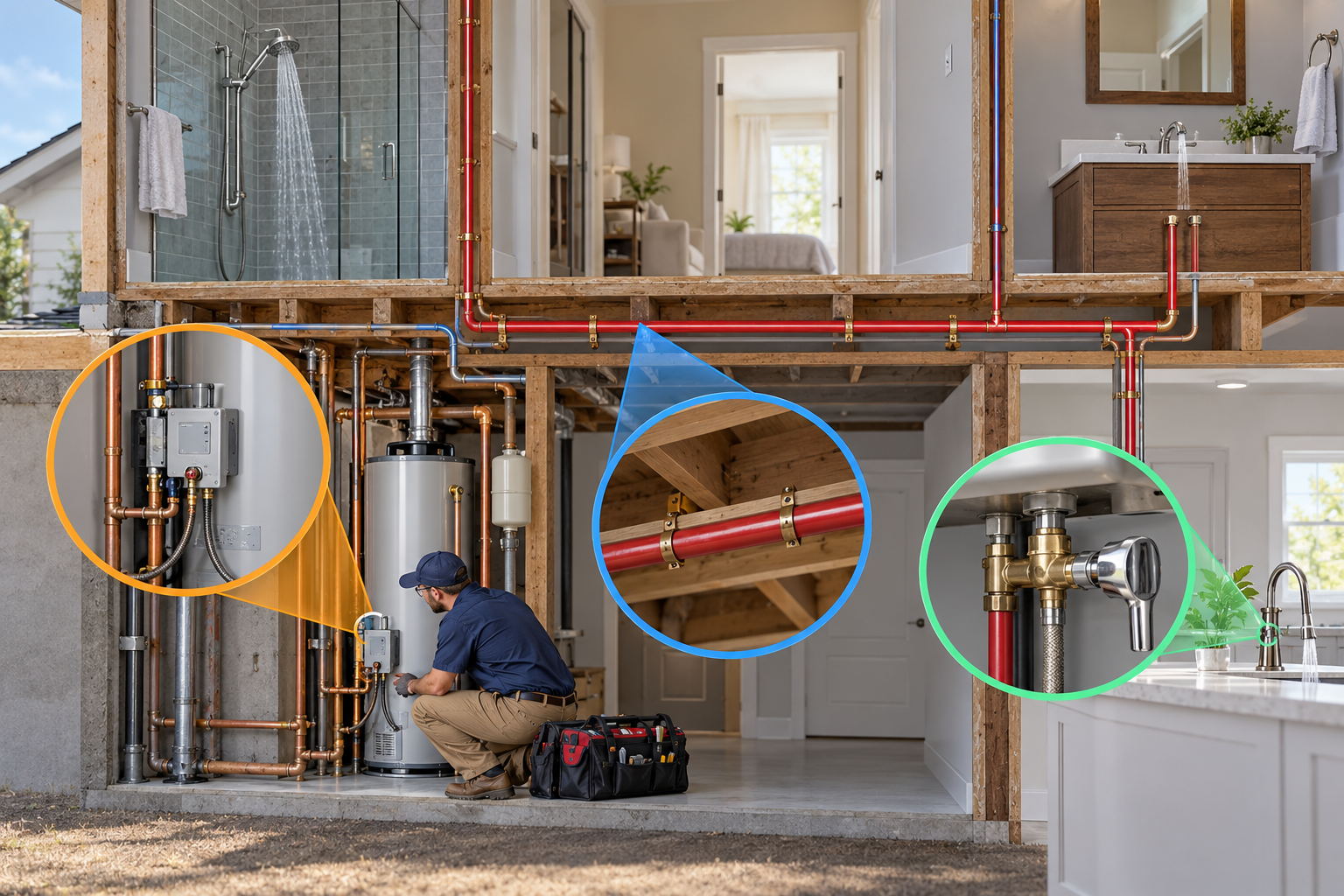
“No hot water” and “not enough hot water” describe symptoms, not one repair. The cause may be a heating or control component, burner or ignition issue, tank capacity, tankless sizing, a mixing valve, long or poorly arranged distribution, recirculation behavior, or a broader equipment failure. Diagnosis is part of the budget because the correct intervention is not visible from the complaint alone.
Start with the pattern
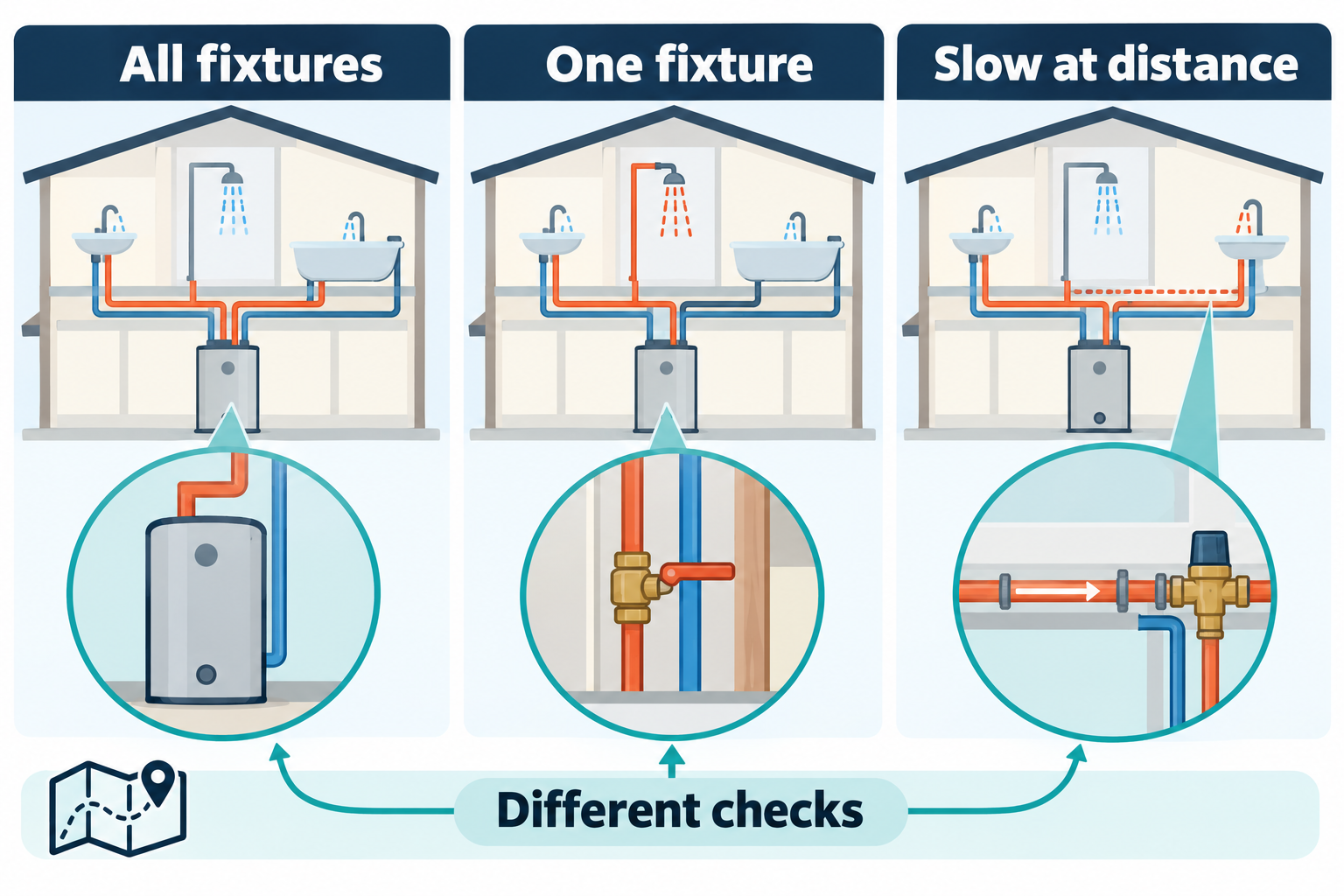
Ask where the problem occurs and when. No hot water everywhere suggests a source, control, fuel, electrical, or equipment issue. One fixture that is cool while others work suggests a local valve, connection, or distribution problem. Hot water that runs out quickly can point to capacity or recovery, while a long wait at a distant fixture may reflect layout rather than heater failure. Inconsistent temperature can involve controls, mixing, pressure, or distribution.
Distance and piping can make the wait itself the problem. DOE’s modeled distribution cases and EPA WaterSense’s delivery guide describe how pipe length, enclosed volume, layout, and insulation affect waiting time and heat loss; those sources do not establish an individual home’s savings or price. If water becomes hot eventually, compare the route, insulation, recirculation, fixture placement, and heater location before treating the delay as a failed heater.
Equipment type changes the possibilities. Storage, tankless, and heat-pump units have different controls, recovery behavior, capacity measures, and installation requirements. Use the manufacturer’s model information and qualified service for fuel-burning, energized, pressure, or scald-related conditions. This article does not provide risky testing or reset procedures.
What a repair visit may cover
A diagnostic visit may include symptom review, equipment identification, control and connection inspection, flow or temperature observations, and testing of a likely component. Repair categories can include a control, sensor, element, valve, burner/ignition assembly, filter, or distribution component. The quote should state which fault was confirmed and what the repair is expected to change.
HomeGuide reports specialist water-heater repair ranges and HomeStars reports Canadian observations around $265–$1,180, but the evidence does not provide a common US/Canadian estimate or a complete diagnostic tree. Treat market figures as broad orientation and ask what is included for labor, parts, call-out, and follow-up.
Cost drivers
- equipment type and failure category;
- diagnostic uncertainty and service minimum;
- fuel, electrical, pressure, and safety requirements;
- access and return visits;
- component availability and warranty;
- capacity or sizing correction;
- mixing, distribution, or recirculation changes; and
- replacement if the repair exposes a broader failure.
Scenario comparison
Focused component fault: A storage control or connection fault is confirmed, the equipment is otherwise sound, and the part is accessible. Repair may be proportionate.
Capacity or recovery problem: The unit operates but cannot meet demand, or a tankless unit is undersized for simultaneous use. Replacing one component will not create more capacity. Compare usage changes, distribution correction, capacity change, and replacement.
Distribution or mixing problem: Hot water exists at the heater but reaches one fixture slowly or at an inconsistent temperature. Investigate layout, a local valve, mixing, insulation, or recirculation before replacing the heater.
Broader equipment failure: Multiple symptoms, repeated service, tank leakage, obsolete support, or a failed core assembly make replacement more credible. See the repair-versus-replace guide.
Quote questions
- Is the issue total loss, low capacity, slow recovery, temperature variation, or delivery delay?
- What equipment type and model were diagnosed?
- What test confirms the proposed component or cause?
- Does the price include diagnosis, labor, parts, access, testing, and return visits?
- Could capacity, mixing, distribution, or recirculation be the actual problem?
- What is the complete replacement alternative, including installation prerequisites?
Do not make a new heater the default response to every hot-water complaint. The best budget matches the symptom to the confirmed intervention and makes the unresolved uncertainty explicit.
Build the diagnostic history
Record whether the failure affects every fixture, only one branch, only peak use, or only certain times. Note the equipment type and model, recent service, changes in household use, and whether water is hot at the heater but delayed at the fixture. This information helps the technician distinguish source capacity, controls, distribution, mixing, and local fixture issues without turning homeowner observations into a diagnosis.
Compare repair with capacity correction
If the heater works but the household outgrew its design, a component repair will not create more hot-water capacity. Options may include changed usage, a different capacity, a technology change, distribution improvement, mixing design, or recirculation. Each has a different cost and operating consequence. Ask the contractor to explain which option is being priced and why.
Safety and quote boundaries
Gas, combustion, energized electrical parts, hot surfaces, pressure, and scalding create reasons to use qualified service. A quote should state what testing is included and whether a return visit is likely. If the heater is leaking or property damage exists, price source correction and restoration separately. If the issue is a drain or water-source problem rather than hot-water equipment, route it to the relevant system scope.
Decide what “enough” means
Before approving a capacity change, describe the household’s actual use: number of occupants, simultaneous showers or appliances, peak times, and how long the shortfall lasts. A larger heater can increase equipment and installation cost without fixing a long distribution wait or a local mixing problem. Conversely, a component repair may restore heating but still leave a household with a genuine capacity mismatch.
Ask for two outcomes in the quote: the repair that restores the existing system and the alternative that changes capacity or distribution. The comparison is most useful when it shows the cost of the extra comfort or capacity rather than treating it as an unexplained upgrade.
Use the least disruptive explanation that fits
If hot water is present at the heater but delayed at a distant tap, first compare distribution, pipe length, insulation, mixing, and recirculation. If the unit shuts down, loses ignition, or cannot heat, a qualified equipment diagnosis comes first. If the water is consistently insufficient during predictable peak use, compare capacity and usage changes. These paths can share a symptom while requiring different trades and budgets.
Describe the symptom in a way a technician can test
Record which fixtures are affected, whether the problem is constant or occurs after several users, how long recovery takes, whether cold water is normal, and whether the heater displays a fault or unusual sound. Note whether the problem began after a repair, remodel, fuel change, control adjustment, or occupancy change. These observations narrow the first test without turning a symptom into a self-diagnosis.
If only one fixture is affected, compare its cartridge, mixing valve, supply, and local restriction before assuming the heater is undersized. If several fixtures lose heat at once, the source equipment, fuel or electrical supply, controls, distribution, or a central mixing component deserves priority. Ask for the proposed test and the decision it will enable before approving replacement parts.
Compare capacity with demand management
When a household runs out of hot water, the answer may be a larger storage unit, a different recovery strategy, staggered use, a repaired control, reduced distribution loss, or a local mixing issue. Ask the contractor to state the peak pattern used for sizing and what use assumption changes between options. A larger heater is not automatically the least expensive or best fit if the complaint is a control or piping problem.
Keep fuel, electrical, venting, condensate, drain, clearance, delivery, and access work visible when comparing equipment. If a technology change is proposed, price infrastructure and commissioning separately from the unit. A like-for-like diagnosis-first option gives the homeowner a useful baseline even when the eventual decision is a replacement.
Make the repair result observable
At handoff, record the test fixtures, temperature or flow behavior observed, control settings, model information, and any remaining limitation. Ask what maintenance or reset procedure belongs to the equipment and what symptom should trigger another service call. If a temporary adjustment was made, state whether it is intended to remain.
For an occupied household, include the disruption of another outage or follow-up visit in the comparison. For a rental or sale, document the condition without promising a universal hot-water result. The finished scope should explain whether it restored production, improved delivery, changed capacity, or only identified the next decision.
Keep the source system in scope
Equipment can appear to be the cause when the building-side conditions are the cause. Ask whether the fuel, electrical supply, venting, condensate, water pressure, mixing, recirculation, and distribution route were checked as applicable to the model. If a private well, shared service, or treatment system feeds the heater, identify that boundary before buying replacement equipment.
For a household deciding between repair and replacement, request a like-for-like baseline with the same capacity and a separate technology-change option. Include delivery, access, removal, infrastructure, commissioning, service, warranty, and finish restoration. An equipment label or advertised efficiency is not a substitute for a complete installed scope.
At the end of the visit, record the symptom, test condition, confirmed cause, repair or adjustment, and remaining uncertainty. A good result may be restored hot water, a more reliable delivery path, or a clear next diagnosis. It should not overstate what one heater visit proved about the entire plumbing system.
Include the household disruption
Ask how long hot water will be unavailable, whether a follow-up visit is likely, and which fixtures can remain in service. If replacement requires delivery, access, electrical, fuel, venting, condensate, or finish work, keep each responsibility visible. A fast diagnosis may be the best first step when the equipment choice depends on an unconfirmed building condition.
At handoff, retain the model, settings, test fixtures, warranty, and any limitation. The record should make clear whether the visit restored production, changed distribution, adjusted a control, or only narrowed the cause. That prevents a recurring symptom from being treated as the same failure without evidence.