
Choosing among a conventional storage tank, a tankless unit, and an integrated heat-pump water heater is an installed-system and ownership decision. Equipment price is only the opening comparison. Capacity, fuel or electrical infrastructure, venting, air volume, condensate, location, maintenance, local energy rates, and how long you will own the home can change the answer.
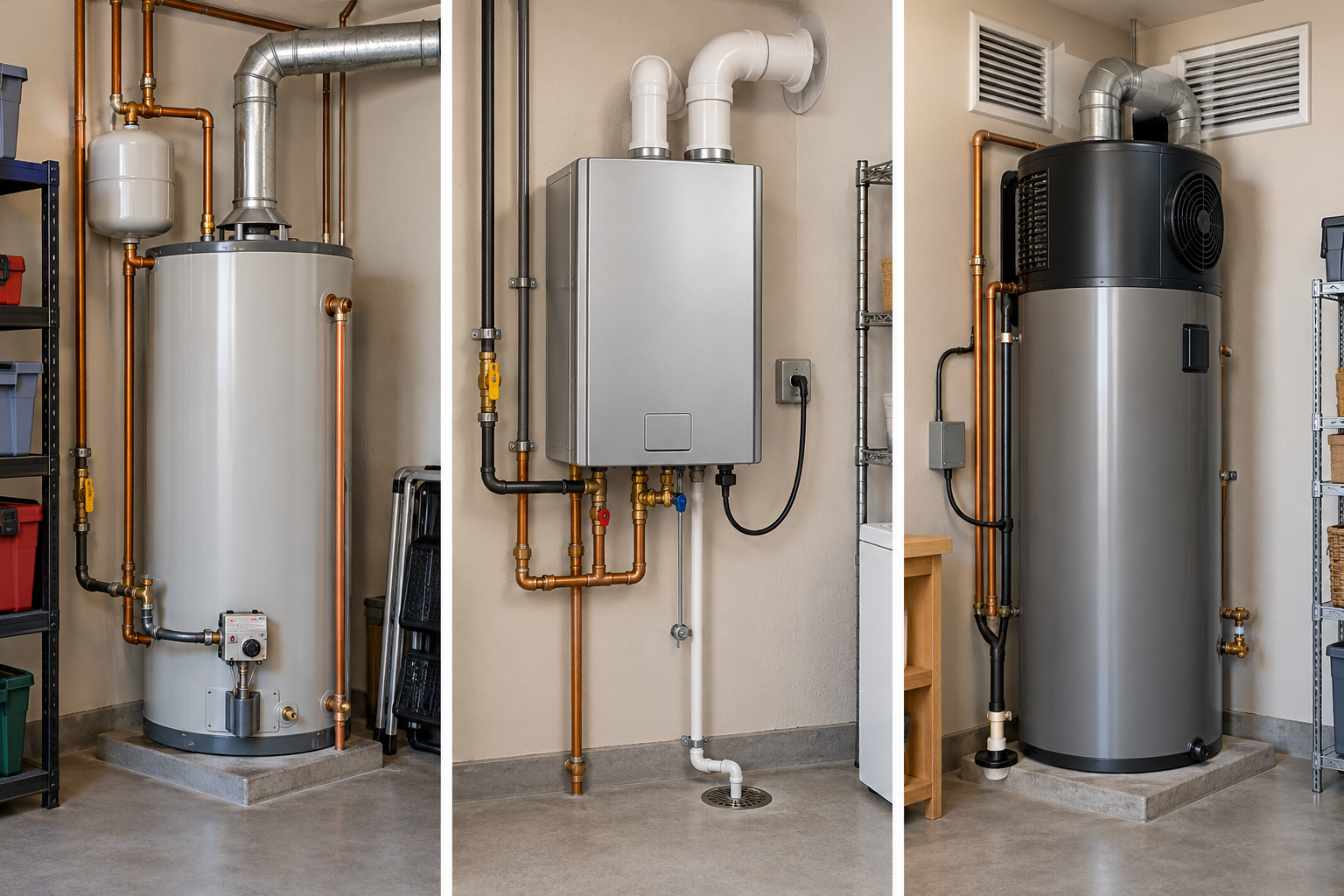
The three systems in plain language
Storage tank: Keeps a reservoir of heated water. It is familiar and often the simplest like-for-like replacement, but the tank, recovery rate, fuel, venting or electrical connection, and available space still matter.
Tankless: Heats water on demand. It avoids the same stored reservoir but must be sized for simultaneous flow and temperature rise. A conversion can require different gas, electrical, venting, condensate, or controls.
Heat-pump water heater: Transfers heat from surrounding air into a tank. ENERGY STAR guidance makes room volume, airflow, service access, condensate, sound, temperature, and electrical supply part of feasibility. A heat-pump tank is not the same installation as a standard electric tank.
Upfront installed cost
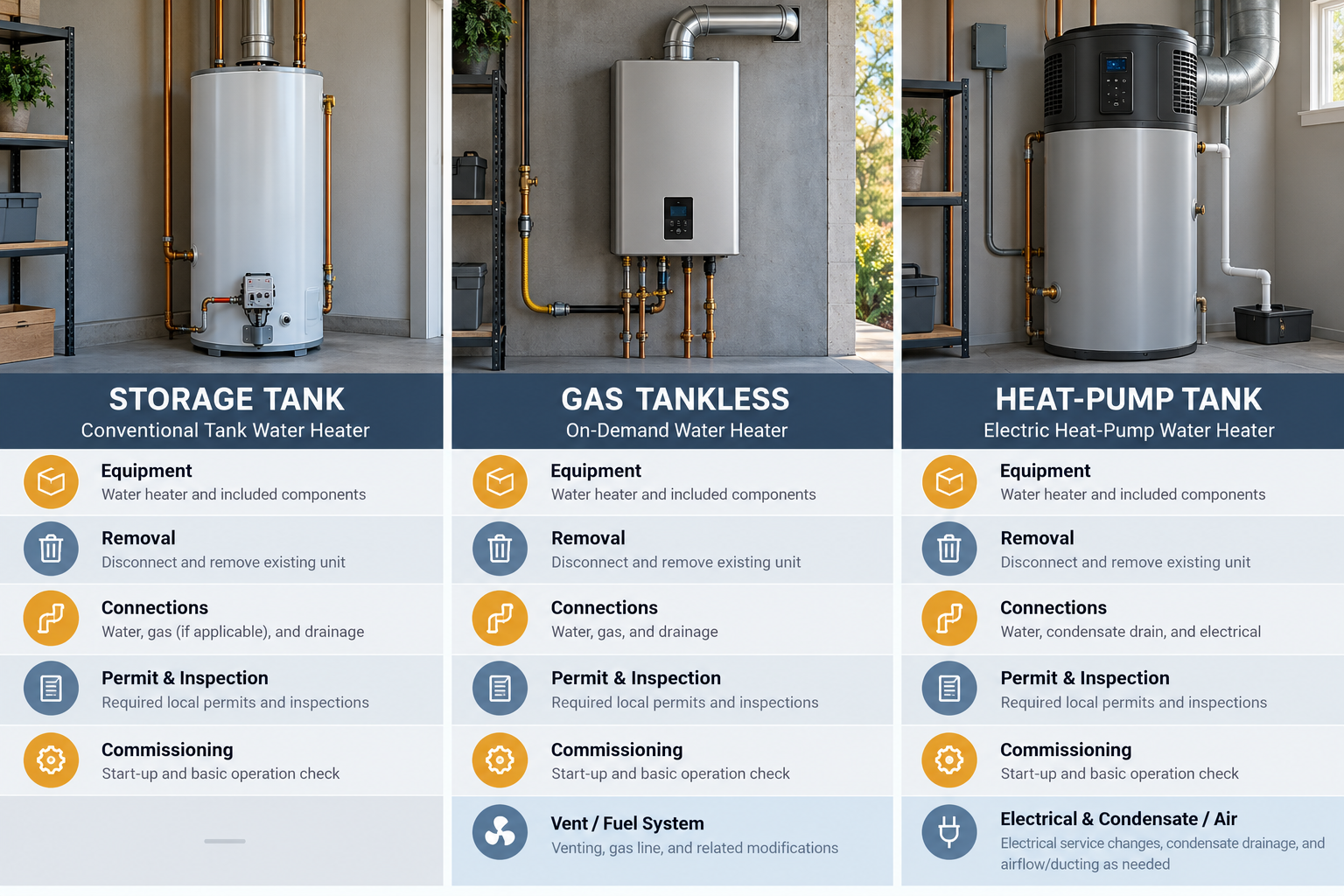
HomeStars reports broad Canadian tank and tankless observations with different scopes, including overall water-heater installation examples around $1,000–$3,500 and tankless work around $1,320–$3,700 in one guide. Its separate 2026 replacement guide lists storage, tankless, and hybrid-HPWH price ranges, but does not disclose the method, ISO currency, or consistent installation inclusions; its separate standard-tank installation figure should not be added to the replacement ranges. A Canadian plumbing provider publishes these installed-price bands by configuration: electric storage, CAD $1,100–$2,600+; gas storage, CAD $1,400–$3,000; power-vent gas storage, CAD $2,200–$4,200; gas tankless, CAD $3,000–$6,500+; electric tankless, CAD $2,500–$5,500+; and HPWH, CAD $3,200–$5,500+. Its figures exclude sales taxes and municipal permit charges, and the provider does not disclose a representative quote sample or geographic distribution. Treat these as one bounded Canadian observation, not matched alternatives or national prices. DOE’s US analysis includes delivery, removal, materials, labor, overhead, and applicable permits in modeled installation scope, with selected adders for access, venting, condensate, electrical, ducting, tempering, and relocation.
A 2026 Metro Vancouver installer also publishes one local schedule across the choices: $1,900–$2,600 for a 40-gallon atmospheric gas tank, $1,800–$2,500 for a 50-gallon electric tank, $4,200–$5,500 for listed mid-tier condensing tankless models, and $4,500–$5,800 for a 50-gallon heat-pump tank. The page describes a standard installation scope that includes the new unit, required connections, removal and disposal, commissioning, and a one-year labor warranty; gas permit/inspection and model-specific venting or condensate work apply where relevant. It displays dollar signs without an ISO currency code. These are one provider’s published prices, not matched bids or a market sample, and the model and site work differ. Use them only as a local prompt for what to compare in a written quote, not as a universal technology premium.
Compare each technology using the same basis: equipment, delivery, removal, plumbing, electrical or fuel work, venting, condensate, access, permits, commissioning, maintenance setup, and restoration. A low equipment price can lose its advantage when the existing infrastructure does not fit.
Operating-cost reasoning
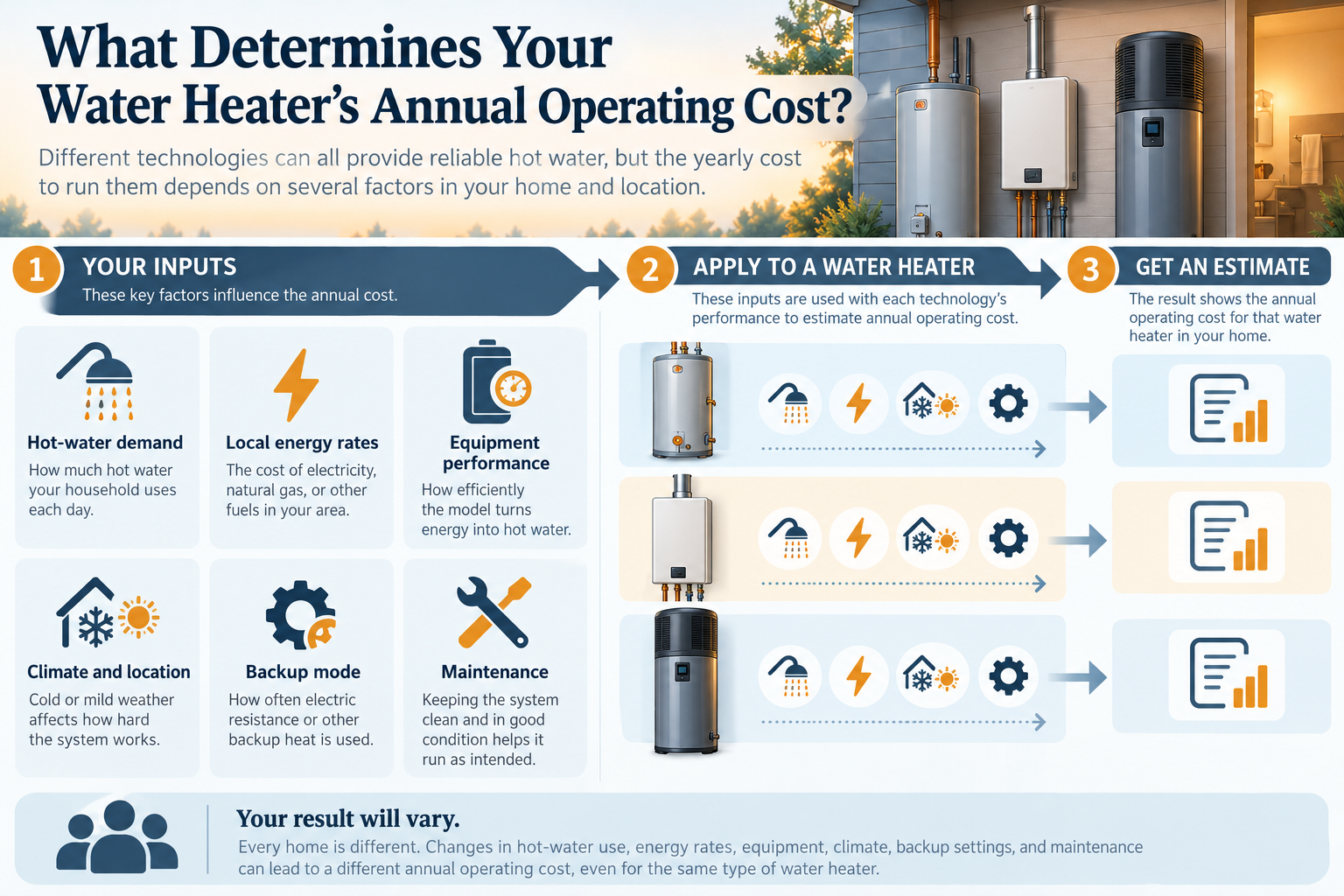
Do not claim one technology is always cheapest to operate. Use the household’s hot-water demand, local fuel and electricity rates, climate, actual efficiency data, settings, backup operation, and maintenance. NRCan’s “up to” HPWH comparisons are product- and program-qualified. A tankless comparison depends on the fuel and usage pattern; storage has different standby and recovery behavior. If a quote offers a savings projection, request its assumptions and compare them with current local rates.
A field study of predictive control for a 50-gallon heat-pump-only unit in one Indiana home reported about 23% and 28% lower energy cost under tested time-based rate cases than a 240-volt hybrid unit with standard controls, but about 5% higher energy cost under the flat-rate case. The tested controls needed additional sensing, flow measurement, and computing. This single-home research does not show that the control is a currently purchasable residential product or predict another household’s savings; use it only to see why tariff and control assumptions matter.
Capacity and delivery
Storage and heat-pump units use tank size and recovery behavior. Tankless units use flow and temperature rise. Ask how peak simultaneous use was modeled and whether a mixing valve, control, recirculation system, or larger capacity changes the result. More capacity may require more space or stronger infrastructure; less capacity may change waiting or recovery behavior.
Location and infrastructure
An existing tank location may favor storage but not tankless or HPWH. Tankless may need venting or gas/electrical changes. HPWH may need free air, service clearance, condensate, sound tolerance, a suitable circuit, and a climate-appropriate location. A relocation can become a multi-trade project. Major panel, service, or whole-home fuel switching belongs in the electrification relationship, while this article keeps the equipment choice in view.
Maintenance and resilience
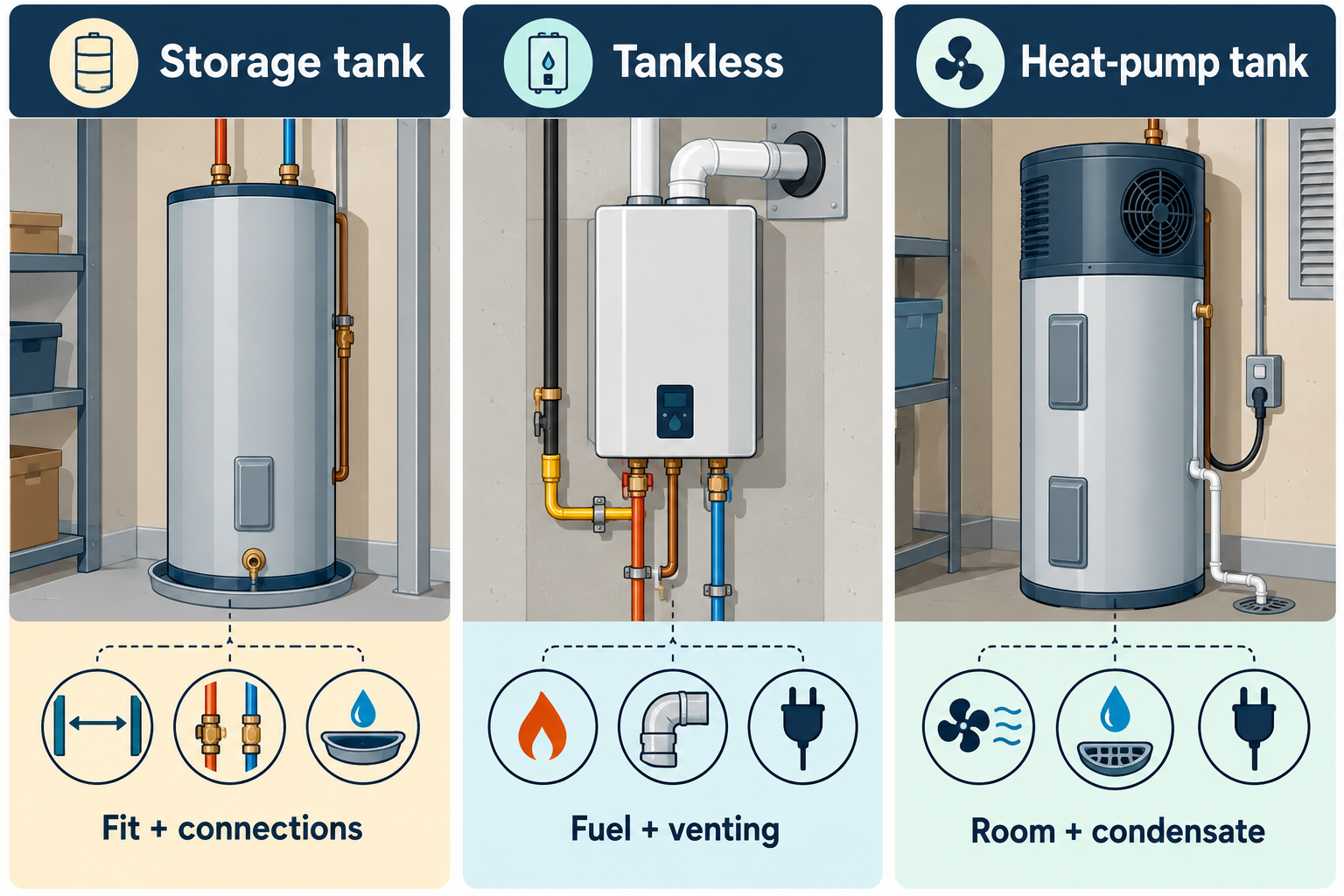
Tankless units may require scale-related service depending on water and model. HPWHs have filters, condensate, controls, and model-specific maintenance. Storage tanks have their own inspection and maintenance needs. Ask for the manual-based schedule, service availability, and replacement access.
Power and fuel dependence also matter. Ask what happens during an outage, whether backup modes change energy use, and whether a control or pump is needed. Do not treat “works without a tank” or “more efficient” as a complete resilience analysis.
Best-fit scenarios
Fast like-for-like replacement: Storage often has the fewest infrastructure changes when the room, capacity, and existing connections fit. Confirm the actual requirements and consider whether an emergency swap should be followed by a planned review.
Long-term efficiency with suitable space: HPWH may fit an owner with an appropriate room, electrical path, drainage, and a long enough horizon to value operating savings. Verify model and incentive assumptions.
Demand and infrastructure fit: Tankless may suit a household that values on-demand delivery and can support the required capacity, fuel, venting, and maintenance. The conversion scope can dominate cost.
Uncertain building conditions: Keep a storage replacement as a benchmark while pricing alternatives. A technology comparison is weaker when it hides access, electrical, venting, or condensate work.
Quote questions
- Are all three options sized for the same demand and service level?
- What equipment, infrastructure, access, removal, permits, and commissioning are included for each?
- What local energy prices and usage assumptions support the operating-cost comparison?
- How do location, sound, condensate, venting, electrical, or fuel requirements differ?
- What maintenance, service, outage behavior, and replacement access should be expected?
- Are incentives current and verified for the exact model and location?
The right choice is the one whose complete installation fits the building and whose operating and maintenance tradeoffs match the ownership horizon. A technology label is not a price comparison.
Start with the existing system and household
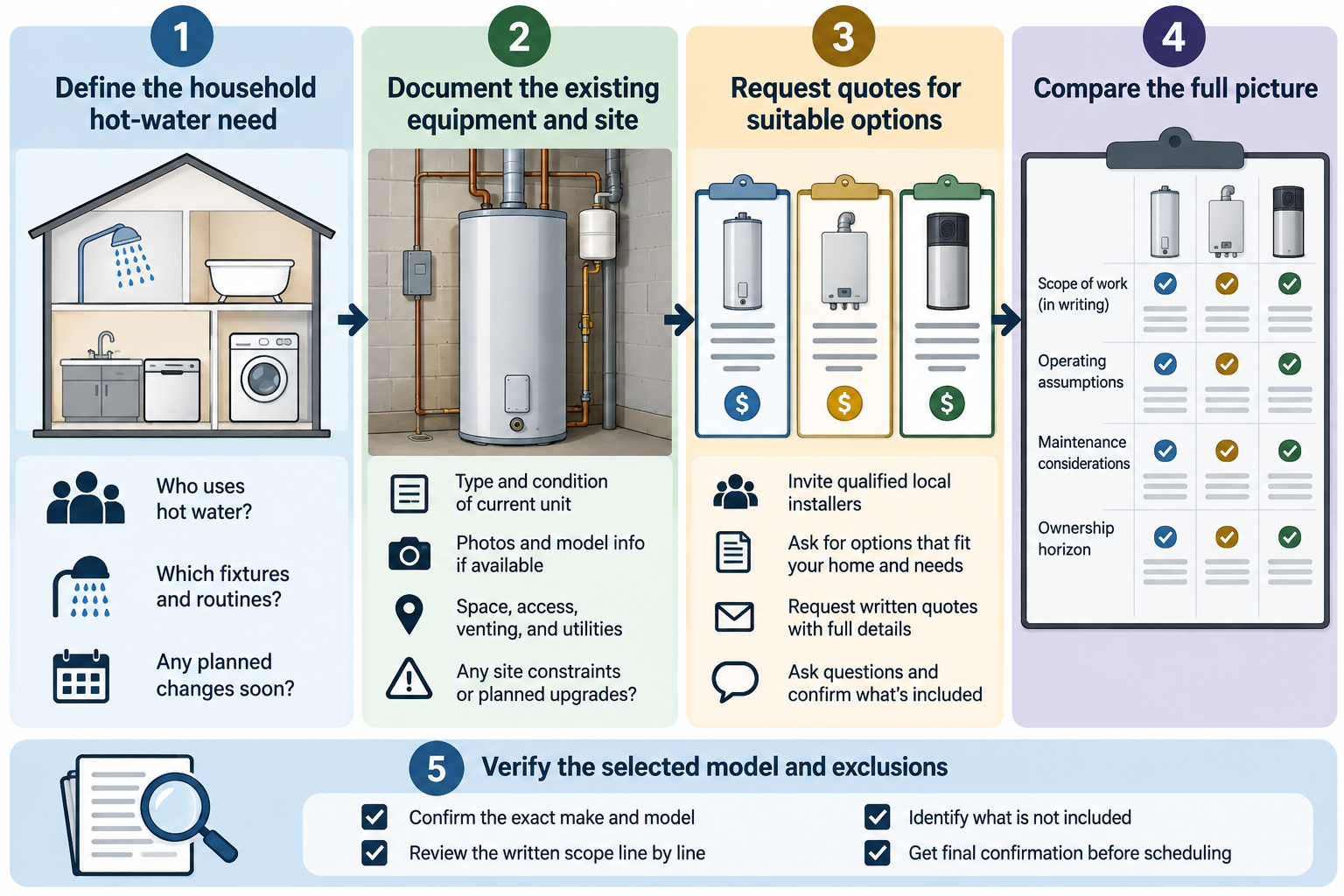
Record the current heater type, fuel or electrical service, capacity, age or condition, space, venting, drain, shutoffs, delivery route, and service access. Then describe peak demand, number of occupants, fixture timing, and tolerance for recovery or waiting. These facts create the baseline. Without them, a technology comparison can reward a specification that the building cannot install or the household does not need.
For a tank option, compare available storage, recovery, footprint, and replacement simplicity. For tankless, verify flow, temperature rise, fuel or electrical capacity, venting, service, and any recirculation interaction. For a heat-pump model, verify room conditions, condensate, electrical supply, sound, air movement, clearance, and recovery behavior. Treat each as a complete installed system rather than a product category.
Compare the project boundary
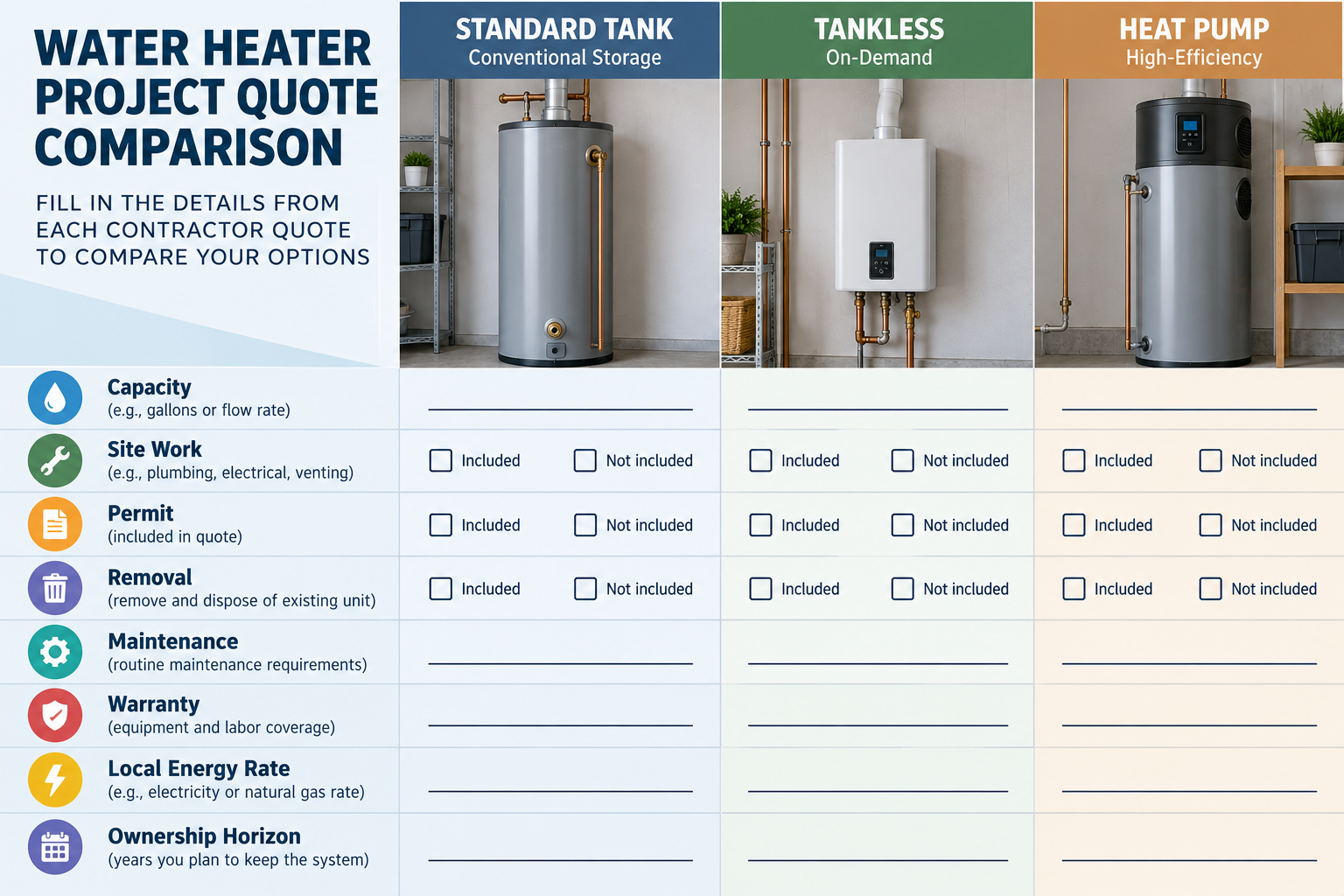
Use the same scope for every option: removal, delivery, connections, access, permits or inspections where applicable, venting or electrical work, condensate, controls, mixing or expansion components, commissioning, finish repair, and warranty. Make assumptions and allowances visible. A low equipment price can lose its advantage when it requires an unpriced circuit, a new vent route, a larger opening, or recurring service.
Keep incentives and operating assumptions separate from the contractor’s installed price. As checked September 27, 2026, US Section 25C is unavailable for property placed in service after December 31, 2025. Canada’s Greener Homes Grant and loan are closed to new participation; the Oil to Heat Pump Affordability program does not by itself establish eligibility for a domestic water heater. Canada’s June 2026 Amendment 19 remains a Part I proposal, not a final rule or a homeowner installation mandate. These federal statuses do not answer whether a local utility, province/state, municipality, or manufacturer has an active offer. DOE’s consumer page also contains conflicting text about a gas instantaneous-water-heater rule: it displays a December 2029 compliance date and states that the rule was withdrawn in 2025. Check the current CFR and coverage for the exact model before treating that date as operative. For selected BC Hydro, Ontario Home Renovation Savings, and Mass Save examples and their separate conditions, see the HPWH cost guide. Verify exact location, model, applicant, date, and paperwork with the administrator, then compare the project both with and without any confirmed amount. A program maximum is not a household savings guarantee.
Decide with a time horizon
A short-term owner may value a reliable, readily serviceable replacement and predictable disruption. A long-term owner may value operating behavior, available space, maintenance, controls, and future infrastructure. A rental, sale, or shared property adds handoff and responsibility questions. None of these horizons makes one technology universally correct; each changes which costs and risks deserve weight.
At handoff, retain the model, settings, route photographs, warranty, service instructions, and commissioning record. The decision is stronger when a future technician can understand the installation and the homeowner can explain what benefit the selected system was intended to deliver.
Use a decision table that can be checked
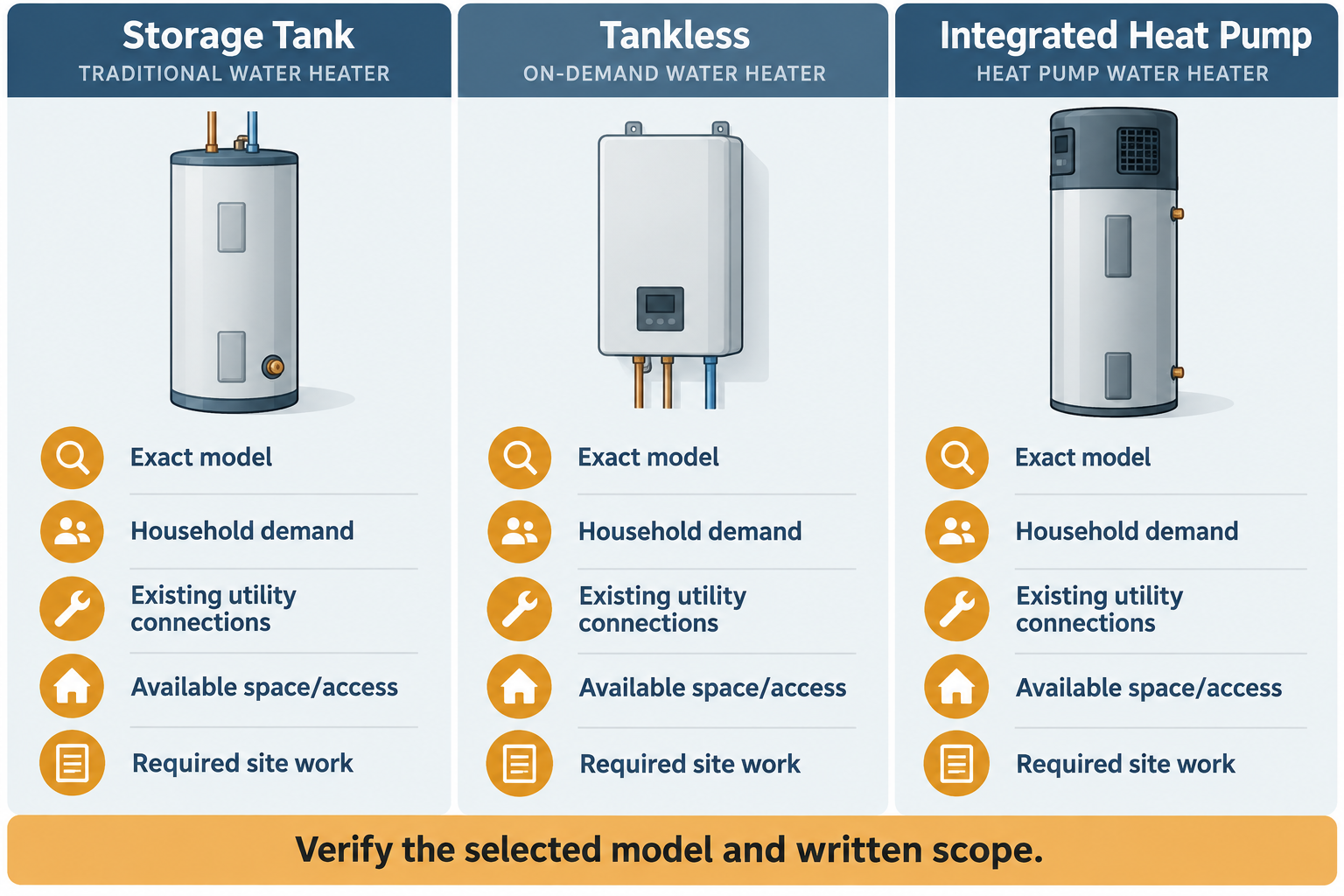
For each option, write the equipment, removal, delivery, connections, infrastructure, access, commissioning, maintenance, warranty, and expected use condition in the same order. Mark each item as confirmed, allowance, or excluded. This prevents a tankless or heat-pump option from appearing cheaper because electrical, venting, condensate, or finish work was omitted from its column.
Then record which fact would change the recommendation: an unavailable circuit, insufficient room, a different peak-demand pattern, an unverified incentive, a service limitation, or a route that cannot be opened. A conditional recommendation is not indecision; it shows where the project’s uncertainty lives. Revisit the comparison when those facts are confirmed rather than adding assumptions to the invoice.
The final handoff should preserve the chosen option’s baseline and the rejected alternatives. That record supports future service and makes the ownership result auditable without claiming a universal payback or operating-cost outcome.