
Hot-water recirculation is intended to reduce waiting at distant fixtures and can reduce water wasted while a line runs hot. It is not automatically an energy-saving upgrade. Installation cost depends on whether a dedicated return line exists, how the retrofit is routed, the pump and controls, pipe access, insulation, and the system’s interaction with the water heater.
The problem it solves
Long runs and dispersed fixtures can make hot water slow to arrive. EPA WaterSense describes demand-initiated recirculation as an option for larger homes or less-centralized layouts and notes that installation may cost more while potentially reducing waiting, water waste, and energy use when properly designed. It does not establish a universal payback or savings percentage.
Dedicated return versus retrofit
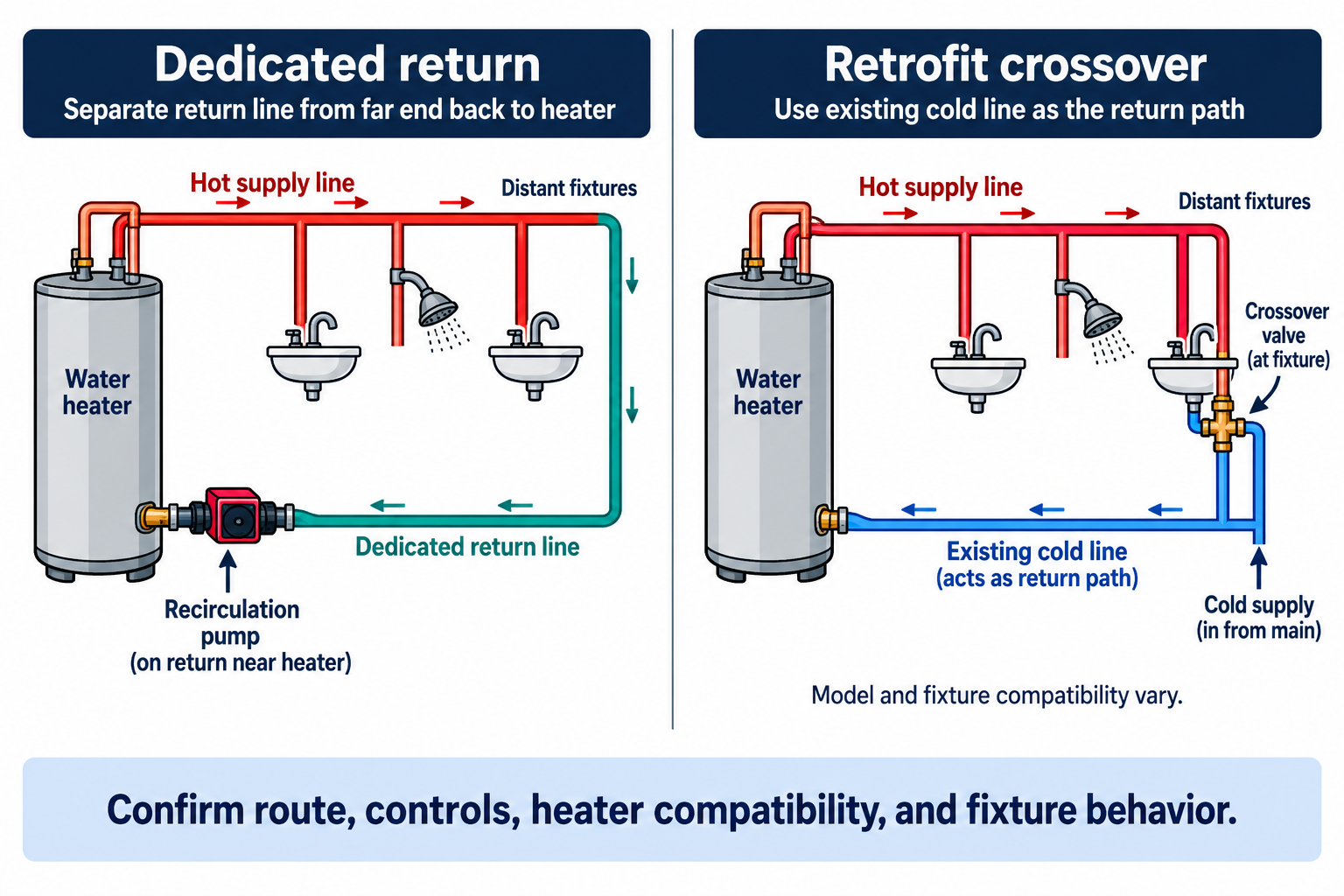
A dedicated return loop provides a separate path back to the heater and may be easier to plan in new construction or an open-access renovation. A retrofit may use existing hot-water piping with a crossover or other model-specific arrangement. The installer should document the proposed route, controls, temperature behavior, and compatibility; do not assume every retrofit works with every heater.
Components and price drivers
The quote may include a pump, timer or demand control, sensors, check or isolation valves, return piping, crossover components, pipe insulation, controls, electrical connection, access, supports, commissioning, and maintenance instructions. New construction can reduce access cost; an occupied finished home can make opening walls or ceilings the dominant expense.
Available market research does not establish a reliable installed range. Compare local proposals by complete scope, not by pump price. A short line item can conceal the route, access, control, or restoration work.
Energy and water tradeoffs
Continuous circulation can keep more piping hot and increase heat loss and pumping energy. ENERGY STAR cautions that continuous circulation can force some HPWH systems into electric-only operation and increase energy use. Controls, insulation, heater type, schedule, and the home’s layout matter. Demand-initiated operation can reduce unnecessary circulation but may cost more to install and require homeowner understanding.
DOE’s modeled cases and EPA WaterSense’s delivery guide show that pipe length, enclosed water volume, layout, and insulation affect distribution losses and waiting time; they do not set a retrofit price or establish an individual home’s savings or payback. NRCan’s guidance uses a heater-to-fixture distance of about 9 m (30 ft) as a reason to consider demand-type recirculation. That is a design prompt in that guidance, not a code threshold or universal break-even point. Have the installer map the route and operating control for the actual fixtures.
Point-of-use heating, a shorter water route, pipe insulation, fixture placement, or simply accepting a wait may be alternatives depending on the problem. Compare the total installation and ownership effect, not the promise of instant water alone.
Scenarios
New-construction loop: The return route is planned with access, insulation, controls, and heater compatibility. The cost is easier to define before finishes close.
Retrofit for a distant fixture: A specific comfort or water-waste problem justifies a return approach. Price access and restoration, and confirm whether the heater supports the controls.
Poor-fit continuous loop: A homeowner wants constant circulation without considering heat loss, HPWH operating modes, controls, or energy rates. A demand-based alternative or no installation may be the better economic result.
Maintenance and quote questions
Ask:
- Is the design dedicated-return or retrofit, and what route is proposed?
- Which pump, controls, sensors, valves, insulation, wiring, and access are included?
- Is operation timer-based, demand-initiated, or continuous?
- How does the system interact with a storage, tankless, or heat-pump heater?
- What water savings, heat loss, and energy assumptions support the proposal?
- What maintenance and homeowner training are required?
- Are wall, ceiling, cabinet, or finish repairs included?
Recirculation is most defensible when it addresses a defined distribution problem and the controls match the water heater. A more complex loop is not automatically cheaper to own or faster to pay back.
Compare comfort with measured waste
Ask how long occupants currently wait, how much water is discarded, which fixtures are distant, and what schedule they actually need. A system used briefly in the morning has a different control need from continuous circulation. If the complaint is one remote fixture, a targeted route or local solution may be more proportionate than a whole-house loop.
Retrofit access and handoffs
A retrofit can require opening walls, ceilings, cabinets, or floors to reach the return route and power. The quote should show those assumptions and say who closes the openings. Insulation can reduce heat loss but adds access and material scope. If a pump is connected to a HPWH or tankless unit, request written compatibility and operating guidance from the installer or manufacturer.
Lifecycle comparison
Include pump electricity, controls, maintenance, replacement, and the cost of a failed control in the ownership comparison. Continuous circulation may improve convenience while increasing heat loss; demand control may save operation but require more equipment and homeowner training. Compare those costs with accepting a wait, changing the fixture location, insulating accessible piping, or using a different heater strategy.
Define success before installation
Agree on the fixtures to be served, an acceptable wait, control behavior, and the operating schedule. “Instant hot water everywhere” is usually too vague to price or verify. Ask how the installer will measure the result and what happens if the distant fixture remains slow because the problem is capacity, pressure, or a local valve rather than the return loop.
For an occupied retrofit, include the disruption of openings and the cost of closing them. A small comfort improvement may not justify extensive finish work when a targeted route or a change in use would solve the same complaint. For a new build, make the loop and insulation decisions before walls close, when access is least expensive.
Avoid an indefinite operating cost
Ask how many hours per day the pump will run and whether the controls respond to demand, schedule, or temperature. The point is not to calculate a universal payback; it is to expose the operating assumption. A loop that runs continuously may reduce waiting while increasing heat loss. A demand control may reduce unnecessary runtime while adding equipment and a learning curve.
Diagnose waiting time before adding a loop
Long waits can result from distance, pipe size, insulation, fixture flow, mixing, a local restriction, or a heater that is not producing enough hot water. Ask the contractor to measure the complaint at the affected fixtures and to explain which part of the distribution path the proposed system changes. A recirculation pump is not a substitute for correcting a closed valve, failed check, crossover, or undersized source.
For a single remote fixture, a local solution may have a smaller scope than a whole-house return loop. For several fixtures, compare a dedicated return, a crossover arrangement, or a demand-controlled device only after the route and control assumptions are known. The article does not establish one design for every home; the useful quote shows how the selected design reaches the fixtures that actually have the problem.
Include route and access work
The installed cost can depend more on the return path than on the pump. Ask whether new pipe follows open framing, finished ceilings, a crawlspace, or existing chases; whether insulation is included; and whether access openings are patched or left for another trade. If the system uses a crossover at a distant fixture, ask how that fixture’s temperature behavior is expected to change.
Also identify valves, checks, sensors, isolation points, controls, electrical supply, and drain or service access. A pump located beside the heater is not fully serviceable if its filter or isolation valve is buried. A quote should state what happens when the loop is isolated and how a technician can test it without guessing which branch is active.
Commission the behavior, not only the pump
At handoff, test the fixtures that motivated the project under the intended schedule or demand trigger. Record the wait-time observation, control setting, pump orientation, and any limitation. If the system is meant to be off during unoccupied periods, show the homeowner how to override it and how to recognize a failed control or check.
Compare the completed system with a no-loop option that improves insulation, changes a route during renovation, or adjusts a local fixture. Recirculation may improve convenience while adding heat loss, maintenance, and controls. The best choice is the one whose added operating and service burden is justified by a documented household need.
Make the distribution assumption visible
Ask for a simple route description showing the heater, pump, return or crossover, valves, checks, sensors, and fixtures served. If the system uses an existing return line, verify where it runs and whether it is accessible. If a new line passes through finished areas, include openings, insulation, supports, and finish restoration. A pump cannot overcome an unknown or blocked route without a different scope.
Compare the proposed control with the household schedule. A timer, temperature sensor, demand button, occupancy trigger, or continuous mode changes convenience, heat loss, controls, and service. Ask how the system behaves when a fixture is used outside the normal schedule and how the homeowner can disable it for maintenance or vacancy.
At handoff, label isolation points, record the control setting and test fixtures, and keep a route photograph or plan. The project should state whether it reduced waiting at the specified locations, what operating routine it assumes, and what other distribution or heater conditions remain unresolved.
Keep the comparison honest over time
Ask how the homeowner will know that the control, check, sensor, and pump are operating as intended. Include service access, replacement parts, power, and the effect of vacancy or seasonal shutdown. If the system is installed during a remodel, photograph the return path before finishes close and retain the isolation map.
The decision should compare the documented convenience gain with added heat loss, controls, maintenance, and access. A recirculation system may be the right answer for a verified long wait, but it should not be presented as a universal efficiency or payback improvement.