
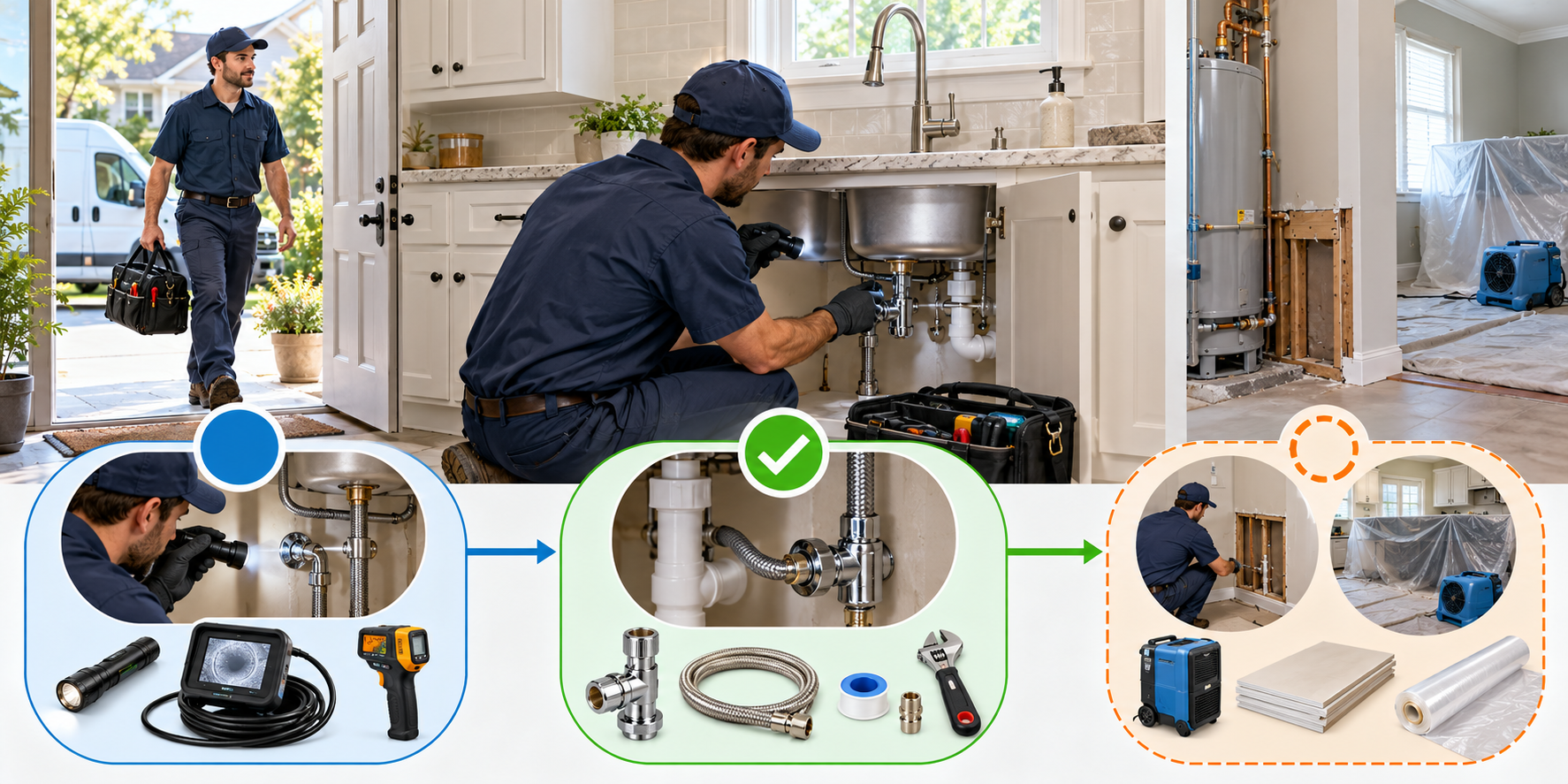
A plumbing service call is usually a purchase of access to diagnosis and labor, not a guaranteed fixed price for a finished repair. The plumber may be coming to identify whether the problem is a leaking fixture, a failed valve, a concealed pipe, a pressure problem, or a water-heater fault. The final bill depends on what can be confirmed during the visit and whether the repair can be completed without a second trip.
What a service call may include
Common quote structures combine some of the following:
- a trip, dispatch, or minimum charge;
- diagnostic time and testing;
- labor charged hourly or as a flat price for a defined repair;
- parts, fittings, valves, or a replacement fixture;
- access work, protection, cleanup, and disposal;
- emergency or after-hours scheduling; and
- a return visit when a part, approval, or opening is needed.
These are different cost components. A low trip fee does not necessarily mean a low total, and a flat-rate repair can still exclude access, finish restoration, or a related failed component. Ask whether the initial charge is credited toward approved work and whether the quote changes if the technician finds a different cause.
Broad market context
HomeStars reports Canadian illustrative observations of roughly $60–$270 per hour, with a commonly reported professional-rate band of about $105–$175, and trip fees of about $70–$400. It also reports that ordinary repair categories have different ranges. These are specialist market observations, not a Canadian fee schedule or a normalized quote. Region, urgency, contractor structure, and what is included can move the result substantially.
Angi’s 2026 U.S.-oriented guide gives different measures rather than one comparable repair price: its Cost Insights range is $182–$501, its broader narrative says $99–$990 with most homeowners around $341, and its service-call fee appears as $150–$250 in one section and $100–$250 in another. The page does not reconcile those measures or disclose a project-level sample for each. Treat them as source estimates, not a local quote. Use local written bids and consider U.S. and Canadian observations independently; do not convert one currency into another and call it a local estimate.
Why a small repair can carry a large minimum
The plumber still spends time traveling, protecting the home, diagnosing the fault, setting up tools, sourcing a part, and documenting the work when the final repair takes ten minutes. A fixture that appears simple may also have seized shutoffs, corroded connections, a nonstandard fitting, or water damage behind it. The minimum charge pays for mobilization and access to trade expertise rather than only the minutes spent turning a wrench.
What makes the call become a project
The first visit can uncover conditions that change scope:
- The visible drip is downstream from a concealed leak.
- A failed shutoff cannot isolate the work and the main valve also needs attention.
- A fixture replacement exposes a damaged flange, countertop opening, wall connection, or floor.
- A pressure complaint is caused by a regulator, restriction, supply limitation, or private-well equipment rather than a simple adjustment.
- A water-heater symptom requires testing before a component or complete replacement can be quoted.
The correct response is not automatically to approve every add-on. Ask which finding is confirmed, which is a risk allowance, and which work is required to make the system safe or functional today. Request separate prices for optional prevention, finish repair, and a future improvement.
Ordinary, planned, and emergency scenarios
In a planned faucet repair with accessible shutoffs, the job may be largely labor and a small parts allowance. In a diagnostic visit for an intermittent leak, the first bill may buy testing while the repair remains unknown. In an emergency burst-pipe call, after-hours labor, water isolation, difficult access, and temporary stabilization can dominate before permanent repair or restoration is priced.
Emergency work is not the same as full recovery. Confirm what the technician will stabilize, what permanent plumbing repair is included, and whether drying, drywall, flooring, mold assessment, or insurance documentation is outside the plumbing quote.
Normalize the quote before comparing it
Ask each plumber to identify the same items: trip or diagnostic fee, expected labor, parts or fixture allowance, access assumptions, removal and disposal, shutoff or utility coordination, permit or inspection allowance where applicable, cleanup, warranty, and return-visit terms. If one quote includes a new fixture and another is labor-only, the totals are not comparable.
Also ask what the quote does not cover. Concealed damage, finish opening and patching, electrical work for equipment, private-well problems, sewer or drain work, and post-loss restoration may belong to another trade or category. The boundary is part of the price.
Questions before approving work
- What problem has been confirmed, and what remains uncertain?
- Is the price for diagnosis, repair, or both?
- What is the minimum charge and when does hourly or flat-rate pricing apply?
- Which parts, fixtures, access, disposal, and cleanup are included?
- What could require a return visit or expand the scope?
- Is emergency work temporary stabilization or a permanent repair?
- Are permits, inspections, utility coordination, or another trade involved?
The useful comparison is not the smallest service-call number. It is the proposal that makes the diagnosis, included work, exclusions, and uncertainty visible enough to compare.
How to read a first invoice
Separate the price of learning from the price of fixing. A diagnostic charge can be reasonable when the symptom has several plausible causes. It becomes difficult to compare when one contractor rolls diagnosis into a flat repair price and another bills it separately. Ask each bidder to state the assumed diagnosis and what happens if it is wrong.
Look for a clear distinction between labor time and a flat-rate task. Hourly work can be fair when the scope is uncertain, but the quote should give an expected duration or a not-to-exceed authorization. Flat-rate work can make the total predictable, but the included access and parts must be clear. Neither pricing model proves better value by itself.
When a return visit is economical
A return visit is not automatically a failure. A planned second visit may avoid rush pricing or an improvised part, especially when a concealed opening, special fixture, or water-heater component is involved. Ask whether the first visit includes temporary protection, measurements, ordering, and a credit toward the completed work. If the plumber proposes several unrelated upgrades while already present, request them as optional lines so urgent correction is not bundled with convenience work.
For a rental, sale, insurance claim, or occupied home, scheduling and documentation can have value beyond labor hours. Request photographs, the confirmed failure, parts replaced, testing performed, and warranty terms. This makes later repair, buyer disclosure, or warranty service easier to evaluate.
A fair market comparison
Collect comparable quotes only after describing the same symptom and access conditions. A local plumber who includes a full visit, materials, and testing may appear more expensive than an online “repair” amount that assumes a known, accessible part. Canadian market observations can orient the conversation, but local availability and regional labor control the actual decision. The best value is a scope that ends with a verified repair, not an attractive first-line charge.
Authorize the work in stages when the cause is uncertain
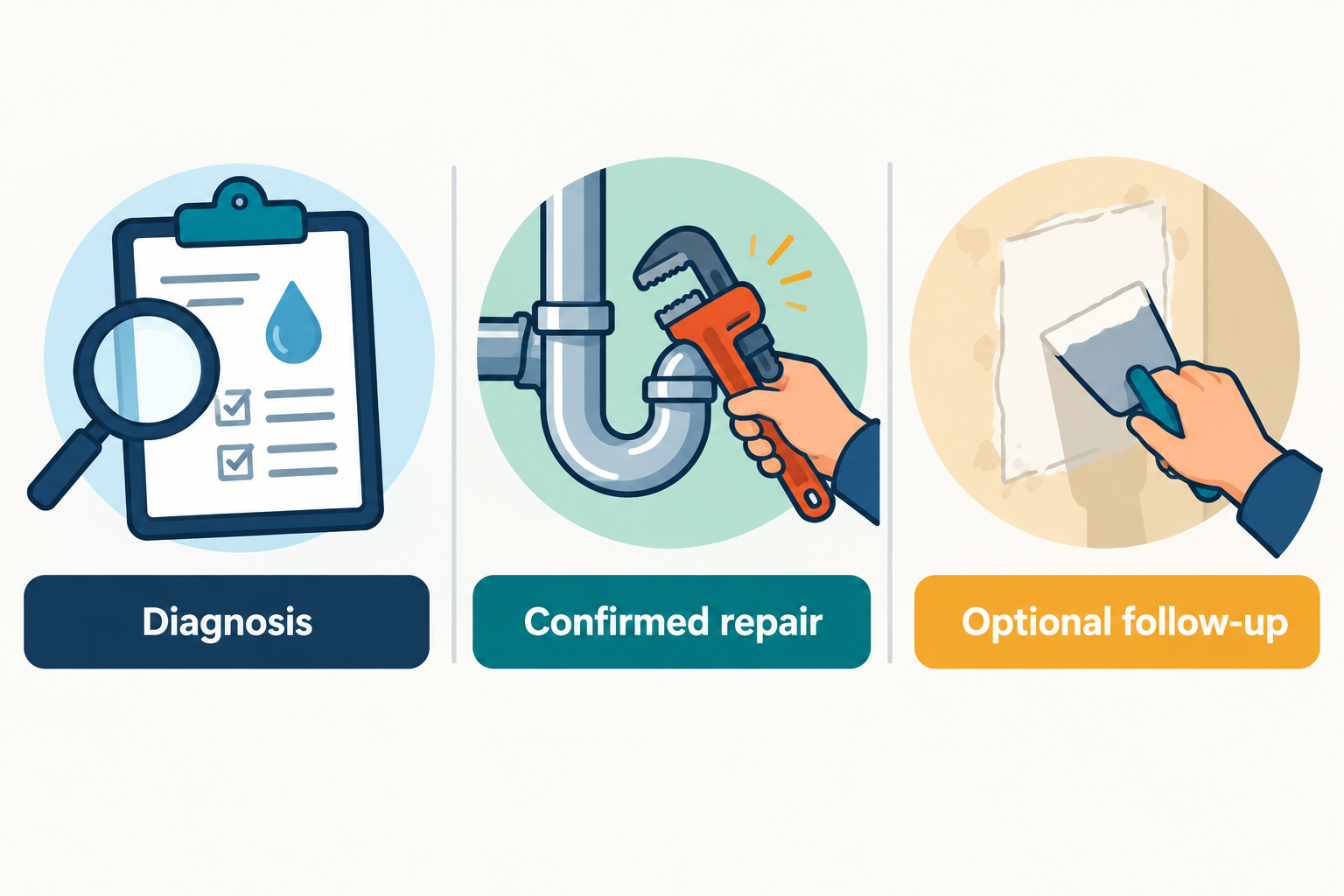
When the symptom has several plausible causes, a staged authorization can protect the homeowner without preventing a necessary repair. The first stage may cover arrival, diagnosis, safe isolation, and a defined amount of testing. The second stage can cover the confirmed repair and ordinary parts. A third stage may be needed for access, finish restoration, or a different trade. Ask the plumber to state the dollar limit and the decision point for each stage.
This structure is useful for an intermittent leak, pressure complaint, or water-heater fault where a flat repair price would depend on an assumption. It is less useful when the failure is visible and the permanent repair is already clear. In an emergency, authorize the work needed to control active water first, then request a written permanent scope after the immediate risk is contained.
Separate convenience work from required correction
A technician who is already at the home may identify useful improvements: a second shutoff, a new supply line, a leak sensor, or a fixture upgrade. Those items may be sensible, but they should be listed separately from the work required to stop the leak or restore service. Bundling optional improvements into an urgent approval makes the total harder to compare and can obscure which condition caused the original call.
Ask whether each line is required for safe operation, required to complete the confirmed repair, recommended risk reduction, or a discretionary improvement. A clear category does not mean optional work is bad. It means the homeowner can compare the immediate repair with a planned improvement using the right ownership horizon and budget.
Check the handoff, not only the invoice
The finished visit should leave a homeowner able to explain what failed, what was changed, and what remains outside the scope. For a plumbing repair, that may mean a pressure or leak test, a photo of an inaccessible connection, a part number, a temporary-repair warning, or a recommendation for a restoration trade. A clean invoice without a result or limitation is difficult to use when the symptom returns.
If the plumber recommends monitoring, ask what change should trigger a return call and how long the observation period is intended to last. If a return visit is expected, ask whether the original diagnostic fee or temporary work is credited. Those details turn a service call from an isolated charge into a sequence the homeowner can manage.