
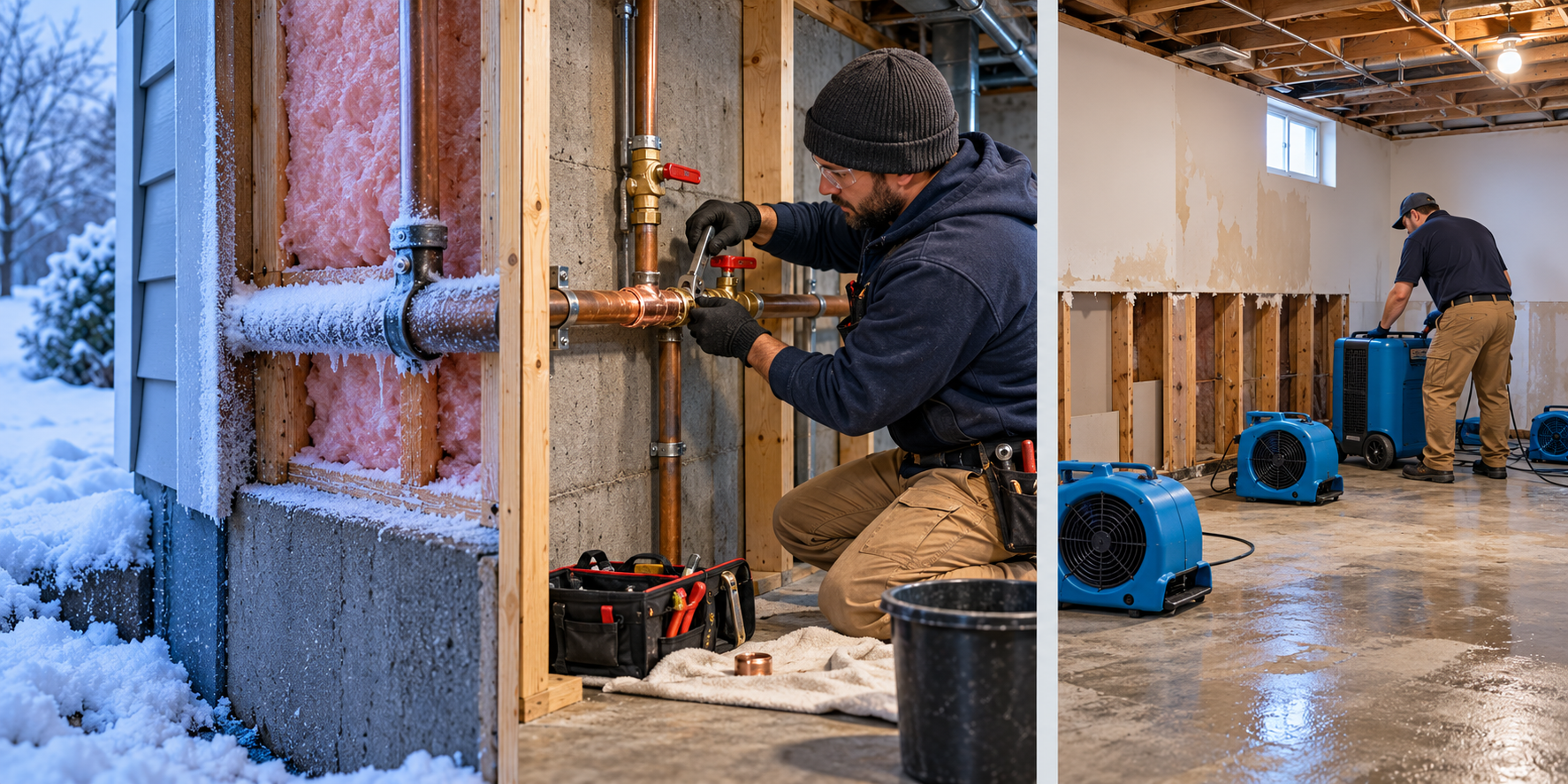
A frozen pipe and a burst pipe are not the same project. A frozen section may leave the home without water and require diagnosis, controlled thawing by a qualified professional, or a preventive correction. A burst section adds active water isolation, emergency access, pipe replacement, and the possibility of substantial damage to walls, ceilings, floors, or contents.
Scope comes before price
The immediate plumbing objective is to control water and restore a sound supply line. EPA identifies cold temperatures as one condition associated with leaks, but its general maintenance guidance is not a complete thawing or repair procedure. Do not rely on improvised heat, energized equipment, or unsafe access around water. If fuel, electricity, pressure, lead, or concealed damage is involved, use qualified service and current local/manufacturer guidance.
Ask the emergency plumber what the first visit will accomplish: locate the frozen or failed section, isolate it, make a temporary stabilization, or complete a permanent repair. A temporary measure may be the right urgent purchase, but it should be labeled as such.
Confirm the local utility and repair boundary
A no-water event may involve a main break, a frozen household line, or damage around the meter. Ask the water utility whether it has a service interruption and which equipment it controls before treating the whole job as a plumbing repair. Local responsibility statements differ: Philadelphia Water Department says it is not responsible for household pipes even when they are outside the home, while New York City DEP assigns homeowners responsibility for freeze protection and licensed-plumber repair of a broken service line or pipe. NYC also says it may bill the homeowner for a meter repair or replacement when the meter froze and broke because reasonable protective steps were not taken. These are local examples, not a rule for another city or a determination of ownership at a particular property.
Cost drivers
- Scheduling: nights, weekends, holidays, and severe-weather demand can increase labor or dispatch cost.
- Isolation: a failed main shutoff, inaccessible valve, or utility-controlled connection can delay the repair and add a valve or coordination scope.
- Location: exposed basement or crawlspace piping is different from a wall, ceiling, slab, or finished floor opening.
- Damage extent: one split fitting is a smaller plumbing scope than multiple damaged sections or a line that has refrozen and failed elsewhere.
- Pipe material and configuration: compatible fittings, transition work, and the existing routing affect labor.
- Prevention: insulation, routing changes, heat protection, or envelope corrections may be needed when freezing repeats.
HomeStars publishes illustrative Canadian leak-repair and general plumbing observations, but available market research does not establish a universal burst-pipe price. Emergency quotes should state response, stabilization, permanent repair, access, cleanup, and restoration separately.
Three project cases
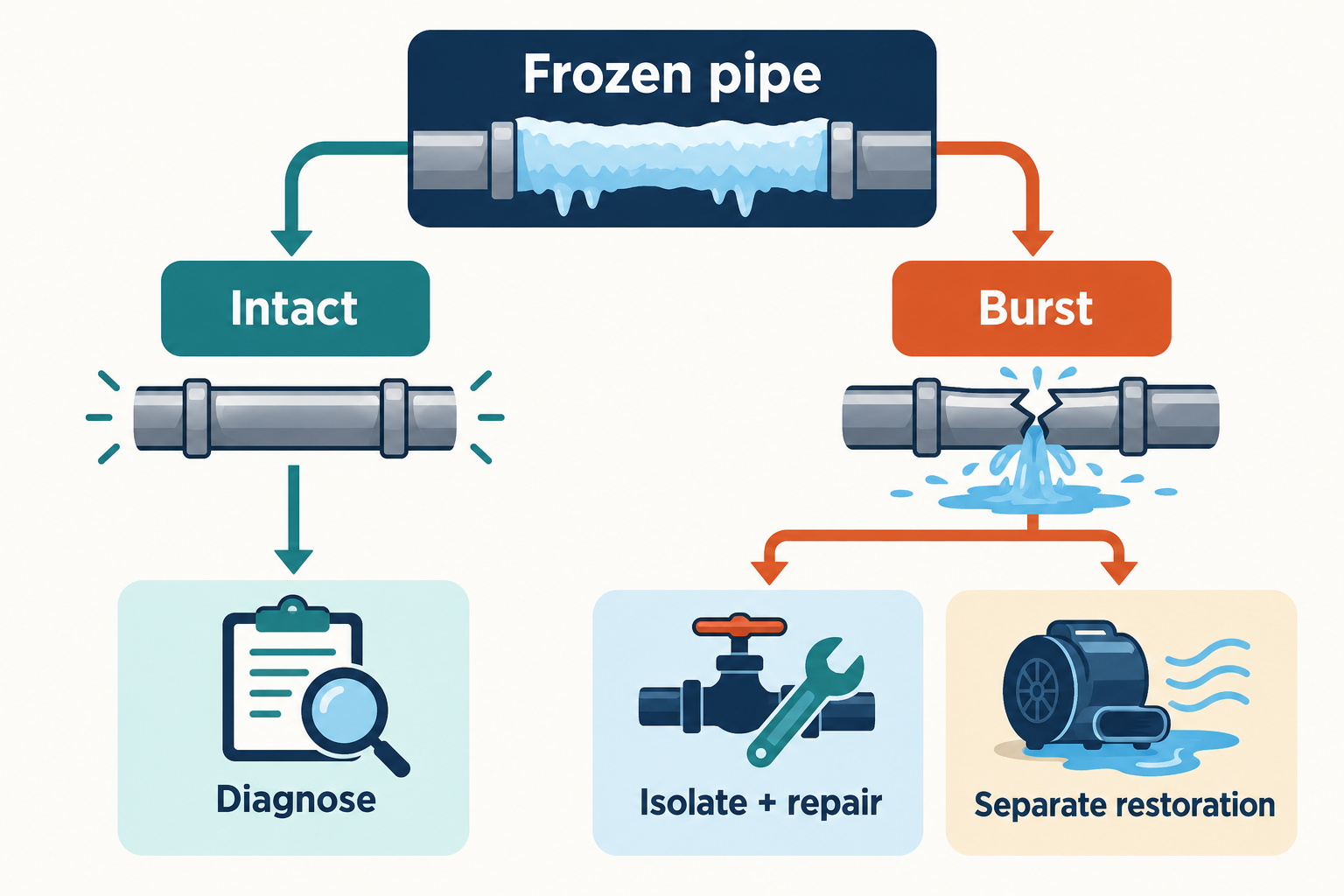
Frozen but apparently intact: The home has reduced or no flow in one area, with no visible water. The professional must determine whether the line is frozen, restricted, or failed. Budget for diagnosis and controlled access, then ask what confirms the line is sound before normal service resumes.
Accessible burst: Water is isolated and the split is in an accessible area. Pipe-section replacement, fittings, testing, cleanup, and a return to service may be the complete plumbing job. If the main shutoff cannot close reliably, add that work rather than pretending isolation is included for free.
Concealed burst or repeated failure: Water has entered a wall, ceiling, floor, or insulation, or several cold-weather failures have occurred. Plumbing correction and restoration become parallel workstreams. Repeated freezing can point to routing, insulation, building-envelope, or operating conditions; a replacement section alone may not prevent recurrence.
Plumbing repair is not water-damage recovery
Drying, demolition, damaged-material disposal, mold assessment, reconstruction, painting, flooring, and insurance documentation may be outside the plumber’s price. Photographing conditions and communicating with the insurer may matter, but the source must be controlled before reconstruction. The restoration decision belongs to a separate scope when damage is consequential.
Compare local repair with broader correction
If the failed section is part of old or deteriorated piping, compare the emergency repair with a partial or whole-house repipe after the immediate risk is controlled. A repipe is not automatically justified by one winter failure. It becomes more economically relevant when failures repeat, access will be opened again, or the existing system has multiple known vulnerabilities.
Quote questions
- Is this a diagnosis, temporary stabilization, or permanent repair?
- What exactly is frozen or burst, and how was that determined?
- Can the house-side water be isolated? If not, who controls the next valve?
- Are access openings, protection, testing, cleanup, and finish restoration included?
- What work addresses the reason the pipe froze, if recurrence is likely?
- Are drying and post-loss repairs outside the plumbing quote?
- What warranty applies to the repaired section and any temporary measure?
Treat urgency seriously, but do not let urgency hide scope. The fair comparison is the one that distinguishes controlling the water today from restoring the property and preventing the same failure next season.
How urgency changes the budget
Emergency pricing often buys response time and availability, not a lower-cost permanent project. A plumber may first isolate water, remove a failed section, or make a temporary connection so the home can be protected. Ask when the permanent repair will be completed, whether the emergency work is credited, and whether the line will be retested after the system returns to pressure.
If the pipe froze but did not visibly burst, the risk may not be resolved when flow returns. A concealed split can appear later, and a restriction can be mistaken for a freeze. Use a qualified inspection for energized spaces, fuel equipment, or inaccessible lines. Do not make a homeowner safety decision from a generic thawing checklist.
Prevention as an economic choice
After a repeat freeze, compare the cost of another localized repair with the cost of correcting the condition that exposes the line. That correction might involve insulation or routing, but it may also be a building-envelope or cold-weather project outside plumbing. The right comparison includes the next likely disruption, not just the pipe section today.
For an occupied home, ask how long water will be unavailable and what temporary arrangements are included. For a vacant or seasonal property, include monitoring and restart risk. These practical constraints can make a planned correction preferable to repeatedly paying emergency minimums even when the first repair is cheaper.
What a permanent repair should document
After the emergency has passed, ask for a record of the failed location, pipe or fitting material, access made, section replaced, pressure or leak test, and any condition left for later work. This is especially valuable when a temporary connection was used or when a wall, ceiling, or floor remains open. A future contractor can then distinguish a repaired section from an unresolved freeze exposure instead of repeating the same diagnosis.
The record should also state what was not inspected. A plumber who replaced one accessible split cannot certify concealed branches or the entire distribution system unless those areas were evaluated. Honest limits are useful: they help the homeowner decide whether to monitor, improve insulation or routing, investigate old piping, or commission a broader assessment.
Compare emergency stabilization with a planned correction
Emergency work often has a different objective from planned work. The emergency visit may stop water, preserve heat or occupancy, and make a temporary connection. A later visit can improve routing, replace a shutoff, address repeated freezing, or coordinate access and finish restoration at a lower-pressure time. Ask whether the emergency invoice includes a credit, warranty, or limitation when permanent work is deferred.
When comparing a planned correction, include the cost of another outage, another dispatch, and the possibility of concealed damage if the temporary measure remains. Do not treat a temporary repair as a discount on a permanent project unless the contractor says exactly what service life and conditions apply. Conversely, do not approve a broad repipe during an emergency without evidence that the broader scope is necessary.
Match the prevention decision to the failure pattern
One exposed failure during an unusual cold event may justify monitoring and a targeted correction. Repeated failures in the same wall, crawlspace, or exterior route make the building condition more important. A cold-water line that freezes repeatedly may need changes to insulation, air leakage, routing, heat, or occupancy practices; those can cross into envelope or resilience work. The plumbing article can identify that connection without pretending to price the entire building correction.
For an occupied home, compare the cost of a planned shutdown with the disruption of another emergency. For a vacant or seasonal property, compare remote monitoring, water shutdown, and restart procedures with leaving the system pressurized. The right prevention plan depends on who can respond and what failure consequence the property can absorb.
Treat the visible split as a starting point
Freezing can affect a section that is not visibly broken until water is restored. Ask the contractor to identify the failed segment, nearby exposed route, shutoff boundary, and areas not inspected. Restore pressure in a controlled way and keep the check for additional leakage distinct from finish cleanup. A patch at the first opening may not represent the full condition.
For a repair, document the pipe or fitting material, access made, test performed, and any temporary measure. For replacement, compare the old route with a more protected or serviceable route only when the building condition supports that scope. Insulation, air sealing, heat, drainage, or seasonal management may belong to another trade or property decision and should not be hidden inside a pipe-repair allowance.
At handoff, record the shutoff, repaired location, restoration boundary, and prevention recommendation. The homeowner should know what was corrected, what remains vulnerable, and what event should trigger a broader assessment.