
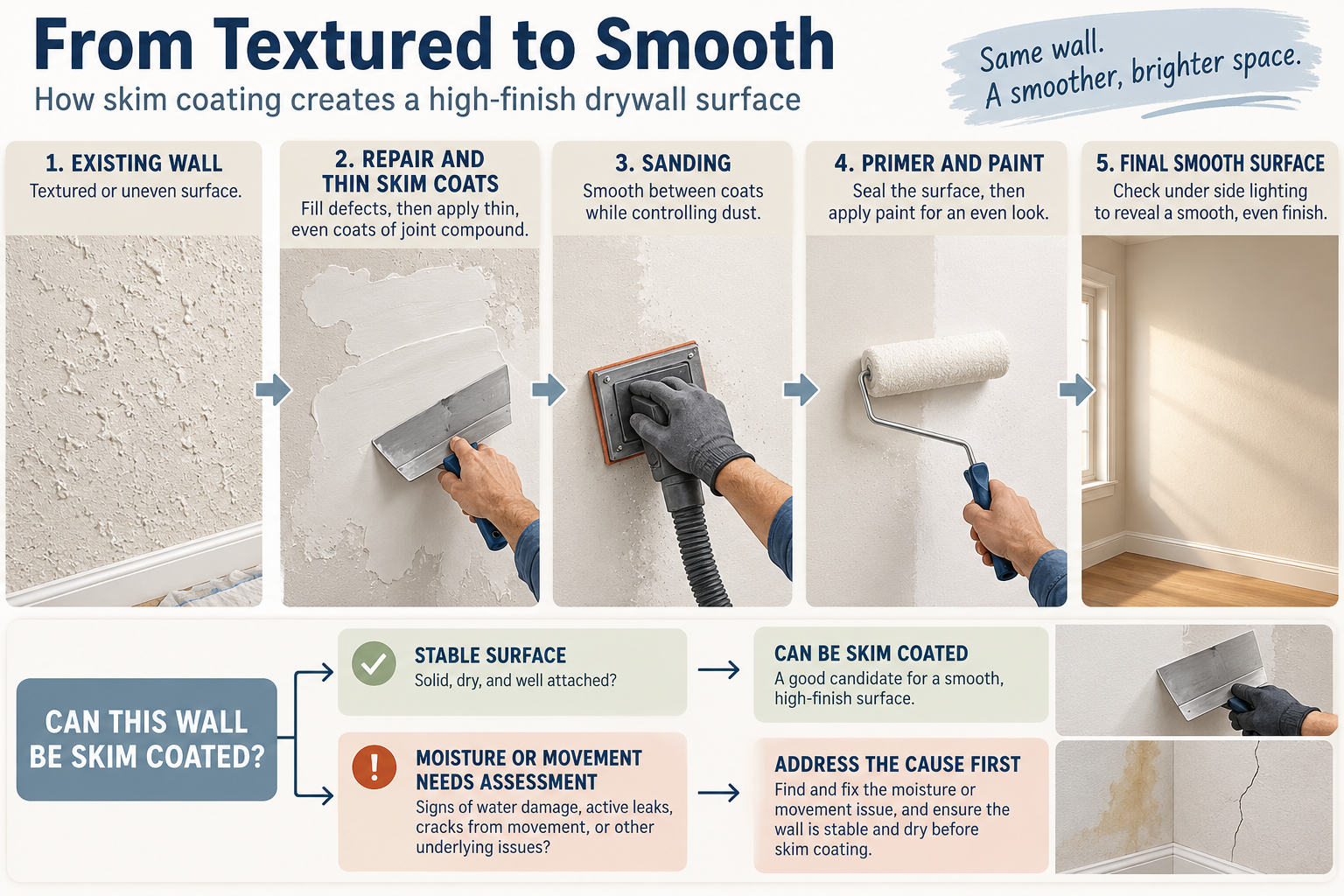
Skim coating is a thin coat over a prepared surface used to create more uniformity before decoration. It is not automatically a repair of movement, moisture, damaged framing, or an unsuitable substrate.
What changes the estimate
The contractor may need to repair joints, holes, cracks, stains, or loose material before applying the finish. Cost then depends on wall or ceiling area, existing texture, sanding and dust control, access, corners, lighting, the desired smoothness, primer, and paint. Occupied rooms require protection and cleanup.
GA-214 explains that finish level depends on decoration, location, and lighting. Glossy coatings and strong side lighting can make small surface differences more visible. A homeowner seeking a smooth result should state that expectation and ask what level of preparation is included.
Avoid a misleading comparison
Compare a skim-coat bid with a full scope that includes patching, coats, sanding, primer, paint, protection, and cleanup. Canadian drywall project observations range widely from $100 to $50,000 and do not create a useful national rate. No reliable U.S. or Canadian skim-coat range was established by the available sources.
When to pause
Peeling or damaged old coatings may require a lead or asbestos assessment depending on the home, material, and jurisdiction. Moisture staining requires source correction before finish work. Do not use skim coating to conceal an active or unresolved cause.
Questions to ask
Request the existing-condition assumptions, finish standard, number of preparation passes, sanding and dust-control scope, primer and paint, and treatment of cracks or recurring movement. Make the desired visual result part of the quote.
What skim coating is meant to do
Skim coating is a thin coat applied over a prepared surface to create greater uniformity before decoration. It is a whole-surface finish decision, not merely a larger patch. The result depends on the existing board, joints, texture, repairs, lighting, paint sheen, and the number and quality of preparation passes.
GA-214 describes finish levels in relation to location, lighting, and decoration. “Level 5” is not simply a promise that a wall will be perfect; it is a defined high-finish concept that must be translated into the actual surface and coating the homeowner expects. Ask the contractor to describe the result in plain language.
When skim coating fits
Skim coating may fit when a wall or ceiling has an unwanted texture, many repairs, or a finish expectation that ordinary patching cannot meet, while the underlying board remains serviceable. It may be an alternative to removing and replacing sound drywall. It does not correct movement, moisture, damaged paper, poor attachment, or a framing condition beneath the surface.
If the existing surface is loose, contaminated, wet, or badly damaged, preparation may expand or new board may be more appropriate. A thin finishing layer should not be used to conceal an unresolved source.
Why the labor varies
Labor depends on surface area, texture adhesion, number of repairs, corners, ceilings, side lighting, sanding, dust control, occupied-room protection, access, and the required final sheen. Strong light and a smooth or glossy finish expose imperfections that a textured or low-sheen finish may hide. Walls with many openings and trim intersections take more careful work than an empty plane.
Ask whether the quote includes scraping or covering texture, patching, joint treatment, multiple coats, sanding, primer, paint, furniture, and cleanup. The phrase “skim coat” should not hide a separate texture-removal, stain-blocking, or paint scope.
Skim coat versus new drywall
Skim coating can preserve sound board and reduce demolition, but new drywall may be more predictable when the existing surface is badly damaged, repeatedly repaired, or impossible to prepare for the desired result. New board adds demolition, disposal, openings, finishing, and possible impact on trim, insulation, utilities, and room dimensions.
Compare the complete scopes, including the final paint and the restoration of baseboards, casings, outlets, and fixtures. The less expensive method on the wall surface may not be the less expensive completed room.
Safety and moisture boundaries
Old coatings and textures can create lead or asbestos concerns depending on the material, home, and jurisdiction. Do not scrape or sand a suspected material based on appearance. U.S. and Canadian guidance is not interchangeable, and hazardous-material assessment or abatement is separate from ordinary skim coating.
Similarly, correct moisture and assess recurring cracks before finishing. A smooth surface is not proof that the wall or ceiling is dry or stable.
Quote checklist
Ask for the existing-condition assessment, finish standard, texture treatment, number of coats, sanding and dust control, primer, paint, access, furniture, protection, cleanup, and the condition that would make replacement necessary. The right price is the one tied to a defined visual result, not a label alone.
Define the finish target
Skim coating can reduce texture, fill minor variation, or prepare an existing surface for a smoother finish, but it does not make a damaged or moving substrate sound. Define whether the goal is a light visual refresh, a smooth wall, a smooth ceiling, or a surface intended for a particular sheen and lighting condition. A side-lit wall may expose variation that is not obvious in ordinary room light.
The finish target should include corners, openings, transitions, and the final primer and paint. A quote for one pass of compound is not equivalent to a quote for a prepared and coated surface.
Skim coat versus new drywall
Skim coating may be efficient when the existing board is stable and the texture or shallow irregularity is the main issue. New board or a larger repair can make more sense when the surface is damaged, contaminated, repeatedly cracking, poorly attached, or incompatible with the intended finish. If the substrate or framing is uncertain, ask for an inspection boundary rather than assuming that additional compound will solve it.
GA-214 finish language can help describe the expected result, but it is not a substitute for agreeing on lighting, sheen, and acceptable variation. Keep any water correction, structural movement, or hazardous-material assessment outside ordinary skim-coat pricing unless explicitly included.
Preparation and access matter
Cleaning, scraping loose material, repairing joints, sealing stains, protecting floors, moving furniture, and controlling sanding dust can take more time than the visible coating. Ceilings and occupied rooms add access and handling. Ask how many preparation and compound passes are assumed, how the surface will be checked between passes, and what happens if the existing coating delaminates.
Scope boundary
Compare a skim-coat quote with a complete alternative: texture treatment, repairs, compound, sanding, primer, paint, access, protection, cleanup, and any board replacement. The appropriate choice is the one that reaches the required appearance without hiding a substrate problem under a new finish.