
Smoothing a textured wall is a whole-surface finish project when scraping, skim coating, sanding, primer, and repainting are needed. It is not the same as filling a few holes in drywall.
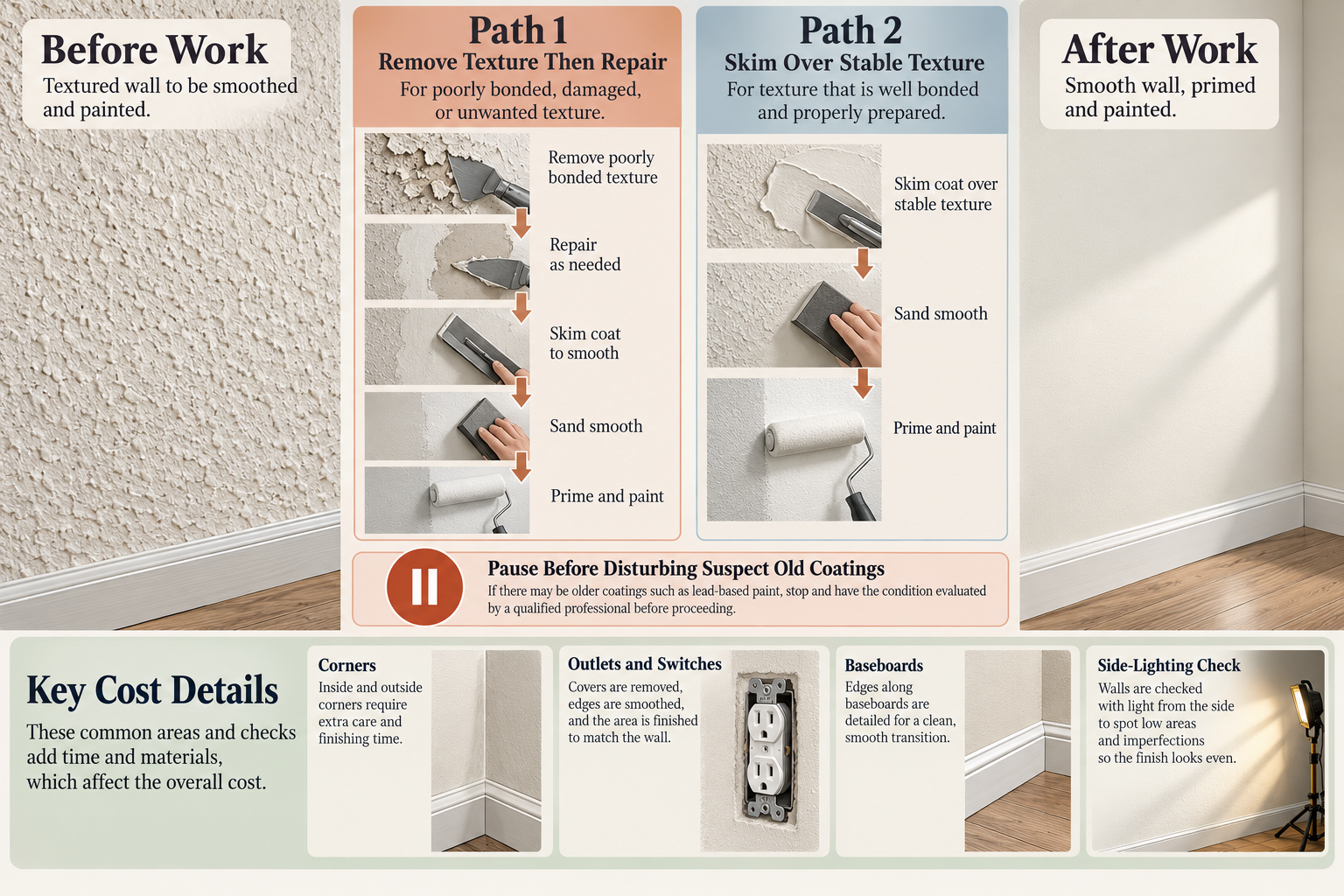
What makes it labor-intensive
Texture type and adhesion, prior coatings, repairs, corners, outlets, trim, dust control, wall height, occupied-room protection, and the expected smoothness change the work. Removal can damage the paper or expose uneven joints. Skim coating can be more appropriate in some conditions, but only after the surface is prepared.
GA-214 explains that the required gypsum finish level depends on decoration, location, and lighting. A smooth finish under critical side lighting requires a different expectation from a textured wall that will hide minor imperfections.
Safety and price limits
Older coatings may require lead or asbestos assessment before disturbance. U.S. and Canadian requirements are not interchangeable, and a specific material cannot be identified from appearance. Available sources do not establish a reliable national smoothing price; Canadian paint and drywall market observations are broad and scope-dependent.
Quote checklist
Ask for the proposed removal or skim method, surface repairs, sanding, primer, paint, protection, debris, cleanup, and finish standard. Make sure the bid says whether electrical-device removal, trim interfaces, and recurring moisture or movement are included or excluded.
Why textured walls are labor-intensive
Texture changes the wall’s surface area and hides some imperfections. Removing it can expose torn paper, uneven joints, old patches, stains, and incompatible coatings. Skim coating may create a more uniform surface without full removal, but it still requires preparation, drying, sanding, primer, and paint. The right method depends on adhesion, material, and the final appearance.
Ask what “smooth” means. A homeowner may want a practical low-sheen improvement, a uniform wall under ordinary lighting, or a high-finish surface under strong side light. The expected result should be written into the quote because it affects the number of preparation passes and the tolerance for visible variation.
Removal versus skim coating
Removal can make sense when the texture is poorly bonded, heavily damaged, or incompatible with the planned finish. It can also create more dust, debris, and substrate repair. Skim coating can reduce demolition when the texture is stable and the wall can accept a prepared overlay, but it does not correct moisture, movement, damaged framing, or an unstable base.
If the wall is behind cabinets, trim, outlets, or door casings, the transitions and cutouts matter. An otherwise good skim coat can look unfinished if the edges, corners, and interfaces are not restored. Ask whether electrical-device removal, trim, and furniture are part of the finish quote.
Paint and surface preparation
Primer may be needed after sanding, patching, stain treatment, or a change in surface. Paint sheen and color affect how visible the result will be. A room-wide or wall-to-corner repaint can be more coherent than painting only the worked area, especially when the existing coating has aged.
Texture smoothing is not a moisture or crack repair. If the wall has a recurring stain, peeling coating, or repeated crack, correct or assess the cause before creating a new surface. A smooth wall should not be used as evidence that the underlying condition is resolved.
Safety boundary
Older coatings may raise lead concerns, and some legacy textures or related materials may raise asbestos questions. U.S. and Canadian guidance is not interchangeable. Do not sand, scrape, or disturb a suspected material based on appearance. Qualified local assessment may be required before ordinary finish work can proceed.
Cost scenarios
A simple project has stable texture, accessible walls, limited repairs, and a forgiving finish. A typical project includes removal or skim coating, sanding, primer, paint, furniture protection, trim interfaces, and cleanup. A complex project includes multiple layers, poor adhesion, extensive repairs, strong side lighting, high walls, occupied-room staging, or legacy-material assessment.
Available market observations for paint and drywall are broad and use different scopes. They do not establish a reliable national smoothing price. Ask for a site-specific local estimate with the same finish expectation.
Quote checklist
Request texture type, removal or skim method, preparation, number of coats, sanding and dust control, primer, paint, access, trim and outlets, furniture, protection, disposal, cleanup, and the condition that triggers additional work. Compare the complete finished wall, not a scraping line alone.
Start with the surface goal
“Remove texture” can mean knocking down high points, scraping a loose coating, skim coating to reduce variation, or creating a fully smooth surface ready for a specific sheen. Those are different scopes. Define the intended appearance at normal viewing distance and under the room’s actual lighting before selecting a method.
Texture can conceal seams, fastener marks, patched areas, stains, and movement. Once it is disturbed, the wall may need broader preparation than the visible texture area suggested. Ask what condition the contractor expects to find and how additional repairs will be priced.
Removal versus skim coating
Removal may be useful when the coating is loose or the new finish cannot accommodate it. Skim coating can reduce disturbance when the existing wall is stable, but it adds compound, sanding, and primer work and does not correct a moving or damp substrate. A new board section may be a better comparison when the wall is broadly damaged.
Prep, paint, and interfaces
Corners, outlets, switch plates, baseboards, doors, cabinets, and adjacent walls make a smooth finish more labor-intensive than an open rectangle. Include protection, dust control, sanding, primer, paint, trim treatment, and cleanup. A quote that ends after scraping is not comparable with one that delivers a finished wall.
Old coatings and concealed conditions
The age and composition of an old coating cannot be determined from its texture alone. Where a suspect legacy coating is possible, obtain the appropriate local assessment before disturbance. Keep hazard work, active moisture, structural movement, and major board repair outside ordinary texture-removal pricing unless explicitly defined.