
Drywall pricing should identify both the board installation and the finished surface. A quote for hanging panels is not automatically a quote for taping, finishing, texture, primer, paint, demolition, insulation, or repair of the framing behind the wall.
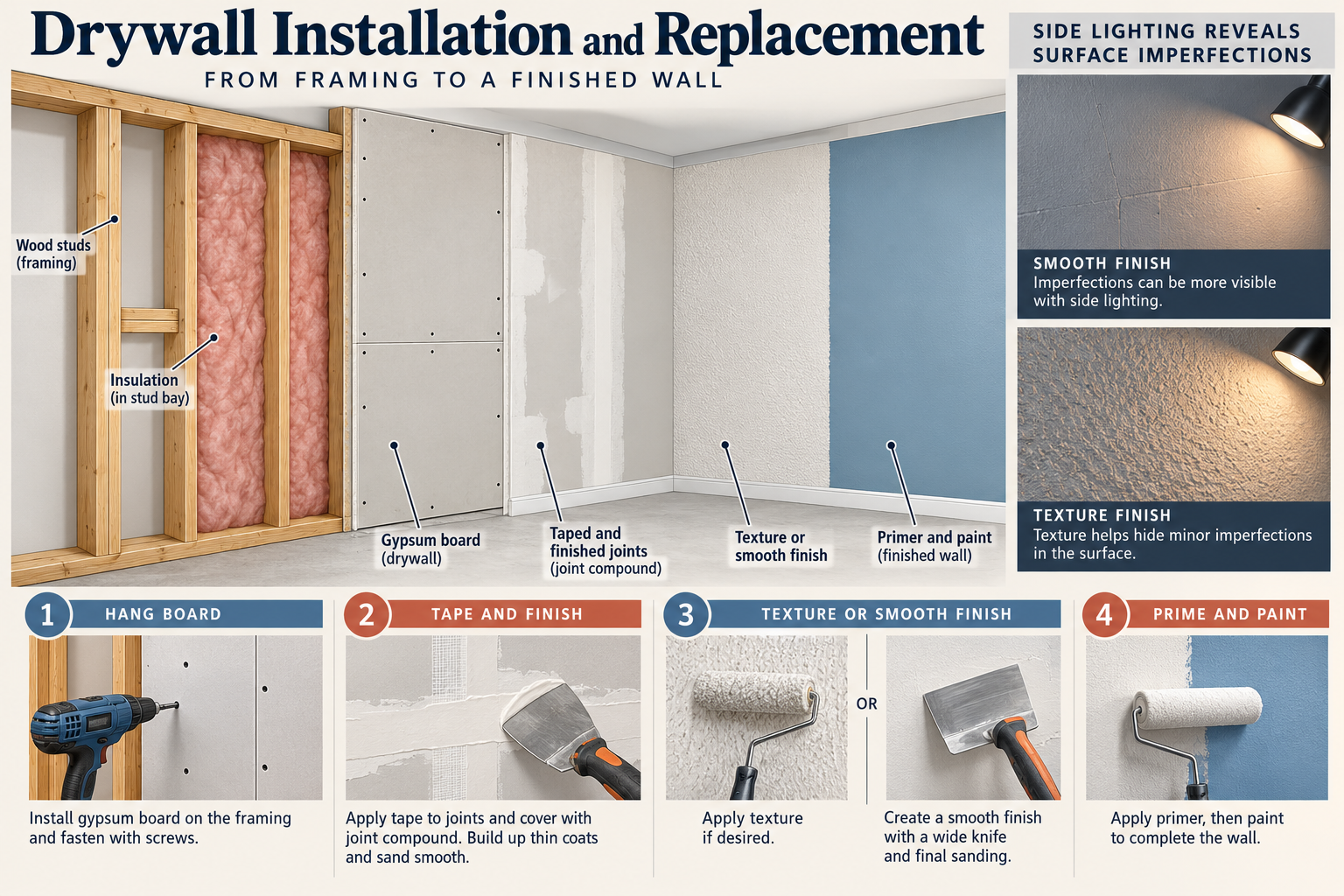
What the scope includes
Ask whether the bid covers board type and thickness, delivery, cutting, fasteners, joint treatment, corner details, openings, finish level, texture, sanding, primer, paint, protection, demolition, disposal, and cleanup. Ceiling work, high walls, stairs, small rooms, and occupied homes can require more setup and protection.
GA-214 defines five gypsum-board finish levels and explains that the appropriate level depends on the decoration, location, and lighting. Glossy finishes and critical side lighting can reveal imperfections that textured finishes may hide. The finish level should be written into the quote rather than left to assumption.
Market context
Canadian homeowner-reported drywall projects range from $100 to $50,000, with plastering observations up to $40,000. The breadth shows how little those project samples support a national rate. Use a site-specific bid with explicit inclusions; do not treat the figures as a standard price.
Boundary questions
If demolition reveals active moisture, mold, legacy hazardous material, damaged insulation, or structural framing issues, those scopes may require another specialist. A finish quote can include restoration after the underlying work is complete, but it should not hide the cause.
Compare bids
Ask for the finish level, surface area, openings, access, texture and paint, prep, protection, and disposal assumptions. Confirm who supplies primer and paint and how concealed conditions are priced.
Hanging, finishing, and painting are separate scopes
Drywall work is often quoted as one line even though it contains several stages: demolition or surface preparation, board delivery and hanging, joint treatment, corner and opening details, sanding, texture or finish level, primer, paint, and cleanup. A comparison is only useful when each bid says which stages are included.
Replacement usually costs more than new board in an empty, accessible space because the contractor must protect the room, remove old material, handle debris, inspect the cavity, and restore trim or adjacent finishes. New construction and occupied-home work can have different access and staging assumptions.
Finish level is part of the specification
GA-214 describes gypsum-board finish levels in relation to location, decoration, lighting, and the expected appearance. A wall that will receive a forgiving texture or low-sheen finish does not have the same visual demand as a smooth surface under strong side lighting and a glossy coating. “Finished drywall” is not enough information for a quote.
Ask the contractor to describe the joint treatment, corner finish, fastener treatment, texture or smoothness, sanding, primer, and paint. A high-finish result can require more preparation and more careful lighting review. Do not force a particular finish level into every room if the homeowner’s actual decision is simpler, but do not let an appearance expectation remain unstated.
Material and access drivers
Board type, thickness, moisture or fire requirements, ceiling height, room geometry, openings, stairs, closets, fixtures, and delivery route affect labor. Ceilings can require more staging and lifting. Small rooms may have more corners and cuts per square foot than open rooms. Repairing or replacing insulation, wiring, plumbing, or framing may be discovered behind the board but belongs to those scopes.
Texture matching and paint can dominate a small repair. Ask whether the contractor is restoring only the board or also the final visible coating. A drywall quote that ends at taped joints is not comparable with one that includes primer, paint, trim, and cleanup.
Cost scenarios
A simple project has an accessible room, new board, uncomplicated openings, a defined finish level, and no demolition. A typical replacement includes removal, disposal, protection, board, finishing, primer, paint, and trim coordination. A complex project includes ceilings, high access, multiple finish levels, occupied-home staging, hidden moisture, damaged insulation, recurring movement, or a restoration after another trade.
Canadian homeowner-reported project observations span a very broad range and combine different project sizes and scopes. They are not a useful national rate. Use local bids with explicit area, finish, and inclusion assumptions.
Hidden conditions and boundaries
If demolition reveals active moisture, mold, legacy hazardous material, damaged insulation, or structural framing issues, pause the ordinary finish scope long enough to assess the condition. The finish contractor may return for reconstruction, but the cause and any remediation or structural work should not be hidden in a drywall allowance.
Quote checklist
Ask for board type, area, demolition, disposal, openings, access, finish level, texture, sanding, primer, paint, insulation and utility exclusions, furniture and protection, trim, and change-order terms. Ask what the price assumes behind the existing wall or ceiling.
The useful drywall budget describes the visible finish and the labor needed to make its substrate, joints, corners, and final coating match the intended result.
Separate board, finish, and paint
Drywall installation is usually three related scopes: placing the board, finishing the joints and fasteners, and applying the final coating. A replacement estimate may also include demolition, disposal, insulation, backing, blocking, trim removal, and protection. Confirm whether the quote is for a ready-to-paint surface or for a painted room.
The board type matters. Standard wall board, moisture-resistant board, fire-rated assemblies, ceiling board, and specialty panels have different uses and installation requirements. The appropriate product depends on the room and assembly, not only on the lowest material allowance. Keep wet-area waterproofing, active leak correction, and structural changes as separate boundaries unless the quote expressly includes them.
Finish level changes the result
GA-214 finish levels describe the intended surface treatment, but a level name does not guarantee that every wall will look identical under every light. A basic utility finish may be adequate in a low-visibility area; a smooth, strongly side-lit wall may justify more preparation, sanding, primer, or a broader skim. Texture, sheen, color, and lighting should be discussed together.
Ask what imperfections are accepted at normal viewing distance and what happens at corners, inside closets, around openings, and at transitions to existing walls. A repair that stops at joint compound may not blend after primer and paint.
What replacement can uncover
Opening a wall or ceiling can reveal damaged framing, missing backing, old insulation, plumbing or electrical conflicts, moisture, or a substrate that cannot accept the planned finish. Those conditions are not automatically part of ordinary board installation. The quote should state the inspection assumption and the rate or decision process for concealed work.
Access also changes labor. Occupied rooms, high ceilings, narrow stairways, many openings, and furniture that cannot be moved increase handling and protection. A measured board quantity alone is not a complete project measure.
Build a comparable quote
Request separate lines for demolition, disposal, board, access and protection, backing or insulation, installation, finish level, texture, primer, paint, trim, cleanup, and allowances for concealed conditions. Compare the final surface and restoration scope, not just the sheet count. A slightly higher quote may be more complete if it includes the preparation needed to make the new work disappear into the existing room.