
Carpet repair can mean a patch, seam repair, cushion replacement, edge repair, or professional restretching. The right scope depends on the defect and whether the carpet is loose because of installation, the cushion, the substrate, or a separate cause.
What changes the quote
Repair labor is affected by room size, furniture, access, carpet age, matching material, pattern direction, seam location, tack-strip condition, and the condition of the cushion and floor below. A small service may still carry a minimum visit charge. If the substrate is damaged or damp, carpet repair alone is not a complete solution.
CRI guidance connects rippling and installation quality with professional restretching and emphasizes planning, seams, cushion, and substrate preparation. It does not establish a universal current U.S. or Canadian restretching rate.
Published prices illustrate why the room and included work matter. Angi’s 2026 U.S. guide reports a $150 restretching average and says many single-room jobs fall between $100 and $300. A Toronto provider lists selected completed jobs of $300 in labor for a bedroom and hallway, and $375 in labor for a large living room and stair landing; its separate $325 patch-and-seam example includes labor and patch material. These are different source types and scopes, not a comparable market range or a promise for a particular repair.
Repair or replace?
A patch can be sensible when spare carpet matches and the damage is localized. Restretching may fit when the carpet and cushion remain suitable but have lost tension. Replacement can be more practical when the carpet is worn, the damage is widespread, the backing or cushion has failed, or a visible patch would not meet the homeowner’s expectations.
Questions to ask
Ask the contractor to identify the defect, state whether the repair is cosmetic or functional, and list furniture moving, seam work, patch material, cushion, tack strips, substrate work, disposal, and cleanup. Request a matching expectation in writing. If moisture or contamination is involved, use the appropriate assessment before authorizing a finish-only repair.
Match the intervention to the defect
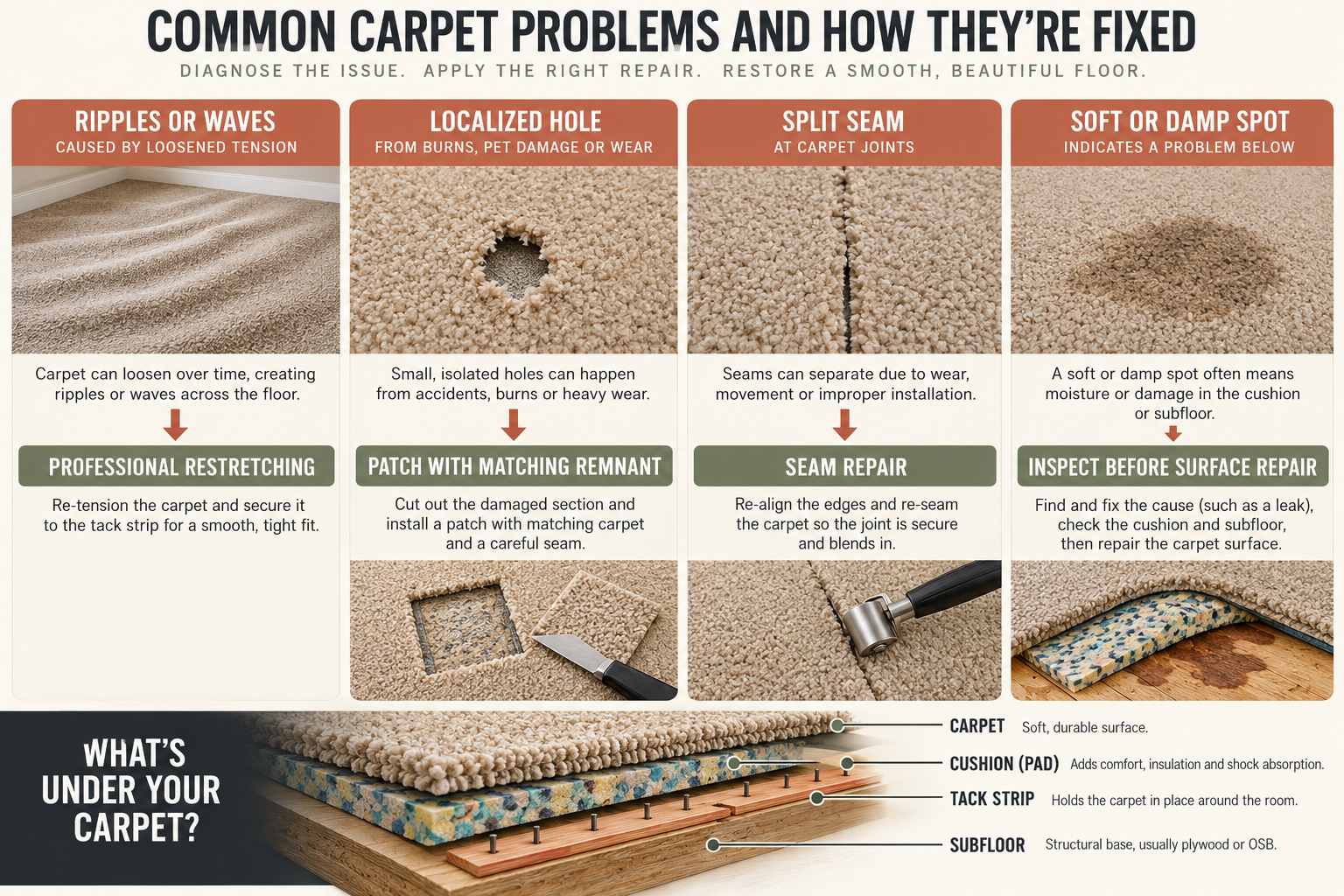
Wrinkles or ripples may call for professional restretching when the carpet, backing, tack strips, cushion, and substrate remain suitable. A torn area may call for a patch or seam repair. A loose edge may involve a transition, tack strip, or carpet attachment. A soft or damp area can point below the carpet and should not be covered by a cosmetic repair.
The repair price is therefore driven by diagnosis as much as by the visible size. A small patch can require a site visit, furniture handling, careful cutting, seam work, and blending. A restretch can require clearing the room and resetting edges. A repair that does not address the cause may look acceptable briefly and then return.
Restretching, patching, and seams
Restretching is most defensible when the carpet and backing still have useful life and the problem is loss of tension or installation condition. It is less attractive when the carpet is brittle, delaminated, badly worn, contaminated, or damaged across many rooms. A patch depends on matching material, pile direction, dye-lot or age, and lighting. Even an accurately cut patch may remain visible.
Seam repair can be affected by traffic, furniture, previous adhesive, room humidity, and the condition of the backing. Ask whether the repair is intended to improve function, appearance, or both. The contractor should tell you what result is realistic before the work begins.
The layer below matters
CRI guidance treats cushion, substrate, seams, and installation quality as connected. A failed cushion can make a carpet feel loose or uneven even when the face fiber looks acceptable. A soft subfloor, moisture, or a loose tack strip can make a restretch temporary. If the room has a water history, assess the material and source before pricing finish repair.
Ask whether the quote includes cushion replacement, tack-strip repair, edge work, furniture, baseboards, thresholds, disposal, and subfloor assessment. If carpet is installed over a surface that does not meet the named system’s requirements, the repair may be treating the consequence rather than the cause.
When replacement is the better budget
Replacement may be more coherent when damage is widespread, the carpet is near the end of its useful appearance, the cushion has failed, matching material is unavailable, or the repair requires many separate service visits. Compare the full replacement scope: removal, disposal, new cushion, seams, furniture, stairs, substrate preparation, and transitions.
Keep spare carpet or a matching remnant where possible. Record the product, color, lot, installation date, and location of stored material. That information can turn a future patch from a material-search problem into a defined repair.
Simple, typical, and complex repair scenarios
A simple repair has a localized defect, clear access, spare matching material, and a sound base. A typical repair includes furniture, seam or edge work, a service minimum, and some cushion or tack-strip assessment. A complex repair includes inaccessible areas, pattern matching, multiple defects, moisture, damaged backing, a failed substrate, or restoration after a larger event.
Questions to ask before approving
Request the identified defect, likely cause, repair method, matching expectation, furniture responsibility, cushion and tack-strip assumptions, substrate condition, disposal, and warranty or return-visit terms. Ask what condition would make replacement more economical. The best repair quote describes both the visible fix and the layer that allows it to last.
How to compare repair bids
Start by asking each contractor to name the defect and the part of the carpet assembly they expect to correct. “Restretch” should identify which rooms or runs will be reset and whether furniture must be removed. “Patch” should state the patch source, its location, seam treatment, and the likely visibility under normal room lighting. A seam repair should say whether the backing is stable and whether the repair covers only the split seam or also a nearby loose edge.
Keep minimum charges separate from unit prices. A one-area repair may be priced as a service visit even when the visible damage is small. Two defects in one visit may share travel and setup, while separate rooms or a return visit may not. Ask whether the bid assumes one trip and whether the price changes if the carpet cannot be matched or the cushion is unsuitable.
A useful comparison records the planned endpoint: carpet secured and usable, a visually blended patch, or a broader replacement-ready room. It also identifies what the contractor will do if tack strips, cushion, or subfloor are damaged once the carpet is lifted. That boundary prevents a small finish repair from becoming an open-ended authorization.
A practical repair decision
A repair is easier to justify when the carpet still has useful life, the problem is localized, and the backing and cushion remain sound. Compare the repair with replacement when there are several defects, repeated ripples, brittle backing, widespread staining, or a matching piece cannot be found. Replacement has its own costs for removal, disposal, cushion, furniture, stairs, and transitions, so compare complete scopes rather than repair price against carpet material alone.
Before scheduling, note the room dimensions, furniture, nearby transitions, damage location, and any moisture history. Photographing the area helps define the scope, but it does not diagnose the layer below. If the floor feels soft or damp, resolve that question before paying for restretching or a patch that may need to be removed again.