
Flooring installation is usually a package of material, labor, preparation, and finish work. A low material price does not guarantee a low installed price if the old floor must be removed or the substrate needs correction.
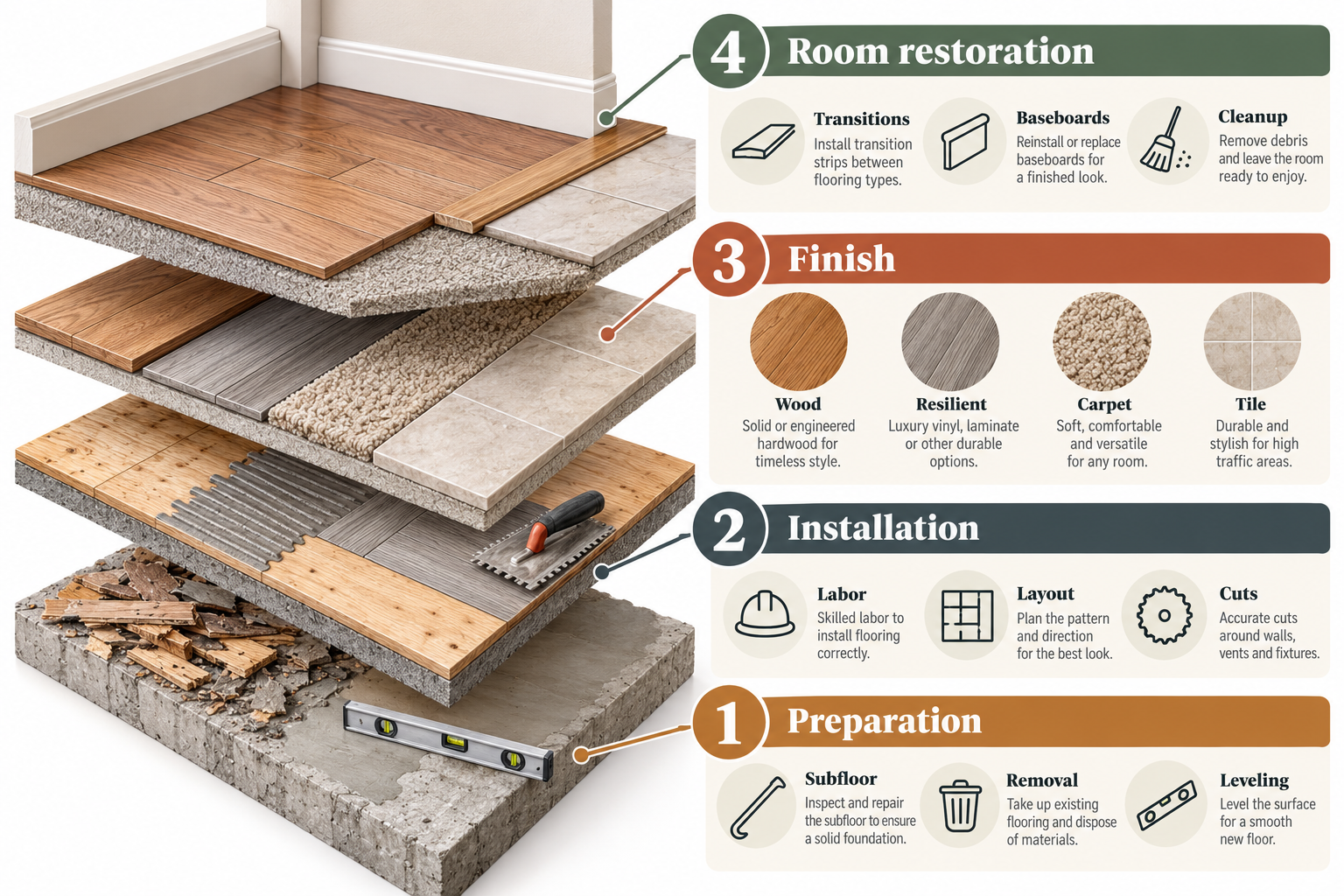
What a flooring quote normally covers
Ask whether the quote includes measurement, material, delivery, room protection, furniture moving, removal, disposal, subfloor repair, leveling, underlayment, installation, transitions, baseboards, stairs, and cleanup. Two bids can describe the same floor but include different scopes.
U.S. market observations report professional installation totals of about $1,528 to $4,859, with broad examples for removal, underlayment, subfloor replacement, and stairs. A Canadian guide reports a $1,963–$5,806 installation range and a 550-square-foot example. These are source-specific planning observations, not national rates or quotes.
A 2026 Greater Vancouver flooring guide gives material-and-installation examples for a typical 500–1,000-square-foot project with average subfloor conditions. Its installed-price scope includes required underlayment and basic trim but excludes existing-floor removal and disposal and major subfloor repair. Treat this as one local guide, not a regional survey; check the inclusions before comparing it with a bid.
How finish families change the economics
- Hardwood and engineered wood: material grade, fastening or adhesive method, moisture conditions, layout, and site finishing can dominate the budget.
- Laminate and resilient flooring: floating systems may reduce some installation labor, but flatness, moisture, underlayment, expansion space, and product instructions still control the scope.
- Carpet: cushion, seams, furniture handling, substrate preparation, and disposal matter as much as the carpet itself.
- Tile and natural stone: substrate stiffness, preparation, layout, setting materials, grout, movement accommodation, and cutting create a more preparation-intensive installation.
Relative rankings are unreliable across projects. A premium material over a ready substrate may cost less to install than an inexpensive material over a damaged, uneven, or difficult-to-access floor.
The preparation allowance
Budget separately for old-floor removal, leveling, subfloor repair, moisture-related investigation, transitions, and stairs. If the floor moves, squeaks, or shows water damage, ask whether the quote is addressing the cause or only covering the symptom. Industry installation guidance treats a sound, suitable substrate as a prerequisite; a finish-only allowance should not be presented as structural repair.
Compare quotes on the same assumptions
Give each installer the same room measurements and ask for line items. Confirm material quantity and waste, labor, removal, disposal, preparation, trim, transitions, tax, permits where applicable, and what happens if hidden damage is found. Keep U.S. and Canadian prices in their reported currencies; do not convert one market into the other with an exchange rate.
The most useful flooring budget is the one that states its assumptions clearly. Related guides below the category page can help isolate the preparation or material decision that is driving your quote.
A practical way to think about the budget
Divide the project into four layers: the finish, preparation, installation, and restoration of the room. The finish is the visible hardwood, engineered wood, laminate, resilient product, carpet, tile, or stone. Preparation includes removal, leveling, subfloor work, moisture-related assessment, underlayment, and repairs. Installation includes layout, cutting, fastening or adhesive, seams, grout, transitions, and stairs. Restoration includes baseboards, doors, furniture handling, protection, paint touch-up, and cleanup.
This division matters because the cheapest material family can lose its advantage when the room needs extensive preparation. A floating product may reduce some fastening labor but still require a flat, dry substrate and careful height transitions. Carpet may install quickly in an open rectangle but require more planning around seams, stairs, furniture, and a damaged subfloor. Tile may have a modest material price while demanding more substrate preparation, cutting, setting materials, and movement accommodation.
Simple, typical, and complex project scenarios
A simple project has an accessible room, a sound and reasonably flat substrate, no hazardous or moisture concern, limited furniture, and a finish that can be installed without unusual transitions. The quote may be close to the material-and-installation price because removal and preparation are small.
A typical project includes some combination of old-floor removal, disposal, minor patching, underlayment, baseboard work, transitions, furniture protection, or a more detailed layout. Those allowances should be listed rather than hidden inside a vague “installation” line.
A complex project has multiple layers, stairs, irregular rooms, a high-end pattern, a wet or moving substrate, difficult access, occupied-home protection, or concealed damage. A complex quote may need a discovery stage before the final price is known. That uncertainty is not automatically an upsell, but the contractor should explain what observation would expand the scope.
Material price is not the same as installed price
Material comparisons are useful only when the systems are compared on equal terms. An unfinished solid-wood floor may require site sanding and finishing. Factory-finished wood may reduce that work but still needs substrate preparation, careful handling, and transitions. Laminate and resilient products can have different requirements for underlayment, expansion space, moisture, and flatness. Carpet needs cushion and a seam plan. Tile and stone need setting materials, grout, cuts, and a suitable base.
Ask whether the quoted material is a basic, mid-range, or premium product and whether the allowance is for the exact product selected. A material allowance that looks attractive may exclude waste, trim pieces, stair parts, or a product-specific underlayment. If the product changes after the quote, the installation method and warranty conditions may change too.
When preparation changes the decision
Removal can reveal water damage, delamination, loose panels, movement, or an unsuitable previous installation. Leveling can be a finish-preparation task, but it is not a substitute for correcting joist movement, settlement, rot, or a persistent moisture source. If the floor squeaks, flexes, or changes elevation, ask whether the contractor is pricing an observation or a repair.
On an occupied project, ask who disconnects or moves appliances, protects furniture, and restores the room. On a stair project, ask whether treads, risers, nosings, landings, and adjacent floors are all included. These details often matter more than a small difference in material price.
A quote comparison worksheet
Before comparing totals, put each bid under the same headings:
- finish material, quantity, waste, and delivery;
- removal, hauling, and disposal;
- substrate inspection, repair, leveling, and underlayment;
- installation method, layout, seams, cuts, grout, or fastening;
- transitions, baseboards, stairs, and door adjustments;
- furniture moving, protection, dust control, and cleanup;
- taxes, permits or testing where applicable; and
- allowances for concealed conditions and the method for approving changes.
If one bid is missing a line, treat it as an unanswered question rather than as a saving. When two contractors make different assumptions, request revised bids with the same scope. That produces better budget information than averaging incompatible totals.
When to use a separate guide
Use the preparation articles when removal, leveling, or subfloor condition is driving the uncertainty. Use the material-specific articles after the finish family is known. Use the repair-versus-replace articles when an existing floor might be salvageable. If moisture, contamination, structural movement, or hazardous material dominates the project, solve that boundary first and price finish restoration afterward.
How to stage the project
For an uncertain floor, a staged quote can be more useful than one large allowance. The first stage may be measurement, removal of a small test area, or inspection of the substrate. The second stage may be leveling, subfloor repair, moisture-related assessment, or a decision about the finish. The final stage is installation and restoration. Staging makes it easier to approve the next decision with better information.
Ask whether the contractor is offering a fixed price, an allowance, or a unit rate. A fixed price should state the conditions it assumes. An allowance should say what it covers and what it does not. A unit rate should identify the unit, such as square foot, linear foot, step, hour, or item, and explain how access and setup are handled. These distinctions matter when comparing bids from contractors who use different estimating habits.
Questions about durability and future repair
The cheapest installed floor is not always the lowest ownership cost. Ask how the finish can be repaired, whether spare material is available, how transitions will be maintained, and what routine care the product requires. For hardwood, consider refinishing and matching. For laminate and resilient products, consider replacement of damaged pieces and product availability. For carpet, consider cushion, seams, and future patch material. For tile and stone, consider spare pieces, grout, and the substrate beneath a failed area.
Do not turn these questions into unsupported lifespan promises. The useful comparison is whether the proposed material and installation fit the home’s traffic, moisture exposure, room use, and future plans. A homeowner planning a kitchen remodel, accessibility change, or major plumbing project may value a finish that can be staged or repaired without redoing the whole area.
For accessible-ready Canadian new construction, CAN-ASC-2.8:2025 describes a floor-replacement path designed so future work may be limited to flooring, baseboards, and kick plates. This is a design provision within that standard’s scope, not a retrofit mandate, price, or guaranteed saving. Where it applies, include future access and the trim and transition work in the project conversation.
Final pre-approval check
Before signing, confirm the product, quantity, waste, currency, taxes, schedule, payment milestones, change-order process, protection, and cleanup. Confirm which rooms are included and whether the finished floor will meet adjacent rooms, doors, stairs, appliances, and baseboards. Record the exact product information and keep spare material when practical.
If the contractor cannot explain how the quote changes when the substrate is damaged or the product changes, the total is not yet a reliable planning number. The most valuable cost guide is the one that turns uncertainty into explicit questions before the work starts.