
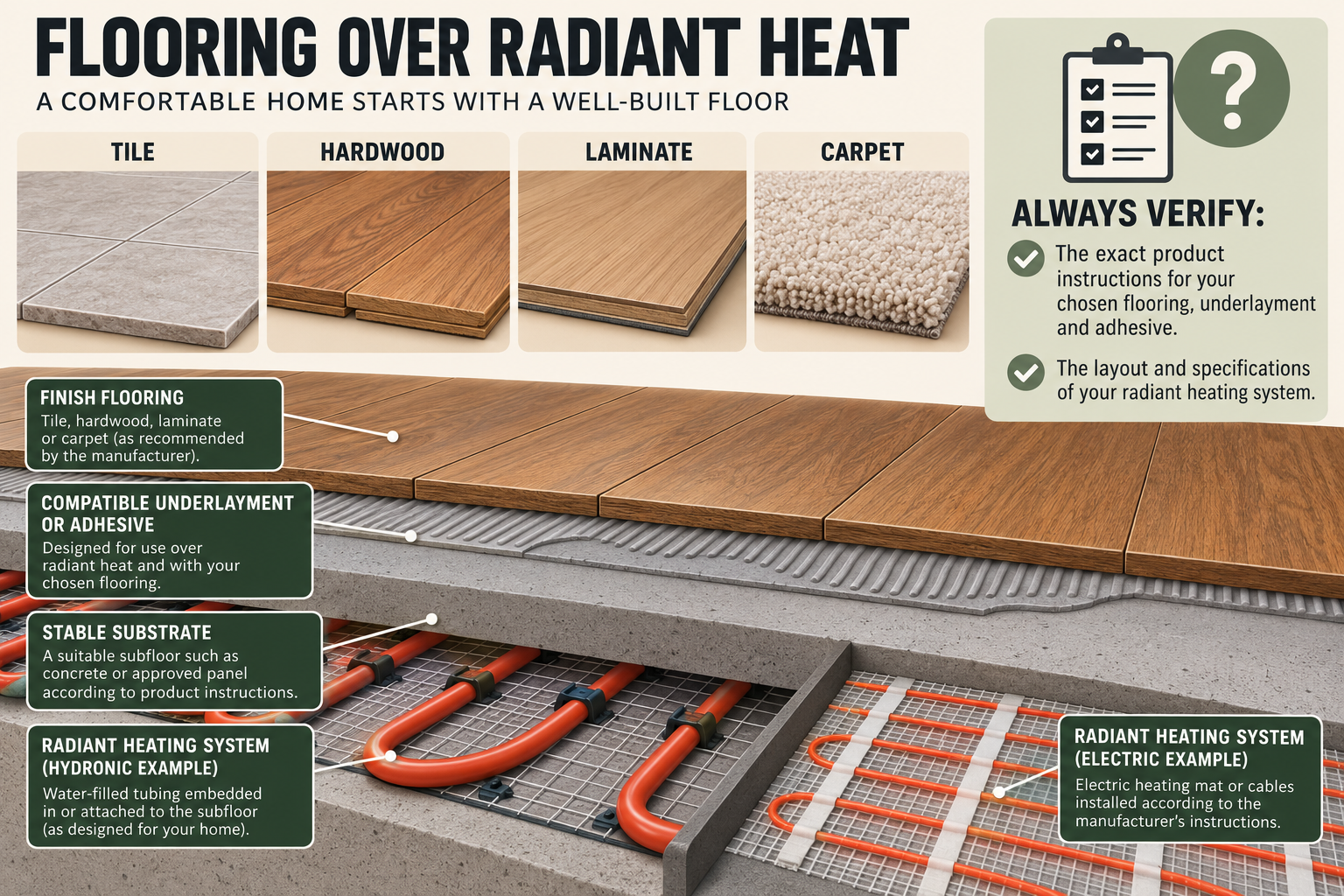
Radiant heat changes the flooring decision because the finish, underlayment or adhesive, substrate, and heating system must work together. A generic “radiant-floor premium” is not a reliable budget rule.
What must be verified
The named flooring product’s current instructions control. Check the radiant-system layout, substrate construction, moisture, vapor control, installation method, floor temperature, thermal resistance, fastener or adhesive requirements, and warranty conditions. A contractor should be able to explain how the proposed method avoids damaging heating tubes or elements.
NWFA’s 2025 guidance gives a controlled environment of roughly 30–50% relative humidity for the described wood-floor applications and notes an 80°F subfloor-surface example for a described nail-down application. Those values are not universal limits for every product or system. CRI 105 gives an 85°F/29°C example for residential carpet, and Pergo specifies a 27°C/80°F finished-floor limit for its covered laminate. Each applies only within its stated scope.
How compatibility affects cost
Verification, moisture conditioning, layout review, alternate glue-down or floating methods, special underlayment, and extra preparation can add labor. Mechanical fastening may not be suitable where it could penetrate heating components. Do not substitute a different product because it looks similar.
Questions for the quote
Provide the heating-system information and exact floor product. Ask for the installation method, temperature and humidity assumptions, thermal-resistance calculation where relevant, moisture checks, protection of heating components, preparation, testing, and warranty exclusions.
The responsible budget is the cost of a compatible flooring system, not the lowest finish price on its own.
Why radiant heat changes the flooring decision
The floor is part of a system that includes the heating source, distribution layout, controls, substrate, underlayment, floor covering, and room conditions. A finish that looks suitable in a sample room may not be suitable for the named heating system or installation method. The cost decision therefore begins with compatibility, then moves to material and labor.
Do not treat radiant heat as a universal premium or a reason to select one material family automatically. Tile, stone, wood, laminate, resilient products, and carpet each have product-specific limits. Thermal resistance, surface temperature, moisture, humidity, fastening, adhesives, expansion, and underlayment can all matter.
Product-specific compatibility
The exact manufacturer documentation should identify whether the named product may be used over the named system and under which conditions. NWFA’s current radiant-heat guidance provides a framework for wood-floor installation, but it does not approve every wood product or heating layout. Pergo’s laminate instructions and CRI’s carpet standard likewise provide bounded examples rather than a universal flooring table.
Ask the installer to identify the product, installation method, underlayment, temperature controls, and requirements that will be verified. If those details are missing, the estimate is not yet a compatibility decision.
Broad material-family considerations
Tile and stone often conduct heat well, but substrate stability, setting materials, movement accommodation, grout, and the wet-area assembly still control the installation. Do not assume the heating layer can be altered or repaired as part of ordinary flooring work.
Wood requires attention to moisture, acclimation or conditioning, humidity, fasteners or adhesive, dimensional response, and the product’s permitted temperature range. Solid and engineered products may have different installation choices.
Laminate and resilient products vary in underlayment, expansion, moisture, surface-temperature, and thermal-resistance requirements. Water-resistance labels do not establish radiant compatibility.
Carpet and cushion can alter heat transfer and may have system-specific surface-temperature or cushion limits. Confirm the exact product rather than assuming that any carpet and pad combination will perform the same.
What adds to the project budget
Radiant-compatible work may add documentation, product selection, system shutdown and protection, moisture or substrate checks, specialized underlayment, preparation, layout, and coordination between flooring and heating contractors. Removing the finish can expose heating components or limit access to the substrate, so the quote should state how the system will be protected.
The lowest material price may create higher lifecycle cost if it requires an unsuitable underlayment, restricts heat output, increases failure risk, or voids a product requirement. Conversely, a premium product is not automatically a better choice if the system and installation conditions are not verified.
Questions for two contractors
Give both the flooring and heating contractor the same information: heating type, layout if known, controls, floor assembly, moisture history, exact product, underlayment, and planned installation method. Ask who confirms compatibility, who protects the heating system, who controls startup, and what happens if the substrate fails inspection.
Ask for separate lines for finish, removal, substrate preparation, underlayment, installation, transitions, controls or coordination, and testing. Keep radiant-system repair or replacement outside the flooring quote unless it is explicitly a separate project.
What not to infer
No general article can determine that a named floor is compatible with an unknown heating system. Do not infer a safe temperature, humidity, fastener, adhesive, or thermal-resistance limit from another product. Obtain current product and system documentation when the decision is material.
The responsible budget is the complete compatible assembly, including the work needed to verify and protect it. Compatibility uncertainty should be resolved before comparing finish prices.
Coordinate flooring and heating work
Before requesting bids, gather whatever system information is available: radiant-electric or hydronic type, control location, known tubing or element layout, prior service records, and the existing floor assembly. The absence of a drawing does not establish that fastening or demolition is safe. Ask who will locate or protect the heating components before removal and who is responsible if the planned flooring method needs to change after the assembly is exposed.
A flooring contractor and heating-system professional may each control a different part of the decision. Clarify who confirms product compatibility, who sets the operating conditions during installation, who checks system operation before and after the work, and who handles a conflict between flooring instructions and system requirements. Keep a written record of the selected product, underlayment, adhesive or attachment method, and any applicable manufacturer limits.
Compare complete compatible bids
Use the same named finish product and room assumptions for each estimate. Ask for separate costs for removal, substrate assessment, moisture checks, compatible underlayment, installation method, transitions, protection, coordination, and any testing or startup steps. An apparently cheaper floor can be a poor comparison if it excludes verification or assumes a different build-up.
If the compatible products narrow the choices, compare the resulting floor on appearance, maintenance, repairability, response to room conditions, and replacement options. Do not choose from a general material ranking; the actual system instructions and site conditions govern. Resolve a material compatibility question before ordering product, because restocking, schedule changes, and repeated labor can outweigh a small difference in material price.