
Indoor particles can come from cooking, candles, fireplaces, wood stoves, tobacco, wildfire smoke, dusty renovation, fuel-burning equipment, attached garages, or outdoor air. The best fix depends on the source. Filtration can reduce particles that are already airborne, but it cannot repair a faulty appliance, stop smoke entering from a garage, or replace safe exhaust ventilation.
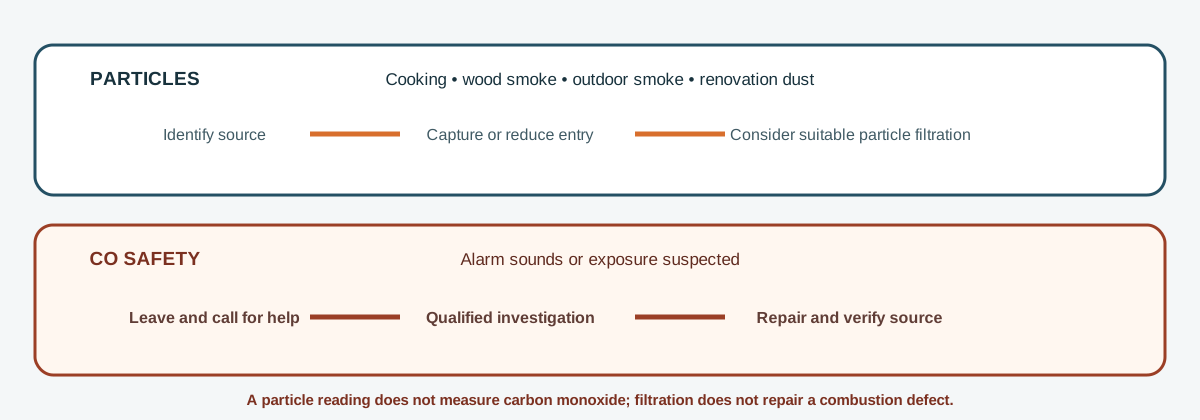
Separate particles from combustion gases
Fine particles and combustion gases are related but different problems. A particle reading does not measure carbon monoxide, and a quiet CO alarm does not prove that particle exposure is low. Odor is also unreliable: some pollutants have little odor, while a strong smell can persist after the main source changes.
If a CO alarm sounds or anyone has possible CO symptoms, leave and follow when a carbon monoxide alarm sounds. Do not use an indoor-air-quality monitor to decide whether it is safe to remain. Appliance, flue, and garage problems require a qualified safety investigation.
Map the source pattern
Record when the particle level or haze changes: during frying, broiling, fireplace use, wood-stove operation, furnace startup, dryer operation, shower exhaust, renovation, nearby traffic, wildfire smoke, or vehicle activity in an attached garage. Note whether the range hood exhausts outdoors or recirculates, whether doors are open, and whether HVAC or filtration is running.
The pattern guides the next professional:
- Cooking peaks may point to source capture, range-hood performance, and operating practice.
- Wood smoke or fireplace events may require appliance, chimney, fuel, and ventilation review.
- Furnace or water-heater changes may require a fuel-burning appliance and venting professional.
- Garage-linked peaks may require separation, door sealing, ventilation, and vehicle-use changes.
- Renovation dust may require containment, cleanup, and material-hazard review.
- Outdoor smoke may require weather-aware filtration and reduced outdoor-air intake where the system permits.
This is a documentation method, not a request to create unsafe test conditions. Never deliberately operate a suspect appliance or vehicle indoors to reproduce a reading.
Source control before filtration
For cooking, use an appropriately sized hood that exhausts outdoors when feasible and operate it during and after cooking according to the manufacturer’s guidance. Keep the hood and filters maintained. A recirculating hood can reduce some contaminants but does not perform the same function as outdoor exhaust.
For fireplaces and wood stoves, use dry, appropriate fuel and have the appliance and chimney inspected and maintained according to local professional guidance. Do not burn materials not intended for the appliance. Smoke entering the room, unusual odors, visible soot, or drafting problems warrant professional attention.
For fuel-burning equipment, do not adjust burners, flues, or combustion air yourself. Arrange qualified inspection and repair. For attached garages, keep vehicles and fuel-burning equipment from creating indoor pathways and ask a building or HVAC professional to evaluate the separation and ventilation.
Ventilation tradeoffs
Outdoor-air ventilation can dilute indoor pollutants, but it is not always the first or only answer. Outdoor wildfire smoke, traffic pollution, high humidity, cold weather, building pressure, and combustion-air requirements affect the safe strategy. Exhaust fans need replacement air; otherwise they can draw air from a garage, crawlspace, chimney, or another contaminated path.
Ask an HVAC or building professional to evaluate the system, filters, outdoor-air intake, return pathways, pressure, and source capture. Do not block combustion-air openings or modify a flue to improve a particle reading. A ventilation change that creates backdrafting can turn a particle concern into a CO emergency.
Filtration and monitoring
Portable or central filtration can reduce airborne particles when the filter is appropriate, sized for the room or system, and maintained. A high-efficiency particle filter does not remove every gas or VOC, and a filter indicator may not reflect actual removal. Avoid devices that intentionally generate ozone in occupied spaces.
Use a particle monitor to understand trends, not as a universal safety certificate. Compare readings under repeatable ordinary conditions, place the monitor away from direct cooking plumes and supply jets, and record the model and limitations. If a decision depends on a specific pollutant or an exposure dispute, ask an indoor-air-quality professional for targeted testing.
Build a complete repair scope
The estimate should distinguish source repair, ventilation or capture, filtration, cleaning, and reconstruction. It should identify whether the work includes appliance service, chimney inspection, duct cleaning, hood replacement, garage-separation work, electrical changes, filter upgrades, or smoke-residue removal. A filter purchase cannot close out a combustion defect.
Retest or reassess after the source is repaired, under normal use and safe conditions. Keep service records, filter specifications, monitor observations, professional findings, and unresolved limitations. For a persistent odor or residue issue, see smoke and persistent indoor odors; for renovation emissions, see formaldehyde and VOCs after renovation.
Choose the intervention by failure mode
| Observed pattern | First decision to discuss |
|---|---|
| Sharp peaks during cooking | Improve outdoor capture, hood operation, and cooking-source control. |
| Smoke during fireplace or wood-stove use | Have the appliance, fuel, chimney, and draft evaluated. |
| Changes when a furnace or water heater starts | Treat as a combustion and venting investigation, with CO safety first. |
| Peaks tied to garage activity | Investigate the garage separation, doors, pressure, and vehicle or equipment use. |
| High readings during renovation | Improve containment and cleanup and screen the work for material hazards. |
| Outdoor smoke event | Reduce entry where safe, use suitable particle filtration, and follow local public-health guidance. |
The table identifies a first conversation, not a self-diagnosis. Multiple sources can occur together. A filter can be useful while a source repair is arranged, but it should not be used to justify continued exposure to a suspected combustion defect.
Filtration is an operating cost
Price the filter, fan energy, noise, replacement schedule, room size, and maintenance access. A high-efficiency filter in a system that cannot accommodate the pressure drop can reduce airflow or damage equipment. A portable unit in one bedroom does not clean the whole home, and a central filter does not necessarily capture pollutants before they enter living space.
Ask the seller or HVAC professional for the clean-air delivery or airflow information relevant to the room and system. Keep the model and replacement filter record. Do not place a unit where it blocks a return, creates a trip hazard, or draws air from a contaminated pathway.
Reassess after weather and occupancy changes
Outdoor smoke, wind, temperature, cooking habits, a new appliance, a basement finish, or an added exhaust fan can change the source pattern. Recheck the system after a repair under ordinary safe conditions and record what changed. If particle levels improve while odor, soot, or a CO concern remains, treat those as separate unresolved questions.
Separate particle control from combustion repair
Particles from cooking, candles, wood smoke, or outdoor events are not the same as carbon monoxide, fuel gas, or a venting defect. A particle monitor can help show a pattern, but it cannot identify every source or prove that a combustion appliance is safe. If an alarm or suspected exposure involves carbon monoxide, follow the emergency-response path first and arrange qualified source investigation afterward.
For a particle concern, identify whether the main question is source capture, filtration, building leakage, cleanup, or a combination. A kitchen hood, a portable HEPA unit, a central HVAC filter, and source repair serve different purposes. Ask the professional to say which pollutant and room the recommendation addresses and what limitations remain.
Compare purchase cost with operating cost
Filtration is an ongoing system decision. Include the equipment, filter replacement, electricity, noise, airflow, space, and maintenance access in the comparison. A portable unit usually serves a defined room; a central filter depends on system compatibility and regular operation. A higher-efficiency filter may not suit an HVAC system that cannot handle the added resistance, so ask the HVAC professional to confirm the equipment’s limits.
When comparing options, request the relevant airflow or clean-air information for the room, the replacement filter model and price, and the expected maintenance interval from the manufacturer. Do not treat a one-time monitor reading as proof that the system will control future cooking or smoke events.
For outdoor wildfire episodes, follow local public-health advice and the separate resilience planning path in Category 029. This article focuses on indoor source identification, combustion safety, and particle-control decisions rather than a complete wildfire preparation plan.
Make the repair measurable without overreading a monitor
Before and after a source or filtration change, use the same monitor and a similar placement and operating condition if the purpose is to compare particle patterns. Record cooking, fireplace, heating, ventilation, and outdoor conditions that could affect the reading. This can show whether the intervention changed the pattern; it does not prove that all pollutants are controlled or identify a medical effect.
If the reading remains high, return to the source and airflow question before purchasing a larger filter. A professional may need to distinguish indoor emissions from outdoor particles, check whether a hood exhausts outdoors, or confirm that a fuel-burning appliance and venting are functioning. A particle reading cannot clear a carbon-monoxide concern.
Keep the model, filter type, operating setting, room served, and replacement dates in the maintenance record. These details help an HVAC professional judge whether a central filter is compatible and whether a portable unit is appropriately sized for the homeowner’s intended room.