
“Indoor-air-quality testing” can mean a building inspection, a targeted measurement, laboratory sampling, or a package of sensors that produces many numbers. The useful choice depends on the decision behind the test. You might want to identify a suspected pollutant, locate a source, compare two areas, document a remediation, or decide whether a ventilation or material change is justified.
A test is not automatically valuable because it is broad, expensive, or performed with sophisticated equipment. A result should have a defined question, a method suited to that question, known limitations, and a practical next step if the result is high, low, or inconclusive.
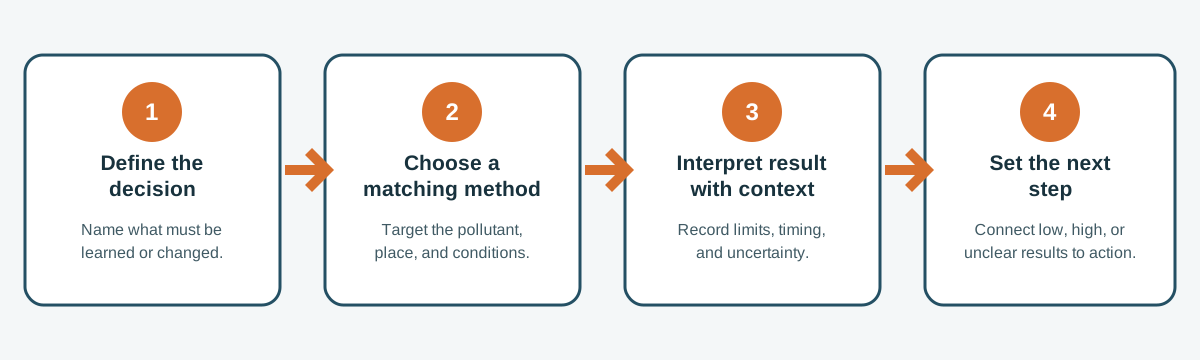
Start with the question
Write the decision in one sentence before requesting a quote. Examples include:
- Is a new cabinet, flooring product, coating, or adhesive a plausible source of an odor or irritation?
- Does a moisture problem extend behind a finish, and will the area need selective opening?
- Is combustion from an appliance, fireplace, garage, or generator entering the living area?
- Did a defined remediation area become visibly clean and dry?
- Does a recurring pattern occur during cooking, painting, heating, or particular weather?
The question changes the work. A suspected formaldehyde source may call for a product history, building conditions, and targeted formaldehyde method. A cooking-particle concern may call for source observation and exhaust evaluation. A musty odor may be better served by a moisture and hidden-mold investigation than by a generic air panel.
An active carbon-monoxide alarm or suspected exposure is an emergency, not an indoor-air testing appointment. Leave for fresh air and call emergency services from outside. A non-acute measurement cannot make it safe to remain in a building during an alarm.
What a professional assessment may include
An appropriately scoped assessment may combine several elements:
- History. The provider asks about construction, remodeling, odors, occupant concerns, appliance operation, cleaning products, weather, occupancy, and the timing of the problem.
- Visual and building review. The provider looks for moisture, visible growth, material sources, ventilation paths, combustion equipment, exhaust routes, and conditions that make a measurement misleading.
- Targeted measurement. Instruments are selected for a named pollutant or condition, with locations, duration, calibration, and operating conditions documented.
- Sampling and laboratory analysis. Air, surface, dust, or material samples may be useful when the sampling question and laboratory method are appropriate.
- Interpretation. The report explains what the result means for the building decision, what it cannot establish, and what should happen next.
The final report should identify the tested locations and conditions. Cooking, painting, showering, heating, window position, filtration, temperature, humidity, weather, and occupancy may all change a reading. A number without this context is difficult to compare with another number or use for a quote.
Why broad panels can mislead
Mold, radon, formaldehyde, other VOCs, particles, combustion gases, and carbon monoxide are different problems. A panel that measures one or two of them does not establish that the others are absent. A monitor also may detect only the pollutants for which its sensors are designed.
EPA notes that widely accepted indoor concentration limits do not exist for most pollutants. A manufacturer’s alert threshold is therefore not automatically a health standard. Low-cost monitors can help observe patterns, but their accuracy and precision may vary with placement, temperature, humidity, time in use, data processing, and the presence of other contaminants. Their alerts are not designed to serve as the immediate-danger warning of a certified CO alarm or smoke detector.
“Total VOC” is a group measurement, not an identification of each compound. A low or high total does not answer whether one specific substance is present or whether the home meets a universal healthy-air threshold. Likewise, odor intensity is not a reliable universal measure of concentration or personal health risk.
When source inspection is more useful
Source control often produces a clearer building decision than an expanding test list. Depending on the concern, source work may include:
| Suspected source | Decision that may matter more than a broad panel |
|---|---|
| New finishes, cabinets, adhesives, or furniture | Identify products, reduce or isolate the source, improve appropriate exhaust, and decide whether targeted testing is needed. |
| Visible mold or persistent dampness | Find and correct moisture, define affected materials, and plan cleanup; routine sampling may not change the decision. |
| Cooking, candles, or wood smoke | Improve source capture and ventilation, then assess particle patterns if the result will change the design. |
| Fuel-burning appliance, chimney, or attached garage | Treat suspected CO as an emergency when indicated and arrange qualified combustion and venting inspection afterward. |
| Excess humidity or condensation | Investigate the moisture pathway, air movement, enclosure, and ventilation rather than treating a humidity number as a diagnosis. |
The physical repair may belong to another project category. Environmental assessment can identify the problem and sequence, while HVAC, chimney, plumbing, roofing, enclosure, or finish specialists handle the underlying work.
Choosing a provider
Ask for an itemized scope before accepting a “whole-house air quality” package. The proposal should state the pollutants or conditions to be assessed, locations, number and duration of measurements, laboratory fees, travel, report contents, follow-up interpretation, and what is excluded. Ask what decision each test is intended to support and what the provider would recommend for each plausible result.
Relevant training and credentials differ by pollutant and jurisdiction. A provider who also sells remediation, filtration, coatings, or equipment should explain how recommendations are separated from sales. Independence is especially useful when the result could lead to extensive work.
Cost and value
Testing cost is shaped by inspection time, travel, number of locations, instruments, laboratory analysis, report depth, repeat visits, and whether a targeted source investigation is included. A broad low-cost package may be less useful than a staged assessment that begins with history and visual review, adds one targeted measurement, and expands only if the result changes the next decision.
Compare quotes by scope, not by the number of sensors or pages in the final report. Ask whether a result will change source correction, material removal, ventilation design, filtration, occupancy, or a decision to do nothing further. If none of those decisions is clear, the test may be premature.
Reading the report
A useful report should allow another professional to understand what was actually measured. Look for the question, locations, dates, duration, conditions, method, detection limits where relevant, laboratory, comparison value if one exists, uncertainty, and recommendations. It should distinguish an observation from a diagnosis and a building concern from a medical conclusion.
If symptoms are part of the concern, discuss them with an appropriate healthcare provider. Air testing cannot diagnose an individual illness. For the building, retain the report with renovation, appliance, moisture, and remediation records so later contractors know what was measured and what remains unresolved.
Decide in advance what each result would change
Before authorizing a test, write down what action is plausible for a low, high, or inconclusive result. The decision does not have to be a precise repair prescription. It should show whether the result would lead to source inspection, a targeted second measurement, a building change, a temporary occupancy decision, or no further testing.
| Result or pattern | Follow-up to discuss |
|---|---|
| A targeted measurement is consistent with the suspected source | Can source control be priced now, and what measurement, if any, would document the result afterward? |
| A low-cost monitor changes with cooking, cleaning, or occupancy | Which activity and room should be observed before commissioning laboratory identification? |
| A result is close to a reference value | Does the reference apply to this pollutant, averaging period, and country, and what uncertainty should be included? |
| A result does not match the concern | Was the location, duration, device, or building condition appropriate, or would a different question be more useful? |
This helps distinguish a measurement that supports a project from one that merely creates another number to interpret. Ask the provider to put the decision path in the proposal, including the point at which work stops and the owner decides whether to authorize a second phase.
Keep the report linked to the renovation, appliance, moisture, or occupancy conditions in place when it was collected. If those conditions change, an old number may not answer a new question. A report that names its limits and next steps can reduce repeat diagnostic fees even when it does not identify a single cause.
Repeat a measurement only when the question has changed
A repeat test can be justified when a source was corrected, building conditions changed, the first method did not match the concern, or the decision depends on a different time period or room. Repeating the same test under the same conditions may simply reproduce the same uncertainty.
Before scheduling another visit, compare the original and proposed question, location, method, duration, operating conditions, and interpretation standard. Ask the provider to explain what new information the second result is expected to add. If the home has changed since the first test, document those changes so the result is not compared as though it were a controlled experiment.
For a persistent concern, a staged plan can be more economical than a series of unrelated panels: first clarify history and likely source; then investigate the specific pathway; then test only if the result will affect a repair, occupancy, or verification choice. The provider should say when the project can stop. This leaves the homeowner with a decision even when no single measurement proves a complete cause.