
New flooring, cabinets, composite wood, adhesives, coatings, sealants, furniture, and cleaning products can change indoor air after a renovation. Formaldehyde is one indoor pollutant of concern, while volatile organic compounds (VOCs) are a broad group with different sources and health effects. A strong odor or a high total-VOC reading can signal that the building needs attention, but neither one alone identifies a safe level for every occupant.
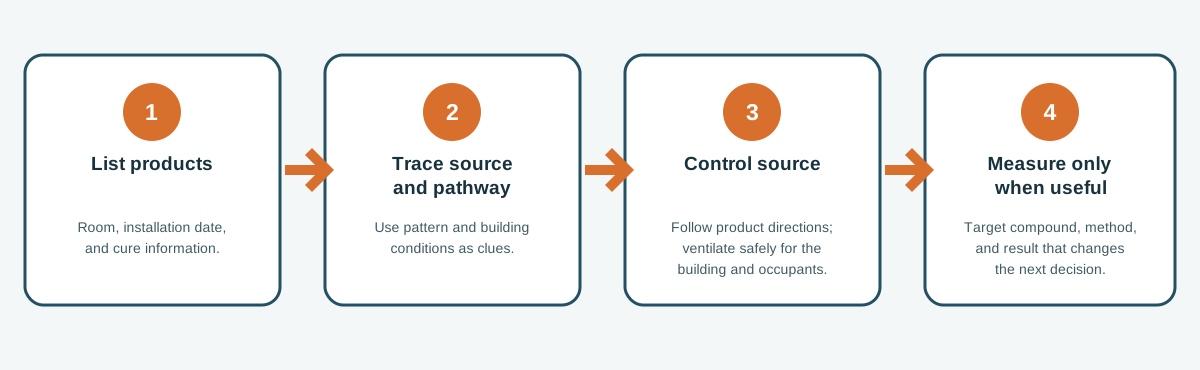
Start with the renovation inventory
List what changed, when it was installed, where it is located, and what products were used. Include cabinets and built-ins, pressed-wood panels, flooring and underlayment, paints, stains, caulks, adhesives, insulation, furniture, and cleaning or pest-control products. Ask the contractor or supplier for product names, safety data, emissions information, and cure or occupancy instructions.
Look for the pattern. Symptoms or odors that are strongest in one room may point to a local source or low ventilation. A whole-home change may involve multiple new materials, HVAC distribution, stored products, or outdoor air. Temperature and humidity can influence emissions and perception, so record those conditions without treating them as a diagnosis.
Source control comes first
The most reliable improvement is to reduce or isolate the source. Depending on the product and advice from the manufacturer or qualified professional, that may mean:
- removing an unnecessary product or stored container from living space;
- replacing a defective or misapplied material;
- allowing a product to cure before normal occupancy;
- sealing or coating a compatible substrate after the source is identified;
- isolating a renovation zone while work continues; or
- choosing lower-emitting products for the next phase.
Do not seal a damp, contaminated, or chemically incompatible surface just to hide an odor. Do not mix cleaners or apply a coating outside the manufacturer’s instructions. A source-control choice should account for fire safety, moisture, durability, future disturbance, and the effect on the whole assembly.
Ventilation can help, but it is not a universal fix
Increase outdoor-air ventilation when weather, building systems, and the product’s instructions make it appropriate. Use exhaust to remove pollutants at the source, maintain a safe path for replacement air, and avoid drawing combustion exhaust or garage air into the home. Do not block combustion-air openings or operate an exhaust strategy that creates a CO risk.
Heating, cooling, and filtration can distribute or reduce pollutants differently. A portable air cleaner may help with some particles, but a particle filter does not automatically remove gases or formaldehyde. Activated-carbon media can have limited capacity and require correct sizing and replacement. Do not use an air cleaner’s display as proof that formaldehyde or every VOC has been removed.
When testing is useful
Testing can help when the source is uncertain, symptoms persist after reasonable source-control measures, a renovation dispute requires documentation, or a professional needs a baseline and follow-up comparison. A useful plan defines the question, target compounds, locations, timing, environmental conditions, laboratory method, and how the result will change the decision.
Generic TVOC meters and odor ratings cannot identify individual compounds or establish that a home is safe for all people. Short-term sampling can miss peaks and may not represent normal occupancy. A result without a sampling plan, detection limits, quality controls, and interpretation is easy to overread.
For a targeted Canadian formaldehyde result, Health Canada’s residential indoor-air guidelines list a long-term exposure limit of 50 µg/m³ (40 ppb) for an 8-hour sampling period and a short-term exposure limit of 123 µg/m³ (100 ppb) for a 1-hour period. Compare a result only with the guideline that matches its sampling period and method. These are Canadian reference values, not US requirements, a universal pass/fail test, or proof that all indoor air is safe.
Ask an indoor-air-quality professional what the test can and cannot establish. If a particular product is suspected, targeted sampling may be more useful than a broad “everything” panel. If symptoms are the primary concern, also seek medical advice; an air sample cannot diagnose a person.
Protect occupants during the transition
Follow the product’s cure, ventilation, and re-entry instructions. Keep children, older adults, people with asthma, and anyone especially affected by odors away from the active work area as appropriate. Do not return furniture, clothing, or stored materials until the source and ventilation plan allow it. Keep a simple log of symptoms, odors, occupancy, products, and ventilation changes without assuming that timing proves causation.
If renovation dust, visible mold, combustion exhaust, or a chemical spill is also present, address those hazards separately. One low TVOC reading does not clear a building of mold, lead, asbestos, or CO.
Choose the next project
Ask the contractor to distinguish ordinary cure time from a persistent emission problem. A durable plan may require replacing a material, correcting installation, increasing safe ventilation, improving source capture, or obtaining targeted professional testing. Keep product records and any test report with the home.
Use indoor air quality testing to define a measurement question, smoke and persistent indoor odors for residue and porous-material decisions, and combustion and particle pollution when the concern is fuel-burning equipment, cooking, or smoke.
Product decisions before installation
For the next renovation phase, choose materials with the actual room and ventilation in mind. Ask whether the product is intended for interior use, whether it requires a cure period, what emissions or handling information is available, and whether the installer must control temperature or humidity. Keep unopened products and solvents out of occupied rooms.
Low-emitting does not mean emission-free, and a product label does not establish that it is appropriate for every occupant or assembly. Compare the full system: substrate, adhesive, finish, underlayment, cabinets, furnishings, and cleaning products. A low-emission finish over a damp or chemically incompatible substrate can still create a failure and a persistent odor.
Source, pathway, or perception?
Persistent odor can arise from a source still emitting, a porous material storing residue, air movement carrying a source from another room, or heightened perception after an earlier event. These possibilities are not interchangeable. A contractor should inspect products and pathways before recommending a sealer, ozone treatment, or whole-home replacement.
If symptoms occur, keep a neutral log of timing, room, occupancy, products, temperature, humidity, and ventilation, and consult a healthcare provider. Do not treat a temporal association as proof that one material caused a symptom. The building investigation can still use the pattern to decide what to inspect.
Compare source correction with repeated testing
When an odor begins after a renovation, start with the project record: product names, installation dates, adhesives and coatings, storage, cure instructions, and the rooms where materials were used. A targeted assessment can help when a result would change whether a product is isolated, repaired, replaced, or tested further. A broad VOC number may not identify the compound or point to the material responsible.
| Finding | Project decision to discuss |
|---|---|
| One new product is strongly associated with the room and timing | Can the installer identify its cure and ventilation requirements, or does the material need a separate assessment? |
| Several products were installed together | Which compound and sampling period will distinguish a useful source question? |
| The odor persists after the stated cure period | What source inspection and targeted test would change the repair decision? |
| The test result is low but odor remains | Could a different compound, material, or non-chemical source explain the condition? |
Testing and material replacement are separate cost layers. Ask the provider to explain whether a result will change the source-control plan before paying for repeat measurements. A report should preserve the room conditions and timing so another professional can interpret it alongside the renovation records.
If a contractor recommends sealing or replacing a surface, ask what product and substrate are included, how the source will be controlled, and what finish restoration costs extra. A coating can change the surface without resolving a hidden source or moisture condition. Keep the decision focused on the material and room under investigation.
Build a product and room history
Before requesting a test, assemble the product and renovation record: flooring, cabinets, adhesives, coatings, composite wood, furnishings, installation dates, and any cure or ventilation directions. Note which room was renovated, whether doors or windows were closed, what ventilation operated, and when the concern is strongest. This helps an assessor decide whether a particular source or compound deserves targeted evaluation.
A room history also helps separate source correction from general ventilation. If a new cabinet or finish is the likely source, ask what the installer can confirm and whether the material can be isolated or replaced. If several products were installed together, ask which test would differentiate them before paying for a broad panel.
Keep the sample period, room conditions, and method attached to the report. This is especially important for formaldehyde because the Canadian reference values use different averaging periods. A test whose duration does not match the reference cannot be interpreted by comparing the displayed number alone.