
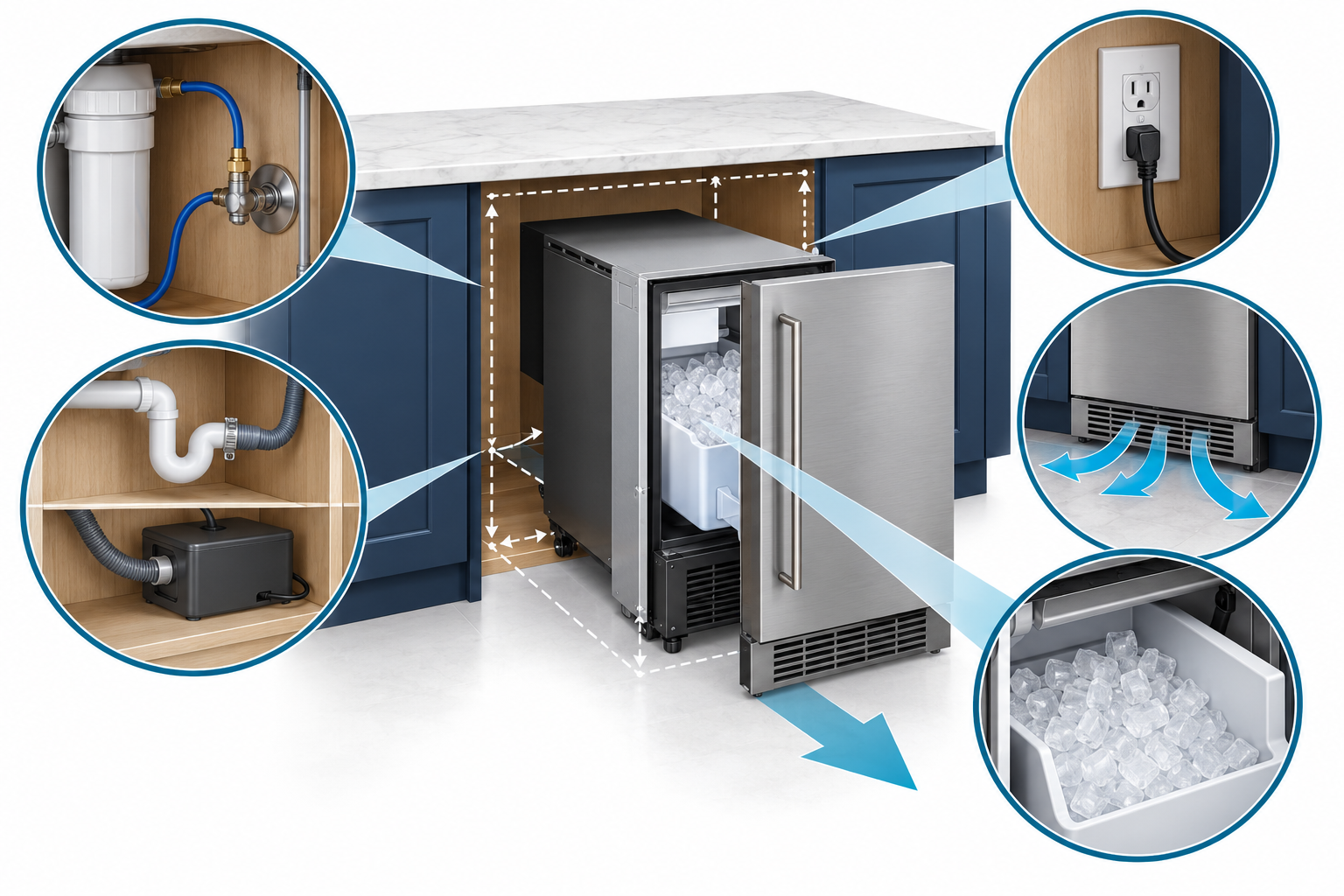
A dedicated residential ice maker is a different project from repairing the ice-maker module inside a refrigerator. An undercounter or freestanding unit can have its own water supply, drain, electrical connection, ventilation, opening, filter, storage bin, and service access. Budget the appliance and the connections together, then verify the exact model before comparing quotes.
Types of dedicated ice makers
Freestanding units may be movable or designed for a particular room. Undercounter units can be installed beside cabinetry or under a counter, but “undercounter” does not establish a universal cutout, ventilation, or drain arrangement. Some models store ice; others make ice for transfer to a separate bin or require different clearances.
Use the product class and model number when requesting a quote. A refrigerator ice-maker repair article may help with appliance-side diagnosis, but it does not establish the purchase, installation, or service scope of a dedicated unit.
What installation may include
A basic installation may involve delivery, positioning, leveling, connecting an approved water supply, connecting a model-supported drain when required, and testing the unit. Add the equipment, installation labor, water or drain materials, filter, access, cabinetry, floor protection, removal, and disposal as separate lines.
Gravity-drain, pump-drain, and no-drain designs can produce very different projects. The manufacturer instructions control whether a drain is required, whether a pump is built in, how the unit vents, and how much service clearance is needed. New household water or drain work belongs in the relevant plumbing category, not inside a generic appliance hookup allowance.
Electrical and ventilation limits
The exact model controls electrical requirements, connection method, clearances, and ventilation. Do not assume that a countertop unit, freestanding unit, and built-in unit use the same power or airflow arrangement. If the existing receptacle, circuit, water line, drain, or opening is unsuitable, price that correction separately through the appropriate qualified trade.
Do not install a water connection beside an unsafe electrical condition or bypass a safety device. The installer should verify the manual, local requirements, access path, and final operating test.
Repair cost and diagnosis
A dedicated ice maker can have different repair economics from a refrigerator’s ice-maker module. The failure may involve water entry, a fill valve, a pump, a control, a bin or cutter mechanism, a condenser, a fan, or a sealed refrigeration system. A symptom such as “not making ice” does not identify the failed part.
U.S. specialist sources report broad ice-maker and appliance-repair signals, but they do not establish a universal dedicated-ice-maker price or a Canadian range. Ask for the diagnostic charge, parts, labor, refrigerant-related service if applicable, access, return visit, and warranty. A specialized or discontinued unit may cost more to diagnose than a common appliance.
Maintenance and service access
Follow the model’s cleaning, water-filter, sanitizing, airflow, and drain instructions. Include filters, cleaning supplies, periodic service, and the cost of taking the unit out of a tight opening. Poor water quality, restricted airflow, an overflowing drain, or infrequent cleaning can create service calls that are not solved by replacing one visible component.
Do not use generic cleaning or refrigerant instructions in place of the exact manual. If the unit has a refrigerant circuit, qualified service and proper disposal are required.
Repair versus replacement
Repair is easier to justify when the cabinet, controls, refrigeration system, and water/drain connections are sound, the part is available, and service is local. Replacement deserves comparison when the unit has repeated failures, corrosion, an obsolete control or sealed system, poor capacity for the household, or an installation that is already being rebuilt.
Include the removal, opening restoration, new connections, access, delivery, and disposal in a replacement comparison. A lower equipment price is not a lower project cost if the new unit needs a different drain or cabinet arrangement.
Disposal and refrigerant
Some dedicated ice makers use refrigeration systems. In the United States, EPA safe-disposal guidance addresses relevant refrigerant-containing equipment and the responsibilities of the disposal chain. It does not establish Canadian provincial, territorial, municipal, or retailer practice. Do not vent, puncture, cut, or dismantle the circuit. Ask the retailer, technician, municipality, utility, or qualified recycler how the unit will be handled.
U.S. and Canadian market differences
Availability, service networks, water quality, installation packages, taxes, disposal programs, and building requirements vary. Use a current local product and service quote in the currency of the purchase market. Canadian availability should be confirmed rather than inferred from a U.S. product listing.
Separate product cost from commissioning cost
The equipment line should not hide water treatment, drain or pump work, electrical verification, ventilation, cabinetry, access, delivery, removal, disposal, testing, or warranty. Ask whether the installer will return if the machine makes ice but leaks, drains poorly, overheats, or cannot be serviced. For an undercounter installation, keep the opening and future removal path visible.
Quote checklist
Ask the provider to identify the exact model, water and drain arrangement, electrical and ventilation assumptions, cabinet or counter work, access, delivery, removal, disposal, testing, service warranty, and any separate plumbing or electrical scope. The dedicated ice-maker decision is economical when the complete installation and service path are clear, not when the appliance price is viewed in isolation.
Price the utility handoff
Before comparing machines, identify the exact water supply, filtration, drain, electrical connection, ventilation or clearance, opening, counter, and delivery route. A freestanding unit may have different assumptions from an undercounter model. A drain may require gravity, a pump, an accessible standpipe, or a particular height. The current manual controls the connection and clearance; a nearby appliance’s setup is not a universal template.
Ask whether the quote includes a shutoff, filter, drain pump, hose, air space, cabinet or counter work, floor protection, leveling, and testing. If water can reach finished cabinetry or flooring, include leak protection and the callback path. Keep plumbing, electrical, cabinetry, and refrigeration work visible as separate scopes so the equipment price does not imply that every trade is covered.
Compare capacity with the household’s use
Estimate normal and peak ice demand, storage space, noise tolerance, cleaning schedule, and the consequence of an outage. A less expensive unit may be adequate for occasional entertaining but a poor fit for a high-use household or a business-like demand. Include the cost of bins, filters, water treatment, cleaning, electricity, and the space occupied by storage.
Repair can preserve a well-installed unit when diagnosis is clear and support is available. Replacement may be better when a sealed system, control, cabinet, drain, or water path has repeated problems, or when the old opening creates more labor than the appliance is worth. Compare the complete repair, replacement, and removal-and-restoration scenarios over the expected ownership period.
Write the project in the order it will occur
Confirm the model and opening first, then verify the water, drain, electrical, ventilation, and delivery path. Next assign plumbing, electrical, cabinetry, and appliance responsibilities. Finally schedule removal, installation, testing, cleanup, and disposal. If a measurement or utility check fails, the quote should show whether the installer reschedules, performs correction work, or stops at the appliance boundary.
This sequence protects the household from paying for an appliance that cannot be commissioned. It also makes a repair decision comparable: a repair quote should state access, diagnosis, parts, labor, warranty, and future service, while a replacement quote should include the complete installed and supported result.
Compare the complete outage consequence
An ice maker may be optional for one household and essential for another. Estimate how a delayed repair affects food service, entertaining, storage, or a connected business use. If the consequence is high, include local parts, technician response, rental or temporary storage, and a supported replacement in the comparison rather than focusing only on the first repair visit.
Preserve future removal access
Before closing cabinetry or placing a counter, confirm how the ice maker can be disconnected, pulled out, serviced, and replaced. Keep the shutoff, drain, electrical connection, and model information accessible according to the exact installation instructions. A lower initial installation cost is not a saving if future service requires dismantling finished work.
Confirm service before committing to a niche model
Ask who can service the model in the actual location, how long common parts take, whether warranty work is local, and how refrigerant-containing equipment is disposed of. U.S. disposal guidance does not establish Canadian practice. A current local service answer is part of the purchase decision, especially when the appliance is built into finished work.