
A built-in compactor decision has three branches: repair the exact unit, install a compatible replacement, or remove it and finish the opening for another use. The appliance market is small, so individual listings and service quotes are examples rather than a reliable national price range. The opening, electrical supply, access, cabinet finish, disposal, and the household’s actual use can matter as much as the machine.
Identify the appliance and the opening
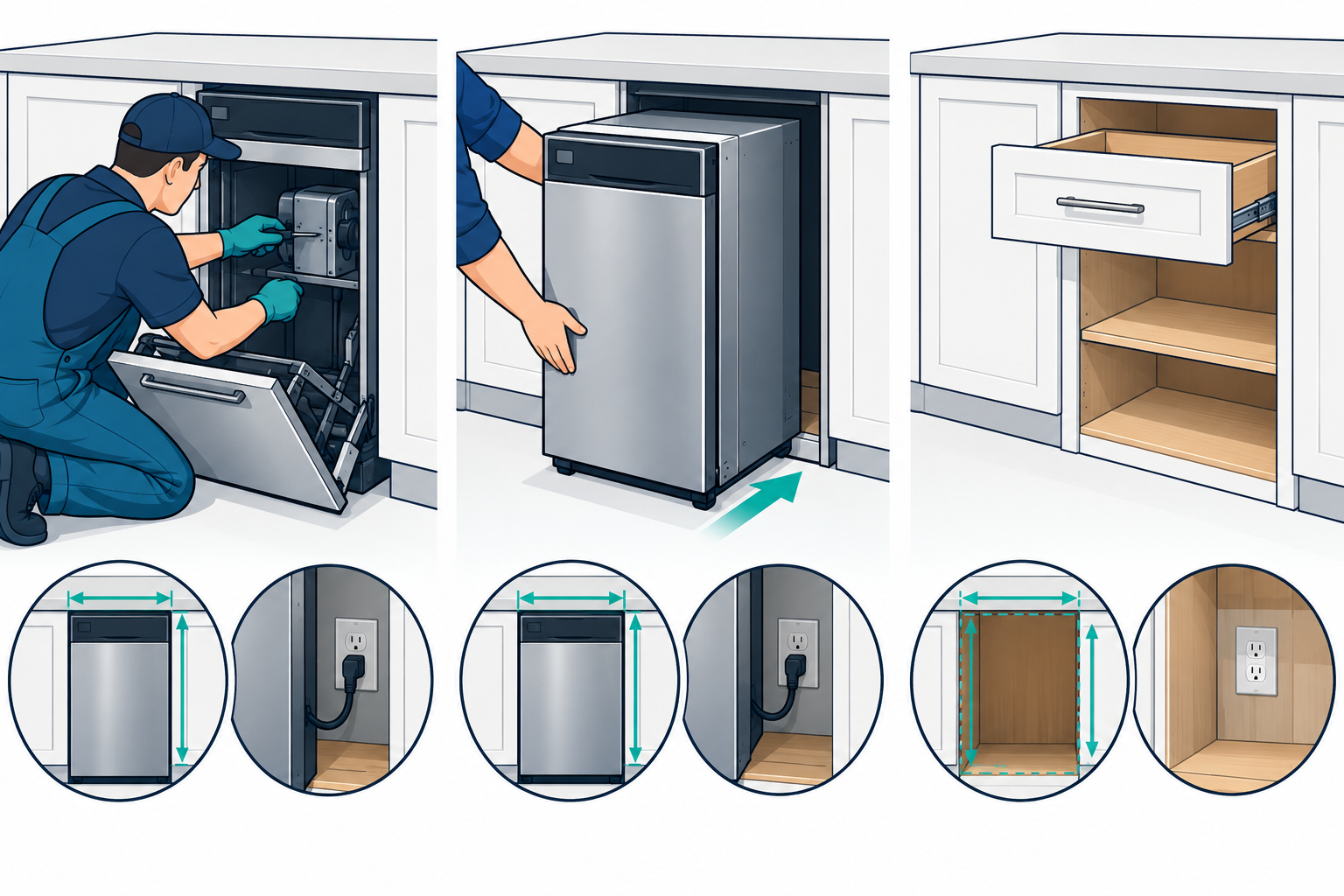
Record brand, exact model and serial, width, depth, door or drawer clearance, mounting, power connection, and cabinet condition. Check whether the existing unit still compacts safely, whether a replacement model fits the opening, and whether service parts and a local technician remain available. A product that is nominally 15 inches wide may still differ in depth, controls, trim, and installation requirements.
Measure the opening after confirming how the current appliance is secured. Do not remove it or access wiring as a diagnostic step. Follow the model manual and use a qualified appliance or electrical professional where required. A failed drawer interlock or ram-stop safety feature is a reason to stop using the unit and seek service, not to bypass the control.
What current listings can establish
The U.S. Home Depot category showed seven 15-inch built-in listings at about $1,259 to $2,149 when checked October 2026. These are product prices, subject to promotion and stock, before delivery, installation, tax, removal, and cabinet or electrical work. RONA’s Canadian category displayed two prices, $1,599 and $1,699; the pages did not state an ISO currency code or establish local stock and tax treatment. KitchenAid Canada’s KTTP515TSS page showed the model out of stock without a usable price at the time checked. These isolated observations show a limited market, not comparable U.S. and Canadian ranges. (Home Depot U.S. compactors, RONA listings, KitchenAid Canada KTTP515TSS)
Homewyse’s September 2026 replacement page displayed a static planning range of $1,379 to $2,988. Its interactive totals were unavailable in the checked view, and its estimate excludes system changes, tax, permit, and inspection. Verify the site’s location, currency, and assumptions before using it as a local comparison. One Southern California repair provider lists an $89 diagnostic fee, waived if repair proceeds, and says typical repairs are $120 to $320; it is a single provider’s service signal, not a regional market survey. Its component examples cannot price another model or fault. (Homewyse replacement estimate, Southern California repair provider)
Compare repair, replacement, and removal
A repair branch should identify the diagnosed failure, parts availability, labor, diagnostic fee, return visit, warranty, and whether a safety feature or electrical component is involved. Ask for the price to restore normal operation and the consequence if a part is unavailable. Broad appliance repair averages do not estimate the exact compactor.
A replacement branch includes the unit, delivery, inside carry, removal, compatible mounting, electrical connection, testing, tax, and disposal. A ready replacement assumes the opening, connection, cabinet, and delivery route are sound. If the chosen model differs, price the correction before purchase rather than assuming a standard opening guarantees fit.
A removal or conversion branch may need a finished cabinet panel, shelf, drawer, electrical treatment, or other cabinet work. The compactor opening is not automatically a safe or finished storage space. Price carpentry, any electrical work, and waste handling separately; keep food waste, odor, moisture, and pest concerns in the new use plan.
Installation and safety scope
Use the exact replacement manual for opening dimensions, securing, clearances, electrical connection, anti-tip or interlock behavior, and operation checks. Installation estimates should identify whether they include old-unit removal, compatible mounting, connection, commissioning, haul-away, and cabinet finishing. Electrical changes, damaged wiring, cabinet alterations, and concealed damage may need separate trades or inspection. Do not rely on one installation calculator to establish permit or code requirements for the home.
After work, confirm the drawer, controls, compacting cycle, stop/interlock behavior, and surrounding cabinet are operating as intended. Ask who owns a callback if the appliance shifts, binds, trips a circuit, or develops a new odor or noise. Never operate a unit with a defective safety control.
Decide whether the compactor earns the space
Estimate how often it is used, whether it reduces trips or waste volume, and whether the household would use the opening more effectively. Compare a confirmed repair with the full delivered replacement and with removal plus cabinet finish. Include expected service, replacement availability, utility work, temporary loss of the cabinet, and disposal. A low repair quote may be sensible for a supported unit; an expensive or uncertain repair may favor replacement or removal, but neither conclusion follows from appliance age alone.
For the final budget, keep product, diagnosis, parts, labor, delivery, installation, electrical or cabinet changes, tax, removal, disposal, and warranty separate. Recheck local stock and written scope before authorizing work; the current examples do not establish a universal compactor cost.