
An ice maker or water dispenser can fail inside the refrigerator or at the household connection feeding it. That distinction matters because an appliance technician may repair the internal assembly while a plumber handles a supply line, shutoff, pressure, or building-side leak. U.S. specialist sources report broad ice-maker repair signals around $100 to $225 or $150 to $250, but the final cost depends on the model, diagnosis, access, and whether water damage is involved.
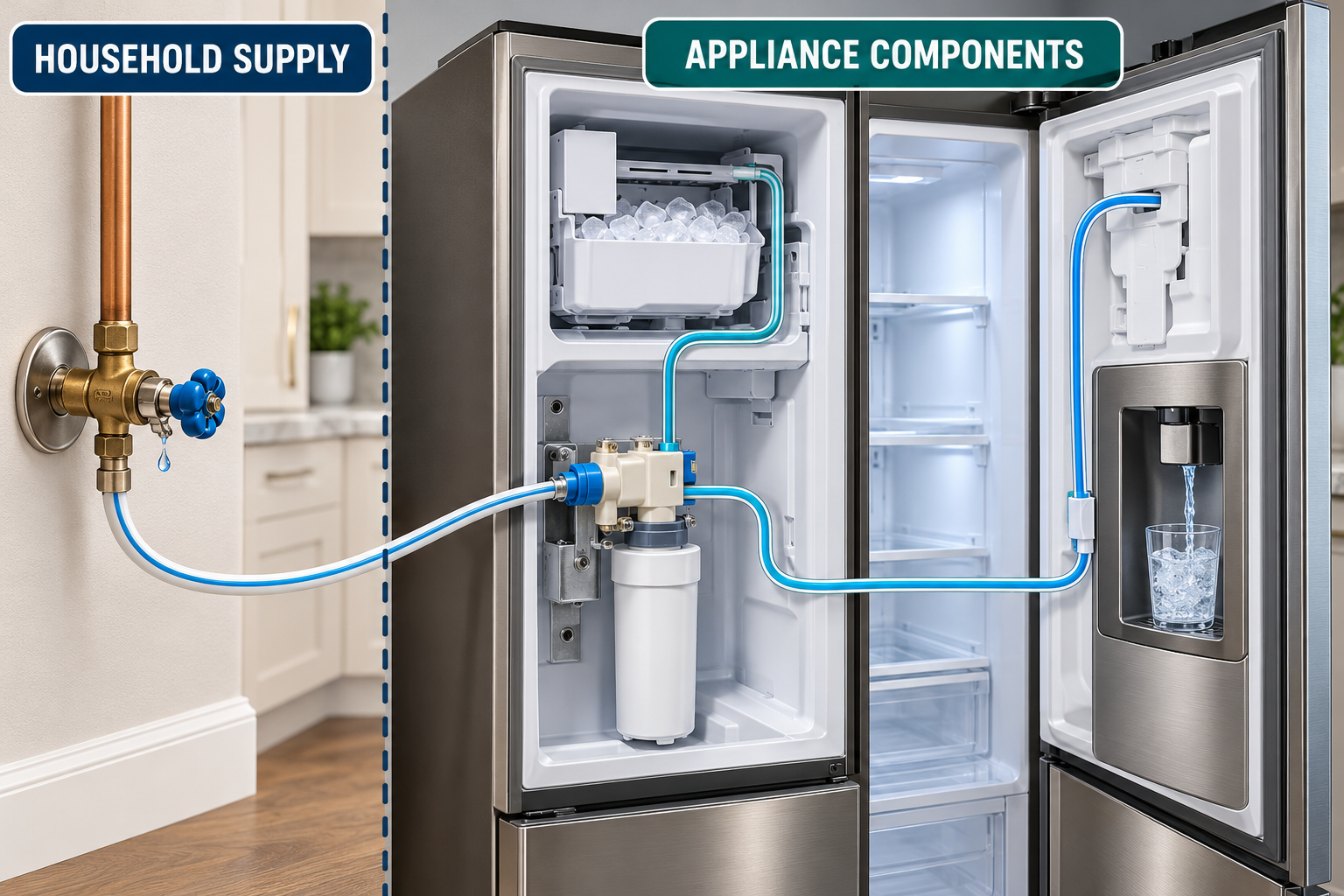
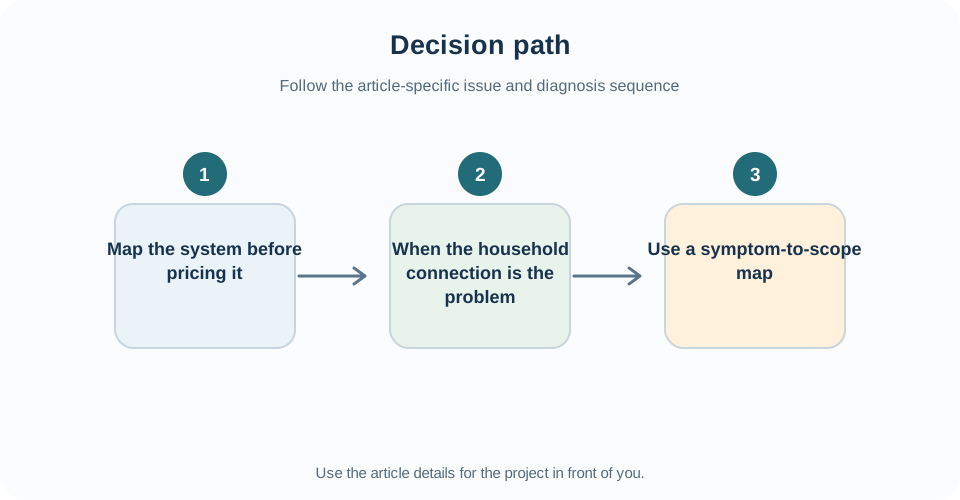
Map the system before pricing it
The appliance-side path can include a filter, inlet valve, internal tubing, ice-maker assembly, dispenser switch, auger, chute, door tubing, control, and sensor. The building-side path can include a supply valve, flexible line, pressure, connection, or drain arrangement. A leak under the refrigerator can come from either path.
Record whether the problem affects ice, chilled water, both, or neither. Note when the leak occurs, whether it appears during dispensing or ice harvesting, and whether the filter was recently changed. Give the technician the model number and photographs, but do not remove electrical or water components to chase a guessed cause.
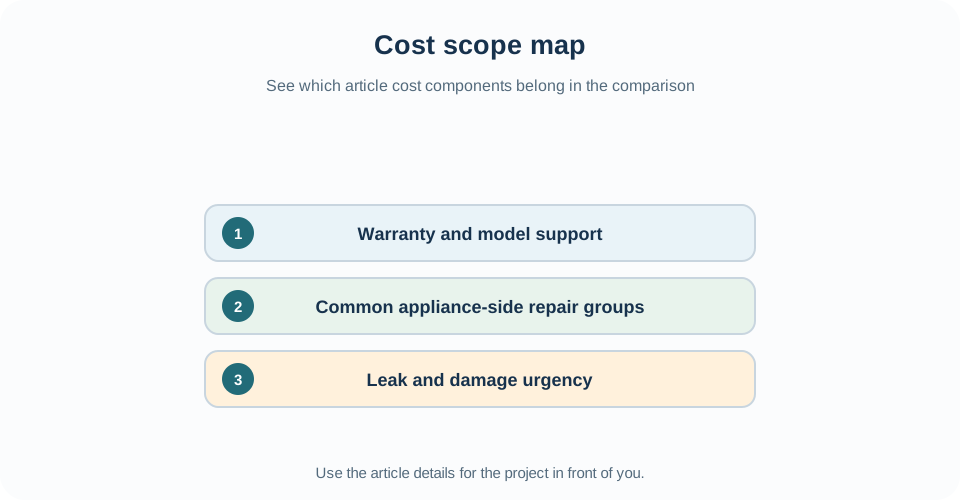
Common appliance-side repair groups
An ice maker may stop producing ice because of a failed assembly, valve, sensor, control, fill tube, or temperature condition. A dispenser may have a switch, motor, auger, chute, filter, valve, or door-tube problem. These symptoms overlap. A technician should identify the failed group before quoting a replacement part.
The part itself is not the full cost. Include diagnosis, service minimum, labor, access, special-order shipping, and a return visit. A built-in or counter-depth refrigerator may require more careful access. A premium unit may have higher parts and service costs, while a common model may have faster support.
When the household connection is the problem
If the refrigerator has no water flow, the building-side valve may be closed, restricted, leaking, inaccessible, or unsuitable. A water line can kink behind the unit or fail at a connection. A plumbing correction may be required even when the appliance is functioning.
Do not let an installer hide a questionable line behind a new refrigerator. Ask where the appliance scope ends and whether a plumber should inspect the connection. New or relocated water piping belongs with the relevant plumbing scope. A refrigerator article can explain the dependency and its cost effect without pricing the entire plumbing project.
Leak and damage urgency
A slow drip can damage flooring, base cabinets, toe-kicks, and wall finishes. A sudden leak requires a prompt response. If water has reached electrical equipment or concealed materials, use qualified help and the appropriate restoration professional. Do not continue using a leaking dispenser simply because the ice function still works.
Document the location and timing of water, then compare an appliance repair with disabling the feature, replacing the line, or replacing the refrigerator. Disabling a dispenser may reduce immediate risk but does not solve a building-side leak or a leak elsewhere in the appliance.
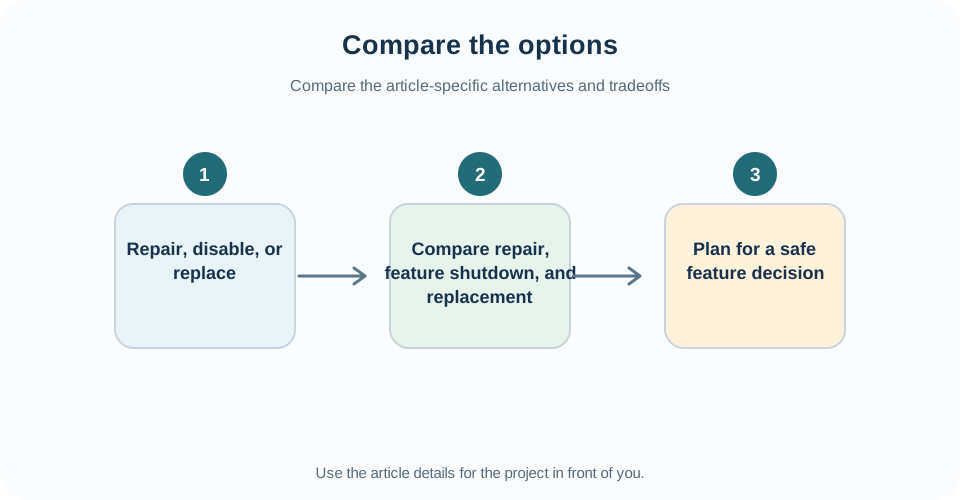
Repair, disable, or replace
Repair tends to make sense when the fault is localized, the refrigerator is otherwise sound, the part is available, and the service warranty is clear. Disabling an optional ice or water feature can be a reasonable temporary choice only when the source is understood and the appliance can operate safely without it. It is not a substitute for repairing a leak.
Replacement may deserve comparison when the refrigerator is old, the repair is uncertain or repeated, the water system is integrated into a failing door, parts are unavailable, or a sealed-system problem exists at the same time. Include delivery, fit, water connection, removal, disposal, and food-loss disruption in that comparison.
Warranty and model support
Check the manufacturer’s warranty for ice-maker, dispenser, sealed-system, labor, and water-related terms. A service contract may exclude filters, cosmetic damage, leaks from household connections, or maintenance. Read the exact plan and ask who supplies the part and technician.
Do not assume a part from a similar model will fit. The model number can change the valve, tubing, control, filter, and assembly. A manufacturer manual or qualified service source should control the applicable connection and repair information.
Pricing context and uncertainty
The published U.S. specialist ranges are useful for relative planning only. A simple ice-maker assembly may be a contained repair, while an integrated door, water valve, or difficult-access issue can cost more. Canadian repair prices and availability require Canadian evidence or a local quote; do not convert U.S. dollars to Canadian dollars.
Ask for an itemized diagnosis, part, labor, diagnostic credit, return visit, warranty, and leak check. If the technician cannot distinguish appliance-side from building-side work, the quote is not yet complete.
A practical service checklist
Before the visit, empty the area enough for safe access, preserve the model and serial information, photograph the connection, note when the symptom occurs, and avoid disassembling the appliance. Ask whether the technician services the model and whether the first visit can identify the source of a leak. If water has damaged the building, request separate restoration advice.
The useful question is not only “what does an ice maker cost to repair?” It is “which part of the water-and-ice chain failed, what risk remains, and is repairing that part better than disabling the feature or replacing the appliance?”
Use a symptom-to-scope map
“No ice” can mean a failed ice-maker assembly, valve, fill path, sensor, temperature condition, control, or a blocked connection. “No water” can involve a filter, valve, tubing, dispenser switch, pressure, or supply line. A leak that appears only during dispensing may follow a different path from a leak that continues while the appliance is idle. The symptom narrows the investigation but does not select the part.
Give the technician the model and serial number, the filter history, the time and location of the leak, whether the refrigerator is level, and whether the refrigerator section is cooling normally. Ask for an appliance-side diagnosis and a separate statement if the household supply, shutoff, or drain needs plumbing work. This prevents an internal part quote from being mistaken for a complete leak repair.
Compare repair, feature shutdown, and replacement
Repair is usually the clearest option when the failure is localized, the refrigerator is otherwise sound, and the model-specific part is available. Temporarily disabling an ice maker or dispenser can reduce use of a known feature, but it is only responsible when the appliance can operate safely and the water source is isolated or otherwise understood. It does not correct a leaking supply line, hidden moisture, or a refrigerator that is failing for another reason.
Replacement becomes more relevant when the water system has repeated failures, the door or internal tubing is difficult to service, parts are obsolete, the refrigerator is already facing a sealed-system repair, or the appliance has caused consequential damage. Compare the replacement’s fit, water connection, delivery, removal, disposal, operating cost, and food-storage disruption rather than its product price alone.
Plan for a safe feature decision
If the household disables an ice maker or dispenser while arranging service, document what water source is affected and what signs would require immediate help. Feature shutdown is not a substitute for isolating a leak, drying damaged material, or correcting a household-side connection. The repair quote should state the safe interim condition and the test needed before returning the feature to use.
Compare the feature with the whole refrigerator
If the ice maker or dispenser is the only failure, compare repair with safe feature shutdown and continued use of the refrigerator. If the same water path, door, control, or sealed system is already unreliable, compare replacement with a complete installed and supported result. Include food storage, delivery, removal, disposal, water connection, and building restoration in the replacement branch.
Make leak risk part of the quote
Ask whether the provider will inspect the connection after repair, test the dispenser and ice cycle, and identify the condition that would require a follow-up visit. Ask who is responsible for drying or restoring the floor, cabinet, toe-kick, or wall if water has escaped. An appliance technician may identify the source without owning building restoration.
For a Canadian purchase, obtain a local service and parts quote in Canadian dollars. U.S. specialist ranges are context for the repair category, not a Canadian price. The best estimate names the failed side of the water-and-ice chain, the immediate risk, the exact model, the warranty, and the total consequence if the repair does not hold.