
Freezer repair cost depends on whether the unit is a chest or upright model, which component failed, how accessible it is, and how much food-storage disruption a failure creates. U.S. specialist sources report broad freezer repair signals around $100 to $400 or $100 to $300. Those are U.S.-weighted planning ranges, not a Canadian estimate and not proof that a particular compressor, control, or sealed-system repair will fall within them.
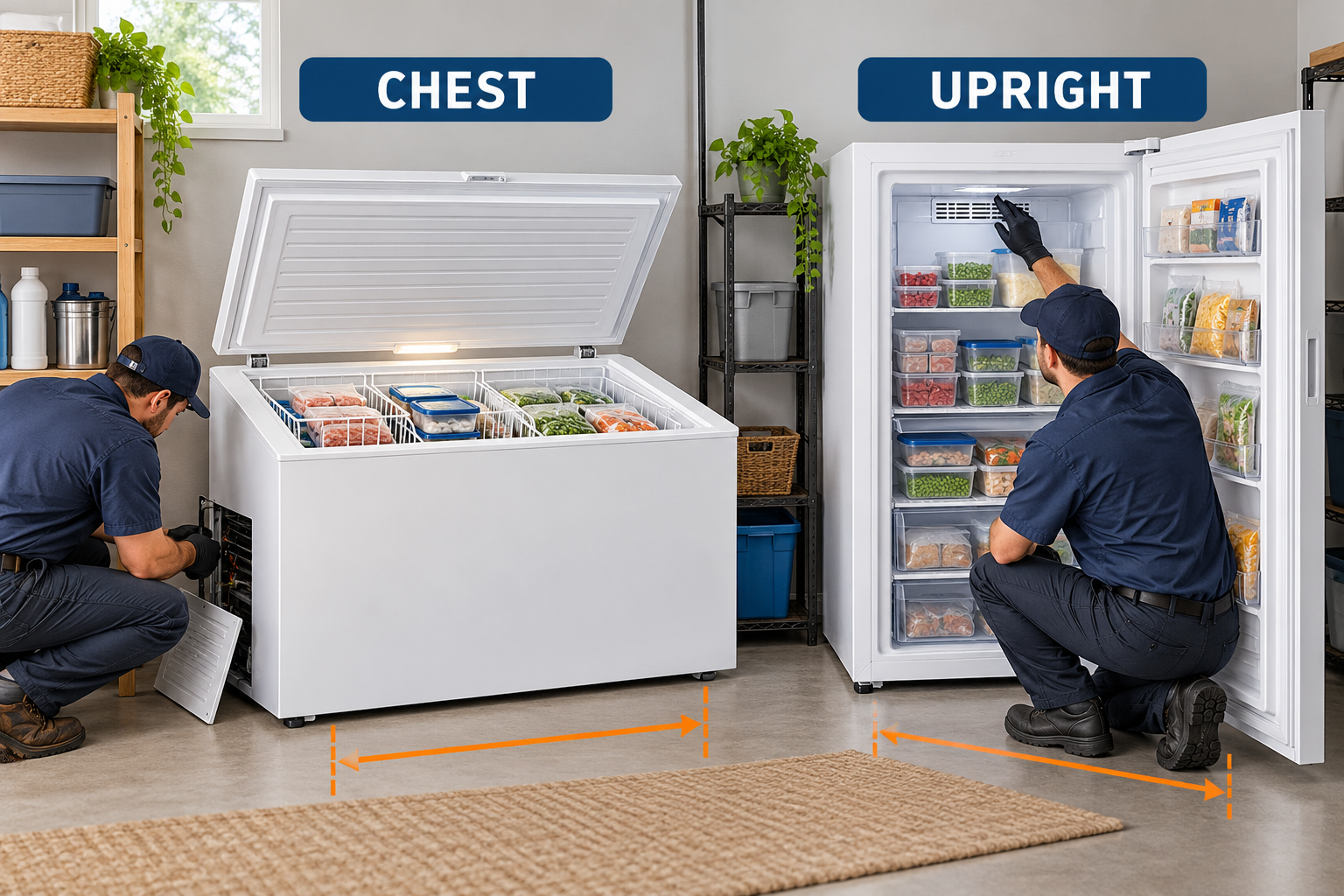
Chest and upright freezers are different decisions
Chest freezers usually offer an open-top storage layout and may have simpler access to some components, but they can be difficult to empty and move. Upright freezers resemble refrigerators and may make organization easier, while door seals, shelves, fans, and vertical access create different failure and replacement considerations. Product design varies; do not assume one repair range applies to both.
Start with the model number, age, capacity, location, energy source, and symptom. A freezer that is warm may have a control, fan, defrost, seal, airflow, or sealed-system problem. Frost buildup can have several causes. A technician should diagnose before a component is ordered.
Common repair groups
Relatively contained repairs can involve a thermostat, sensor, start relay, door gasket, fan, control, or defrost component. Major outcomes can involve the compressor, evaporator, condenser, leak, or another sealed-system part. Labor, access, special-order parts, and a return visit can matter as much as the initial component.
Ask what was tested, what failed, whether the part is available, and what warranty applies. Do not open or alter electrical covers or the refrigerant circuit. A freezer in a garage, basement, or outbuilding may also have model-specific location limits; the repair visit should not become an assumption that every freezer is suitable for every space.
Food-loss risk changes urgency
The cost of a freezer failure includes more than the service invoice. Food loss, temporary storage, travel, meal replacement, and the timing of a move or event can matter. Use your household’s actual exposure rather than a generic dollar figure. If food safety is uncertain, follow appropriate public-health guidance rather than relying on smell or appearance alone.
An emergency service call may cost more than a scheduled visit, but delay may increase loss. Ask whether the provider can diagnose and restore operation promptly and whether a temporary repair has a meaningful warranty.
Repair versus replacement
Repair is more defensible when the fault is localized, the cabinet and insulation are sound, the unit has a good service history, parts are available, and replacement would involve difficult delivery or disposal. Replacement deserves comparison when the compressor or sealed system is failing, the cabinet is damaged, repairs repeat, parts are obsolete, or a similar new unit can be installed without major changes.
Do not use age as an automatic expiration date. An older chest freezer can still be reliable; a newer unit can have an expensive failure. Compare diagnosis, repair, second visit, food loss, replacement price, delivery, placement, energy cost, haul-away, and disposal.
Sealed-system and refrigerant work
Compressor, leak, evaporator, and other refrigerant-system repairs require specialized service. A warm freezer does not authorize a homeowner to add refrigerant or open the circuit. Ask whether the diagnosis is confirmed and whether the provider is equipped to perform the work.
In the United States, EPA safe-disposal rules apply to household freezers entering the waste stream with refrigerant charge intact. Use a proper recycling, utility, retailer, municipal, or qualified disposal channel. Canadian requirements and programs must be checked separately. Never vent or puncture a refrigerant circuit.
Location and access costs
An appliance in a tight basement, garage, shed, or remote property can cost more to diagnose or replace. Measure doorways, steps, turns, and the path for a dolly. An upright may require more clear width; a chest freezer may need a safe lift or clearance above the lid.
Location also affects service. A technician may charge travel or decline an appliance outside the service area. Ask about after-hours, remote, seasonal, and second-visit fees. These conditions are market-specific and should not be hidden inside an average.
What the quote should show
Request the diagnostic fee, parts, labor, return visit, access assumptions, warranty, taxes, and cleanup. If replacement is recommended, request the exact model, delivery route, location requirements, energy data, removal, and disposal plan. Keep the repair and replacement scopes separate.
Canadian prices require local Canadian evidence or a quote. U.S. specialist ranges can indicate that freezers occupy a broad repair distribution, but they cannot be converted mechanically into Canadian dollars or treated as universal.
Set a decision date
If food must be moved, agree on how long the household will wait for diagnosis, parts, and a return visit. Ask the provider for the earliest point at which the repair branch should be compared with replacement. This avoids losing food or paying for an emergency delivery because the initial quote did not include timing.
Decide whether access changes the repair
Ask whether the provider can work in place, whether the unit must be emptied or moved, and whether stairs, a narrow door, a basement, or an outbuilding changes the labor. Include floor protection, temporary storage, return visits, and disposal in a replacement comparison. An apparently inexpensive repair may not be the lower household cost when access or timing is difficult.
A sensible decision
If the freezer is still needed, identify a temporary storage plan while diagnosis is pending. If the repair is uncertain or high-cost, get a second opinion before authorizing sealed-system work. If a new freezer is selected, compare chest and upright capacity, access, energy use, location suitability, delivery, and disposal rather than chasing the lowest unit price.
The best choice balances the freezer’s confirmed condition, food-storage consequence, total repair or replacement cost, service support, and the risk of another failure. A headline repair range is only the starting point.
Match the diagnosis to the freezer’s location
The same component failure can have a different household consequence depending on where the freezer sits. A unit in a basement may be hard to remove but easier to keep cool while waiting. A garage or outbuilding may have temperature conditions that the model does not support. A chest freezer may require emptying and lifting before a technician can reach the equipment; an upright may have a narrower route or door-side service issue.
Tell the provider the location, route, model, capacity, and recent operating conditions. Ask whether the diagnosis includes checking the seal, airflow, controls, defrost behavior, and any location-related concern. Do not assume that a freezer’s failure is caused by the room, or that moving it to another room will solve a component problem.
Build the repair quote in stages
Separate the service call, diagnosis, part, labor, access, return visit, testing, and warranty. A smaller repair may involve a seal, fan, sensor, relay, or control. A larger repair may involve the compressor, evaporator, condenser, leak, or another sealed-system component. The provider should explain what evidence supports the proposed branch and whether a second failure remains likely.
If a repair is not immediately available, document the temporary storage plan and the expected decision date. Food loss, travel to another freezer, and emergency delivery are household-specific costs; they belong in the comparison without being inflated into a universal allowance. Follow appropriate food-safety guidance if the contents have thawed or the temperature history is unknown.
Protect the contents while deciding
Record the temperature, timing, food that must be moved, available alternate storage, and the expected service date. If the freezer has thawed, use appropriate food-safety guidance rather than relying on an appliance estimate. A fast repair may have household value, but it should still be compared with a supported replacement if the diagnosis is uncertain.
When a second opinion has value
A second opinion is most useful when the diagnosis changes from a contained part to sealed-system work, the quote is close to replacement cost, the first provider cannot service the model, or the unit is difficult to replace. Give the second provider the model, symptoms, tests, and first estimate, but ask for an independent diagnosis rather than a confirmation by default.
If replacement is selected, compare chest and upright models by task, capacity, access, operating energy, delivery, removal, and disposal. U.S. EPA refrigerant-disposal guidance applies to the relevant U.S. waste stream; it does not establish Canadian requirements. Never vent or dismantle the circuit to reduce the removal fee.