
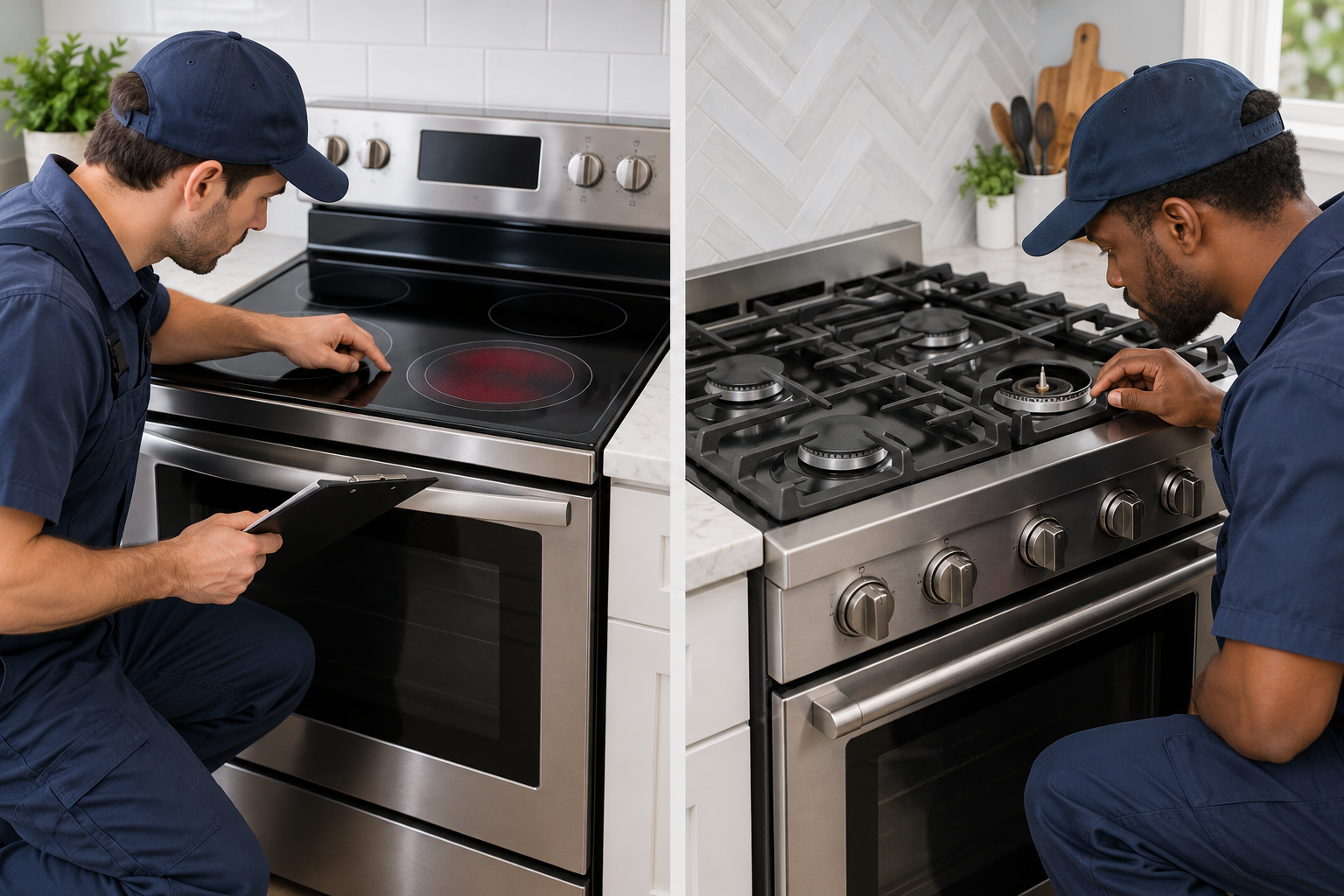
“Range,” “stove,” and “oven” are used inconsistently, so start by identifying the equipment: a freestanding or slide-in unit with a cooktop and oven. Repair cost then depends on whether the appliance is gas or electric, whether the failure affects cooking or only appearance, which part failed, and how difficult the unit is to service. U.S. specialist sources place stove repair around $100 to $300 or $100 to $400, but a local quote and Canadian market can differ.
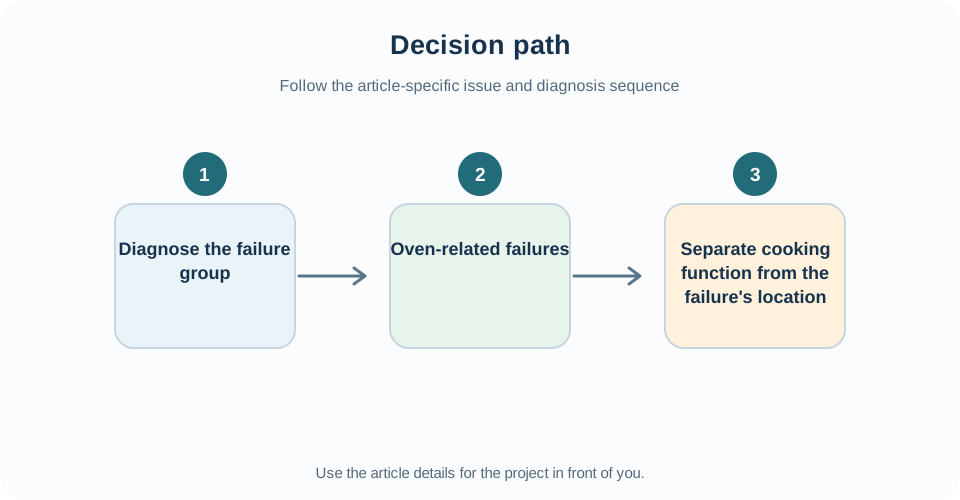
Diagnose the failure group
Burners or elements, igniters, heating sensors, thermostats, controls, timers, switches, display boards, door hardware, and wiring can produce overlapping symptoms. A burner that does not heat may involve the element, receptacle, switch, control, or supply. An oven that runs cool may involve a sensor, element, igniter, control, calibration, or another issue.
Describe the symptom, model, age, fuel, error message, and whether the problem affects one zone or the whole unit. Do not disassemble a gas or electrical appliance to test a suspected part. A technician should establish what was observed and what remains uncertain.
Gas and electric economics
Gas ranges can require specialized diagnosis of ignition, burner, valve, combustion, and controls. Electric ranges can involve elements, glass or ceramic surfaces, switches, wiring, and electronic modules. Neither product type has one universal repair price. Premium and smart appliances can have higher parts costs and fewer local service providers.
Keep gas and electrical safety within qualified professional work. A repair quote should state whether it includes diagnosis, parts, labor, testing, and a service warranty. If the problem is a household gas or electrical supply rather than the appliance, that is separate trade work.
Cosmetic versus functional damage
A scratched finish, damaged knob, discolored trim, or cracked glass can be economically different from a failure that stops cooking. Cosmetic repairs may be difficult to match on an older model. A cracked glass surface can also create a safety concern and should not be treated as an aesthetic defect without the manufacturer’s guidance.
Ask whether the part is still available and whether replacement affects the appliance’s fit or safety. Repairing a cosmetic item may be reasonable for a premium built-in appearance, but it may be a poor investment on a low-cost older unit.
Oven-related failures
An oven that does not heat, heats unevenly, shuts off, or shows an error can have several causes. A service call may be needed before estimating parts. An oven control board or integrated assembly can cost more than a simple heating component. The range may still have a usable cooktop, but partial operation affects the household’s disruption and urgency.
Avoid procedural electrical or gas instructions. The useful reader decision is whether the technician has identified a contained repair, a major electronics or fuel-related repair, or a replacement project.
Repair versus replacement
Repair is more defensible when the defect is localized, the cabinet and cooking surfaces are sound, parts are available, the repair warranty is clear, and replacement would require a different fuel or electrical arrangement. Replacement deserves comparison when failures repeat, the control or surface is obsolete, the unit has safety concerns, or a new unit can be installed without major changes.
Include delivery, installation, anti-tip hardware, ventilation, removal, disposal, and operating cost in the replacement comparison. A range that is cheap to buy may be expensive to install if the energy source or opening changes.
Anti-tip and recalls
The GE anti-tip instruction used as a representative source warns that ranges can tip and states that the range must be secured by a properly installed anti-tip bracket in accordance with local codes. This is a model/manufacturer installation instruction, not a complete universal code guide. When repairing or replacing a range, confirm the correct safety hardware for the exact model.
Check current recall notices using the applicable product model and manufacturer. A recall search does not prove that an appliance is defective, and an absence of a matching notice does not replace normal diagnosis or installation review.
One 2026 CPSC notice covers only its listed Frigidaire-family gas-range models with serial numbers VF52200000 through VF54399999. For an exact match, the notice directs owners to stop using the oven until a no-cost professional bake-burner replacement; it says the cooktop burners may continue to be used. Verify both model and serial against the current notice and follow its instructions; this does not support a repair or reliability claim about other Frigidaire ranges.
Premium and smart models
Smart controls, induction electronics, dual fuel, built-in trim, and specialty cooking functions can change repairability and parts availability. A branded service network may be necessary, and a second visit may be costly. Ask whether the provider can obtain the part and whether software, control, or warranty terms affect the repair.
U.S. and Canadian pricing
The published repair ranges are U.S.-weighted specialist signals. Canadian service networks, taxes, labor, parts availability, and fuel or electrical rules differ. Do not convert the figures into Canadian dollars. Request a local quote with diagnosis, parts, labor, and return-visit terms.
Two Canadian provider observations illustrate how repair quotes can be structured. Fateh Air Comfort’s Greater Toronto Area page, checked October 7, 2026, lists oven/range repairs at $150–$500, including service, diagnosis, parts, and labor, and a separate $89–$129 diagnostic fee waived with repair. Vancity Appliance Service’s Vancouver page lists an $89–$119 plus-tax service-call charge by brand, applied toward the job when a recommended repair is approved; it separately gives average labor of $225–$300, with parts extra. The Vancity page also shows a $100 diagnostic charge when the repair is declined, so do not treat its fee wording as one reconciled schedule. Neither source states an ISO currency code or represents a market average; confirm the current fault-specific quote and inclusions.
Compare the repair with a usable replacement
The replacement branch should include a measured fit, delivery route, fuel or electrical scope, anti-tip or securing instruction, removal, disposal, testing, warranty, and temporary cooking. If the old range is built into difficult finishes or a conversion is being considered, those project conditions may make a sound repair more valuable. If the repair diagnosis remains uncertain, price a second opinion before authorizing a major part.
Plan the household’s cooking continuity
Record which cooking functions remain available, how long a repair or part may take, and what temporary equipment or meals-away cost is realistic. If the problem affects gas, electrical safety, uncontrolled heat, smoke, or a damaged surface, stop using the appliance and obtain qualified help. A continuity plan helps compare an urgent repair with a planned replacement without inventing a universal emergency premium.
Keep the replacement model-specific
If repair is not supported, choose a representative replacement only after checking the measured opening, fuel, electrical path, ventilation, safety hardware, delivery route, removal, disposal, and service network. A retail listing is not an installed alternative. Use a local quote and keep U.S. specialist repair figures as context only.
What to ask the technician
Ask what failed, how it was tested, whether the issue is appliance-side, whether gas or electrical work is involved, what parts are available, what the repair warranty covers, whether the diagnostic fee is credited, and what a model-appropriate replacement would cost installed. Ask whether the anti-tip provision and other safety features were inspected.
A range repair decision is sound when it accounts for the confirmed failure, safety, service support, remaining appliance condition, replacement fit, and the household cost of losing cooking capacity. The part name alone is not a budget.
Separate cooking function from the failure’s location
Start by identifying whether the symptom affects one burner or element, the oven, the controls, the door, the surface, or the entire appliance. A single cold burner can involve the element, igniter, switch, valve, receptacle, control, or supply. A range that shuts down can have a control, sensor, wiring, fuel, or safety-related issue. The repair path and price differ, so the technician should state what was tested rather than quote from the symptom alone.
Ask whether the issue is inside the appliance or in the household gas or electrical service. A range article can explain that a building-side correction may be required, but the appropriate qualified trade must define that work. Do not remove covers, test live electrical parts, alter gas components, or bypass safety devices based on general information.
Compare repair scopes by consequence
A localized control, element, igniter, sensor, or switch repair may preserve an otherwise sound range. A cracked cooking surface, obsolete control, damaged wiring, repeated failure, or unavailable part can produce a replacement decision. If the oven still works while one burner does not, the household may have a different urgency from a failure that removes all cooking capacity; include the actual temporary cooking cost rather than a generic emergency premium.
Request separate diagnosis, parts, labor, access, testing, return visit, and warranty lines. If a replacement is considered, include delivery, removal, anti-tip hardware, fuel or electrical verification, installation, disposal, and operating cost. A replacement that changes the fuel source is an infrastructure project as well as an appliance purchase.
Keep safety checks visible
The referenced GE anti-tip document states that ranges should be secured with a properly installed bracket and that local codes govern installation. Treat that as model-specific manufacturer guidance, not as a complete code manual. Ask the installer whether the bracket and leveling leg are compatible with the exact range and whether the existing floor or wall can accept the required attachment.
The repair decision is complete when the provider explains the failure, the safe operating boundary, the likely total, the service support, and the installed alternative. A low part price is not a low household cost if the repair leaves the range unsafe or unreliable.